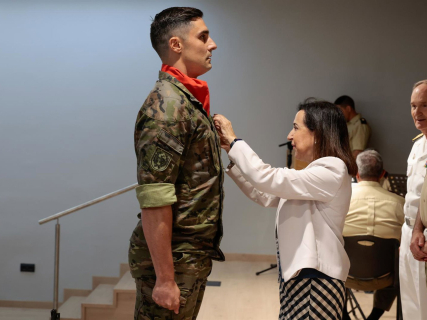

A rumor about the return of military service, following a call for 500 positions for volunteer reservists, is sowing doubts in Spain. However, the Government has neither restored compulsory military service nor is there a general call for young people turning 18 nor has forced recruitment been approved for those born in 2007 and 2008. So, compulsory military service is not returning to Spain in 2026, although it is not something that cannot be recovered because it was not eliminated from the Constitution, but was legally suspended.
The origin of the current confusion lies in the Royal Decree 170/2026, of March 4, which approves the public employment offer of the Armed Forces for 2026. Among other positions, the regulation authorizes a maximum of 500 positions to acquire the status of volunteer reservist. This is a figure that already existed in Spain and is accessed voluntarily. It does not imply the recovery of the old military service, suspended since December 31, 2001.
Thus, the royal decree published by the Government only authorizes the Ministry of Defense to offer up to 500 positions for volunteer reservists during 2026. The regulation does not contain any provision that restores compulsory military service, obliges 18-year-olds to join the Armed Forces, limits the call to those born in 2007 and 2008, creates a lottery or a general recruitment system, suspends studies or work contracts to join the ranks, or recovers the substitute social service for objectors.
The Ministry of Defense has reiterated that it is not working on the recovery of compulsory service. Minister Margarita Robles responded in July with a "absolutely not" when asked about this possibility and defended the current model of professional Armed Forces.
What the BOE has really published
The Royal Decree 170/2026 regulates the provision of positions in the Armed Forces and in the ranks of officers of the Civil Guard for 2026. Within that offer, different access and promotion pathways appear.
Specifically, it authorizes up to 1,000 positions for troops and sailors to access a permanent service relationship, a maximum of 500 positions to acquire the status of volunteer reservist after entry, promotion, and training positions in the different military bodies and ranks.
The appearance of those 500 positions has served to build headlines that talk about the return of military service. But the legal concept is different: a voluntary reservist requests to join and accepts a temporary commitment; a mandatory recruit would be called by the State even if they had not requested to join.
What is a voluntary reservist
Voluntary reservists are citizens who wish to temporarily contribute their skills to the Armed Forces. They normally maintain their civilian life and work, but can receive military training and be activated during specific periods to cover concrete needs.
They do not permanently belong to the Armed Forces nor remain mobilized throughout the duration of their commitment.
According to the recruitment portal of the Ministry of Defense, the general requirements include:
- Having Spanish nationality.
- Lacking a criminal record.
- Not being deprived of civil rights.
- Demonstrating good citizen conduct.
- Meeting the corresponding academic and psychophysical requirements.
- Being between 18 and 57 years old for the categories of officer and non-commissioned officer.
- Being between 18 and 54 years old for troops and sailors.
Therefore, the positions are not exclusively reserved for those born in 2007 or 2008. The reference to those years comes from the fact that those young people turn 18 or 19 during 2026 and can apply if they meet the requirements, just like other older candidates.
Is 2,400 euros per month paid for doing military service?
There is also no new general salary of 2,400 euros per month for all young people participating in a supposed military service. Reservists receive compensation during training phases and the corresponding remuneration when they are activated. The amount depends on the situation, the duration of the activation, and the assigned military category: officer, non-commissioned officer, or troops and sailors.
Therefore, presenting a maximum amount as a fixed and permanent salary for any young person who signs up is misleading. There is no universal monthly payment of 2,400 euros for fulfilling a new military service.
When did military service disappear in Spain
The last mandatory call-up occurred in 2001. The Royal Decree 247/2001 brought forward to December 31 of that year the suspension initially planned for the end of 2002.
The military was not eliminated from the Constitution, but rather it was legally suspended within the process of professionalization of the Armed Forces. Since then, the Spanish model is based on professional soldiers and different voluntary reserve figures.
The Constitution continues to establish in its article 30 that Spaniards have the right and the duty to defend Spain. The same article provides that a law will determine military obligations, regulate conscientious objection, and establish possible causes for exemption from mandatory military service.
That is to say, the Constitution allows for its existence, but does not require it to be permanently active.
What should be done legally to reintroduce mandatory military service
The Government could not recover the military through a simple administrative resolution, a call for positions, or an order from the Ministry of Defense. It would also not be enough to announce it or include it in the General State Budgets.
To reintroduce mandatory military service, at a minimum, the following steps would be necessary:
1. Approve a new law in the General Courts
Article 30.2 of the Constitution expressly states that the law will set the military obligations of Spaniards. Therefore, the Congress and the Senate would have to approve a norm that reinstated mandatory recruitment and modified the system suspended in 2001.
The new legislation would have to define:
- Who would be obliged to join.
- The age of the call-up.
- The duration of service.
- The selection criteria.
- The deferrals and exemptions.
- The labor protection of recruits.
- The reservation of university or educational places.
- The economic compensations.
- The applicable disciplinary regime.
- The appeal mechanisms.
It would also have to modify or repeal the suspension included in the military personnel legislation.
2. Regulate conscientious objection
The Constitution itself requires guarantees to be offered for conscientious objection. A new law would have to establish who can be recognized as a conscientious objector, how to apply for it, and what controls are applied. The legislator would also need to decide whether to recover a substitute civil service, like the one that existed before 2001, and determine its duration and conditions.
3. Resolve who it would affect
A future law would have to specify whether the service would affect only men or also women. Any difference should exceed the constitutional requirements of equality and non-discrimination.
The State would also have to resolve the situation of people with dual nationality, Spaniards residing abroad, students, salaried workers, self-employed individuals, people with dependent family members, and citizens with physical or psychological limitations.
4. Develop a recruitment system
After the law is approved, regulatory development would be necessary to organize censuses, medical examinations, lotteries or selection criteria, assignments, training, and incorporation schedules.
Defense would also need to expand barracks, instructors, equipment, healthcare, and budget. The current professional Army does not automatically have the structure used to mobilize complete replacements before 2001.
5. Approve specific calls
Once the legal framework is created, the Government could approve the corresponding annual calls. Only then would there be an effective obligation for the generations or groups included. It would not be necessary to reform the Constitution, because its article 30 already expressly contemplates the possibility of mandatory military service. It would also not be mandatory to hold a referendum, unless the Government decided to accompany the measure with a constitutional reform.
The return of military service in other countries of Europe
The confusion occurs in a context of strengthening European defense after the Russian invasion of Ukraine. However, there is no single model. Some countries maintain mandatory service, others have recovered it, and several are testing voluntary formulas with mechanisms to activate recruitment if they do not achieve sufficient personnel.
A report from the European Parliament Research Service identified nine EU States with some recruitment system: Austria, Cyprus, Denmark, Estonia, Finland, Greece, Latvia, Lithuania, and Sweden. Croatia was later added to this list after recovering mandatory service in 2026.
Croatia recovers mandatory service
Croatia has reintroduced mandatory basic military training in 2026 after almost two decades of suspension. The first recruits began a two-month training in March.
The reform mainly affects young men and includes the possibility of opting for a civil service for reasons of conscience. Croatia has justified the measure due to the deterioration of European security and the need to strengthen its reserves.
Germany adopts an initially voluntary model
Germany suspended compulsory military service in 2011, but has launched a new model since 2026.
All young people aged 18 receive a questionnaire to assess their willingness and suitability to serve. Men are required to respond, while for women it is voluntary. The service remains initially voluntary, although the law allows for strengthening the system if the necessary personnel are not reached. The German government explains the new model here.
Therefore, Germany has not yet restored a general conscription identical to that which existed before 2011. It has established a registration, evaluation, and recognition infrastructure that would facilitate increasing calls if the voluntary model proves insufficient.
Sweden expands its selective system
Sweden suspended conscription in 2010 and reintroduced it in 2017 through a selective system that can affect both men and women.
Not all young people are called to the ranks. Authorities assess the needs of the Armed Forces and select a portion of the generation each year. The Swedish government aims to gradually increase the volume of training to at least 10,000 recruits annually by 2030.
Latvia reintroduced service in 2024
Latvia restored compulsory service in 2024 after having eliminated it in 2007. Its proximity to Russia and the war in Ukraine were decisive in rebuilding a recruitment system and expanding military reserves.
France and Belgium bet on voluntary programs
France has strengthened its national service and voluntary military training programs, but has not restored a general conscription for an entire generation.
Belgium has also sent invitations to young people to join voluntarily for a paid period. Receiving a letter does not equate to being obligated to enlist.
| Country | Military service situation |
|---|---|
| Spain | Suspended since 2001; Professional Armed Forces and volunteer reservists |
| Croatia | Mandatory service recovered in 2026 |
| Germany | Initially voluntary service with mandatory questionnaire for men |
| Sweden | Selective recruitment for men and women |
| Latvia | Mandatory service recovered in 2024 |
| Austria, Cyprus, Estonia, Finland, Greece, and Lithuania | Maintain mandatory systems |
| Denmark | Maintains a mandatory model with selection according to needs |
| France and Belgium | Voluntary programs, without a general mandatory military service |
Short lead: The BOE has authorized 500 places for volunteer reservists, but Spain has not recovered military service nor is there a mandatory call for those born in 2007 and 2008.