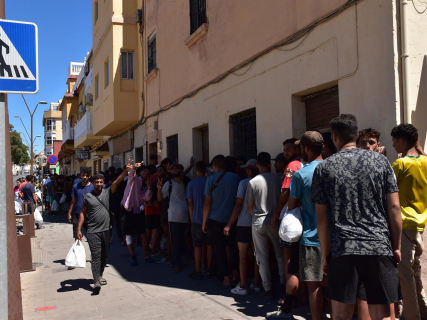

The National Human Rights Council of Morocco (CNDH), the official body of the country, has accused members of the Spanish security forces of having committed "mistreatment and assaults" against migrants during the mass entries recorded in Ceuta on July 30 and 31.
The accusations appear in a preliminary report presented on August 8, which still does not constitute the definitive version of the body's conclusions. The document analyzes both what happened on both sides of the border and the role played by social media before and during the crisis.
The CNDH claims to have interviewed people who returned to Morocco after entering Ceuta and states that it has collected "multiple coinciding allegations" about assaults attributed to Spanish agents.
According to the text, some of the interviewees maintained that the alleged abuses would have occurred "especially in places out of the reach of cameras." The report records these accusations as testimonies from the migrants, but the available information does not substantiate through independent evidence that those episodes occurred in the terms reported.
Complaints against Spanish and Moroccan agents
The document does not limit its reproaches to Spain. The Council claims to have verified cases of physical integrity being affected for those who participated in the crossings both by Spanish and Moroccan authorities.
"Cases of violation of the physical integrity of passersby by Spanish and Moroccan authorities have been verified, as well as cases of violation of the physical integrity of members of the Moroccan security forces," the report states.
The CNDH also asserts that some minors were victims in Ceuta of attacks, insults, beatings, and stigmatization by what it defines as "extremist groups," and reproaches that sufficient protection and assistance were not provided against racist and xenophobic assaults.
The document analyzes the attention received by part of the tens of thousands of people who crossed into the city during those 48 hours. The report itself estimates the contingent at around 72,000 people.
The report attributes to Ceuta a closure of businesses that was not ordered by the Administration
One of the claims in the document, however, contradicts what happened during the crisis.
The CNDH holds the "local authorities" of Ceuta responsible for having ordered the closure of restaurants, cafes, and commercial establishments, presenting it as part of a supposed lack of assistance to migrants.
There was no closure order issued by the city government.
The Confederation of Entrepreneurs of Ceuta recommended that commercial establishments remain closed due to the situation in the streets. It was subsequently the entrepreneurs themselves who decided whether or not to follow that recommendation.
The data introduces a relevant inaccuracy in a document that is still in the preliminary phase.
More than a million users in the analyzed groups
An important part of the report is dedicated to the role of social networks in the mobilization towards Ceuta, a matter that Spanish and European authorities have also focused on in recent days.
The Moroccan agency claims to have identified the first misleading content as early as July 8, three weeks before the mass entry.
A Facebook page dedicated to content about migration, Spain, and Moroccan citizens residing in Spanish territory then spread the message that those intercepted at sea while trying to swim to Ceuta or Melilla could not be returned.
The publication attributed that statement to a supposed "Spanish government delegation" and had, according to the report, significant dissemination.
The Council also points out as a mobilization element the circulation of a photograph of a young Moroccan making the victory sign after having crossed to Ceuta on July 28 along with another group of migrants.
The CNDH monitoring team examined publications from 23 Facebook groups that totaled more than 1,086,000 members and that generated an average of more than 1,400 daily posts.
Five of the main groups were deleted on Thursday, July 30, precisely the first day of the mass entries.
The networks, but also the economic situation in Morocco
The report does not attribute what happened solely to the messages disseminated online.
The agency also points to the economic and humanitarian situation of a part of the Moroccan population and to the internal conditions that would have driven thousands of young people and minors to attempt to reach Ceuta.
The digital issue has gained special relevance after the crisis. Meta and TikTok have agreed to strengthen the verification of content related to crossings to Spain amid fears that criminal networks may use false information to promote new displacements.
In addition, there is concern about new calls disseminated on TikTok and WhatsApp to attempt another collective entry into Ceuta on August 15.
The precedent of the tragedy in Melilla
This is not the first time that the National Council for Human Rights of Morocco has published controversial conclusions about a border crisis with Spain.
After the tragedy recorded in Melilla on June 24, 2022, when at least 23 migrants died during an attempt to enter through the Barrio Chino border, the agency attributed part of the responsibility to the Spanish authorities.
Its report then stated that the decision to keep the border gates closed had contributed to the concentration of people.
Subsequent investigations carried out by organizations and media documented, however, the role of Moroccan forces in the detention of migrants, the launching of tear gas, and the use of force during those events.
The investigation by the Moroccan Prosecutor's Office was eventually archived in 2024 due to "lack of evidence of a crime," after concluding that the agents had made proportional use of force.
Four years later, the CNDH intervenes again in a border crisis between Morocco and Spain. This time, its conclusions are still provisional and contain both serious accusations against the security forces of both countries and an extensive analysis of the digital mobilization that preceded the massive arrival of migrants in Ceuta.