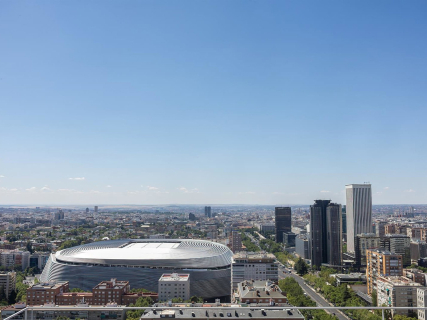
From the Bernabéu to Vallecas: who is the owner of each stadium in the First Division

Nine teams play on fields that belong to the club itself, while others use municipal, regional, or publicly participated facilities.

3 minutes

fotonoticia 20260806134330 1920

fotonoticia 20260806134330 1920

Add DEMÓCRATA to Google

Ask FREN

Published

3 minutes

Most read

The crisis of Rayo Vallecano has exposed a peculiarity of Spanish football: playing every weekend in a stadium does not mean owning it. The Vallecas field belongs to the Community of Madrid and the club used it through a concession, a situation that is far from being exceptional in La Liga.

Of the 20 teams competing in LaLiga EA Sports this season, only nine currently play in stadiums owned by the club itself. Another ten use public-owned facilities and there is one different case, San Mamés, whose ownership corresponds to a company participated by Athletic and several institutions and entities.

The model changes considerably from one city to another.

The nine clubs that own their stadium

Real Madrid and Barcelona belong to the most well-known group. Santiago Bernabéu and Spotify Camp Nou are part of the heritage of their respective clubs, which have also taken on the major financing operations undertaken to transform them.

Atlético de Madrid also controls its field. The current Metropolitano ended up in the hands of the club after the process developed to leave Vicente Calderón.

In the Community of Valencia, there are four more examples. Mestalla belongs to Valencia CF, Martínez Valero to Elche, Ciutat de València to Levante, and Estadio de la Cerámica to Villarreal. Levante's accounts, for example, expressly identify the stadium and its sports city as two of the most significant assets owned by the company.

Completing the group are Sevilla, owner of Ramón Sánchez-Pizjuán, and Espanyol, owner of RCDE Stadium.

Vallecas is not an exception

The other half of the championship operates differently.

The Estadio de Vallecas belongs to the Community of Madrid, which granted its use to Rayo for years. Precisely that separation between owner and user explains that it is the regional Government that has been able to suspend the concession that allowed the team to play there.

A similar situation occurs with the Coliseum of Getafe, although the owner in this case is the City Council. The council granted the club the use of the stadium, but the venue continues to be part of the municipal heritage.

These are not isolated cases. Mendizorroza is owned by the City Council of Vitoria-Gasteiz and is used by Deportivo Alavés.

The Reale Arena is also municipally owned. The City Council of San Sebastián identifies Anoeta as municipal heritage, while Real Sociedad uses the venue and has participated financially in its remodeling.

From Balaídos to Riazor

In Galicia, the two Primera teams play this season in public facilities.

Balaídos belongs to the City Council of Vigo, which maintains ownership of the venue used by Celta.

Deportivo plays in an equivalent situation: Riazor is owned by the City Council of A Coruña and is registered in the municipal inventory as a public domain asset. The club has the use of it through the corresponding agreement with the council.

The newly promoted Racing is also not the owner of its field. Los Campos de Sport de El Sardinero belong to the City Council of Santander, despite Racing using it as its home since the inauguration of the current venue in 1988.

Osasuna plays in a stadium owned by the Government of Navarra

The case of Osasuna is particularly unique because El Sadar belonged to the club and stopped doing so.

The entity handed over the stadium to the Government of Navarra as part of the operation carried out to settle part of its tax debt. The Foral Community currently maintains ownership and Osasuna has a lease of use, in addition to assuming maintenance and conservation costs. The club itself recently acknowledged that El Sadar is still owned by the Navarre government.

La Rosaleda has three public owners

Málaga offers another model.

La Rosaleda is jointly owned by the City Council of Málaga, the provincial council, and the Junta de Andalucía. The three administrations are owners of the venue used by Málaga CF.

Betis presents a provisional situation. While the transformation of Benito Villamarín is being executed, it plays its home matches at La Cartuja, owned by a company largely majority-owned by public administrations and entities.

San Mamés, the mixed model

The case that does not strictly fit into either of the two groups is San Mamés.

The stadium belongs to San Mamés Barria SL, a company in which Athletic Club, the Basque Government, the Foral Council of Bizkaia, the City Council of Bilbao, and Kutxabank participate. The club manages and uses the venue, but it is not its only owner.

More key points, information and questions with FREN

AI-GENERATED CONTENT

What is the legal process for a football club to acquire ownership of its stadium in Spain?

In Spain, there is no single “special procedure” for a football club to acquire ownership of its stadium; rather, general rules of administrative, urban planning, civil, and commercial law are combined. However, there are quite typical schemes depending on who currently owns the field and what type of operation is proposed.

1. When the stadium is municipal and the club has a concession

This is the most common case in professional and semi-professional categories when the stadium is owned by the city council:

  • Starting situation: the municipality owns the land and the stadium (either as patrimonial asset or sometimes as a public service) and the club operates the facility through an administrative concession or a usage contract.
  • Need for political agreement: the direct sale or transfer of stadium ownership requires an agreement by the City Council Plenary, because it affects municipal assets and often goods of general interest. Local government legislation and public administration asset regulations apply.
  • Technical report and appraisal: before any operation, it is common for municipal technical services to prepare urban planning, economic, and legality reports, and for an independent valuation of the asset to be conducted to prove there is no “sale at a favorable price.”
  • Disposal procedure: as a general rule, the sale of municipal assets is done through tender or auction, unless a direct sale is legally justified (for example, because the club is the only viable interested party and a sports service is thus protected). The decision must respect principles of transparency, competition, and non-discrimination.
  • External control: the operation may be reviewed by bodies such as the Court of Auditors or the regional audit chamber, and is subject to challenges before the administrative courts (for example, by other sports operators or municipal groups).
  • Formalization: if the sale is approved, a purchase agreement is signed between the city council and the club (or its sports public limited company), it is elevated to a notarial public deed, and registered in the Property Registry.

2. When the stadium is already within the club’s perimeter

In some cases, the stadium is already owned by the club or a group company (for example, a real estate company of the club itself) and what is proposed is an internal purchase, sale, or reorganization:

  • Corporate decision: if the club is a Sports Public Limited Company (SAD), an operation of this magnitude is usually considered an essential act and requires approval by the General Shareholders’ Meeting, in addition to the Board of Directors’ approval.
  • Valuation and conditions: independent appraisals are usually sought, both for financial prudence and to avoid conflicts of interest among shareholders or directors, and to comply with “related party transactions” requirements under corporate law.
  • Sports and financial supervision: the professional leagues and the Spanish Sports Council (CSD) may require information and impose indirect limits via economic control and financial fair play rules (for example, on how capital gains from stadium sales are accounted for or on the club’s subsequent solvency).
  • Legal instrumentation: it is structured through one or more deeds of sale, non-monetary contribution, merger, or partial spin-off, depending on the design. Again, it is registered in the Property Registry and the Commercial Registry when it affects the capital or perimeter of the SAD.

3. Other common formulas

Between pure direct purchase and mere concession, there are intermediate formulas:

  • Surface rights: the city council retains ownership of the land but grants the club a long-term surface right to build, operate, and amortize a new stadium. This also requires plenary agreement, valuation, and, if applicable, tender.
  • “Land for works” swap: the club can build public interest facilities or infrastructure (parking lots, green areas, new sports facilities) in exchange for receiving ownership of part of the land or building rights. It is a complex operation, heavily conditioned by urban planning and State aid controls.
  • Reclassifications and urban planning agreements: sometimes acquisition is linked to the urban reorganization of the surroundings. It is formalized through urban planning agreements between the club and the city council, which must comply with urban planning and asset regulations and undergo public exposure.

4. Key limits and controls

  • Administrative legality: respect for public asset and contracting regulations; prohibition of sales below market value unless clearly legally covered.
  • Urban planning: any operation involving changes of use, buildability, or new construction must comply with the general plan and planning instruments.
  • Economic-sports control: sports authorities may consider these operations for salary limits, debt ratios, and the club’s financial stability.

In practice, for a club to become owner of its stadium in Spain requires aligning these aspects: political and administrative agreement at the local level, urban planning feasibility, and a solid corporate and financial structure that supports the operation without risking sporting continuity.

What exact role does the city council plenary play in the decision to sell a municipal stadium to a club? What are the advantages and disadvantages for a club of opting for a surface right instead of buying the stadium? How do LaLiga’s economic control rules affect a club’s purchase or swap operation of the stadium?

What powers do city councils have over municipal stadiums used by professional football clubs?

City councils have a central role over municipally owned stadiums, even when used by professional football clubs (First or Second Division). The key is to distinguish between two levels: on one hand, the municipality’s own powers over public sports facilities; on the other, the specific legal regime established with each club (agreements, concessions, leases, sponsorships, etc.).

1. Ownership and management of the stadium

  • Ownership and public domain: If the stadium is municipal, it usually has the status of a public domain asset (asset for use or public service). The city council decides the property’s purpose (sports facility, compatible uses, renovations, etc.) and approves the ordinances regulating its use.
  • Conservation and maintenance: Unless the contract with the club states otherwise, the city council is ultimately responsible for the safety, structural maintenance, and compliance of the stadium with urban planning, accessibility, event safety, risk prevention, etc.
  • Direct or indirect management: It can manage the stadium directly (municipal service) or through dependent entities (autonomous bodies, public companies) or indirect management (administrative concession, service contract, lease, or other formulas).

2. Granting use to the professional club

  • Concession or exclusive/preferential use right: It is common in professional football for the city council to grant the club a stable right of use (concession, long-term lease, or patrimonial agreement), which may include:
    • Exclusive or preferential use on match days and training sessions.
    • Investment obligations for improvements and ordinary maintenance.
    • Distribution of income from exploitation (ticket sales, boxes, advertising, naming rights).
  • Economic conditions: The city council sets the economic regime (fee, rent, in-kind considerations, season ticket transfers, use for municipal events, etc.), which must comply with State aid and public asset management regulations. This is formalized through specifications, agreements, or contracts.
  • Compatibility with other uses: The municipality retains the power to decide if the stadium can host other sports or cultural events (concerts, matches of other categories, institutional acts) and how these coordinate with the club’s calendar.

3. Public order, security, and capacity control

  • Local police and citizen security: The city council, through local police and in coordination with the Government Delegation and state forces, has powers over public order around the stadium, traffic regulation, access and evacuation devices, and enforcement of ordinances (noise, street vending, cleaning, etc.).
  • Licenses and capacity: It grants and controls activity licenses, inspects compliance with safety, accessibility, and health conditions, and may limit or condition capacities and schedules for technical or neighborhood coexistence reasons.

4. Urban planning, works, and commercial exploitation

  • Urban licenses: Any expansion, renovation of stands, roofs, or commercial areas requires municipal licenses. The city council can condition projects on urban planning, mobility, noise impact, etc.
  • Ancillary commercial uses: Official stores, catering, offices, or tertiary areas in the stadium are subject to planning, licenses, and, if applicable, municipal regulation on shopping centers, opening hours, and terraces.
  • Urban environment: The municipality decides on parking, public transport, pedestrianization on match days, signage, and other infrastructure that affect the stadium experience.

5. Promotion of sport and strategic relationship with the club

  • Promotion of sport: Sport is a typical municipal competence. The city council can link stadium use to youth academy, grassroots football, municipal schools programs or grant the field for amateur competitions at certain times.
  • City image and tourism: Many councils use the professional club and its stadium as city brand assets. They may sign institutional sponsorship agreements, joint tourism campaigns, or protocol events at the stadium.
  • Social responsibility conditions: Clauses on social responsibility, equality, fight against violence and discrimination, or specific obligations regarding fan behavior and awareness campaigns may also be included.

In summary, the city council retains broad decision-making power over the purpose, usage conditions, economic regime, security, and urban environment of the municipal stadium. The professional club operates there under a legal title granted by the council, which can be renegotiated and is always conditioned by local powers in assets, urban planning, security, and sport promotion.

Can you explain what types of contracts or legal figures a city council uses to grant a municipal stadium to a professional club? What legal limits does a city council have when setting the fee or price a club pays to use a municipal stadium? Could you provide examples of specific agreements between city councils and professional football clubs regarding the use of municipal stadiums?

What requirements must clubs meet to sign or renew concessions for the use of public stadiums?

In Spain, the requirements for a sports club to sign or renew a concession for the use of a publicly owned stadium or facility are not unified in a single regulation, but mainly derive from public asset legislation, local government law, and public sector contracting. Based on this, administrations (especially city councils and autonomous communities) design their own specifications with specific conditions.

1. Most common enabling title

The most frequent arrangement is that stadium use is granted through a public domain concession or, occasionally, a special use authorization of public domain:

  • Public domain concession: grants the club an exclusive or preferential right of use over the stadium for a medium or long term (often 20–50 years), in exchange for a fee and obligations for investment and maintenance. This is the typical scheme when the club is the main user and makes significant investments.
  • Special use authorization or license: used for more limited or less intensive uses, or as a complementary title for specific events.
  • In complex contexts, it may be combined with a public service management contract (if the administration classifies stadium use as a public sports service) or with works and operation contracts if major renovations are involved.

2. Legal and administrative requirements for the club

The specifications usually require the club to meet minimums very similar to those of any operator contracting with the public sector:

  • Legal personality: normally a sports club, sports public limited company, or another legally recognized corporate form.
  • Legal capacity and accredited representation (by-laws, powers of attorney, decisions of the competent body).
  • Being up to date with tax and Social Security obligations, evidenced by official certificates.
  • Absence of prohibitions to contract with the public sector (not disqualified, sanctioned for fraud, corruption, etc.).
  • Minimum economic and financial solvency (turnover, equity, debt ratios) and sometimes rating or risk reports.
  • Technical solvency or experience in managing sports facilities or large public venues.

3. Economic requirements and guarantees

Economically, it is common to require:

  • Fee or public price: a fixed or variable annual amount (based on turnover, capacity, etc.) for stadium use.
  • Bonds or guarantees: a definitive guarantee to cover proper fulfillment of obligations (fee, investments, maintenance).
  • Mandatory insurance: civil liability, damage to infrastructure, accidents involving spectators and workers, among others.
  • Investment plan: detailed schedule of improvement works, accessibility, safety, energy efficiency, etc.
  • Maintenance plan: preventive and corrective program, with minimum standards and verifiable service levels.
  • Economic transparency: audited accounting, periodic information to the administration on operating income and costs.

4. Common obligations regarding facility use

The specifications usually protect the public function of the stadium and introduce conditions on:

  • Priority sports use: ensuring primary use for sports practice (first team, youth academy, grassroots sports).
  • Granting for institutional events: reservation of certain dates or capacity for city council or autonomous community events.
  • Commercial exploitation regime: limits or authorizations for VIP areas, catering, museums, concerts, naming rights, etc.
  • Subleasing or transfer of use: prohibition or strong conditioning of subletting to third parties without prior administrative authorization.
  • Public access and pricing: sometimes clauses on pricing policy, season tickets for specific groups, or granting for school sports.
  • Conservation of the public asset: obligation to maintain the stadium in adequate conditions; regime for replacement of elements and final reversion.

5. Margin for additional conditions

The administration has broad discretion to set additional conditions, provided they respect the principles of equality, transparency, and proportionality typical of the public sector. It is increasingly common to include:

  • Social clauses: local employment, inclusion of vulnerable groups, sports scholarships, programs for minors.
  • Environmental conditions: energy efficiency, waste reduction, sustainable mobility on match days.
  • Return to the neighborhood: use of facilities by neighborhood entities, complementary facilities open to the surroundings, limits on hours and noise.
  • Transparency and good governance clauses: public information of certain metrics, ethical codes, protocols against violence and discrimination.

In short, beyond homogeneous minimums of solvency and legality, the specific content of each concession is defined in the specifications and agreements approved by the administration owning the stadium, which can be adapted to the reality of the club, the city, and the sports project itself.

Play

Test your knowledge with FREN!

How much do you know about this topic? Answer the following 3 questions.

Who owns the Vallecas Stadium used by Rayo Vallecano?

Question 1 of 3

Which club uses a stadium whose ownership corresponds to a company participated by various institutions and entities?

Question 2 of 3

Which First Division stadium belongs to three different public administrations?

Question 3 of 3

Hola, soy Fren. ¿Cómo te ayudo?