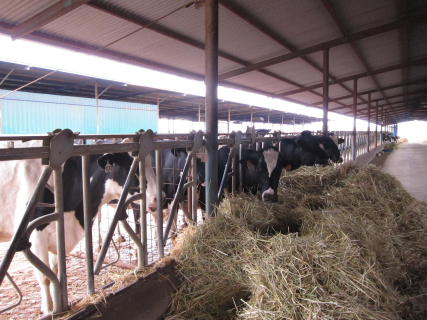

The first confirmed positive case of shamonda virus in Cantabria, located in a dairy cow from a farm in Riotuerto, corresponds to a variant that had not been identified in Spain until now, according to sources from the Ministry of Livestock reported to Europa Press.
Specifically, the Cantabrian focus has been classified as Shamonda-Europe type 2, while the other nine positives that, until Wednesday morning, the Ministry had registered correspond to type 1.
Although there are genetic differences between both genotypes, no variations in the clinical presentation of the disease have been observed so far, as stated in a situation report sent on the 8th by the department headed by Luis Planas.
This document details that type 1 has been identified mainly in France, Switzerland, and southern Germany, while type 2 has been located primarily in western France, the Netherlands, and northern Germany.
The shamonda virus mainly affects cattle, especially dairy cows, although it can also occur in sheep, goats, and horses, although in these species it usually presents asymptomatically, as explained by the regional minister, María Jesús Susinos, at the press conference on Wednesday where she announced the first positive case in the community.
The regional official emphasized that the disease, transmitted by the bite of mosquitoes of the genus culicoides, "does not affect people, neither directly nor through the consumption of products."
On the other hand, it can have "relevant" economic consequences, as infected cows see their milk production reduced (by between 10 and 20 percent in the 7 to 10 days following infection, recovering afterwards, although not reaching 100% again).
Furthermore, the virus can cause reproductive disorders in pregnant females, with possible abortions, embryonic reabsorptions, and other alterations during gestation.
The direct mortality associated with shamonda is, as Susinos specified, "low," but the morbidity — that is, the percentage of animals that can become infected within the same farm — is "very high, reaching up to 100%."
In the absence of a specific vaccine (sick animals are treated with antivirals), the "only and fundamental" tool that farmers have to try to curb the spread among their cattle is to reinforce biosecurity measures, as the counselor insisted.
In addition, it will be necessary to wait for a change in weather conditions, with the arrival of rains, the drop in temperatures, and the end of the vector's activity period.
The shamonda virus was first identified in Nigeria in the mid-1960s and, until this year, had only been reported sporadically in different areas of West, East, and Southern Africa, as well as in Japan.
On the European continent, the pathogen was first detected this summer, in July, in Switzerland and, since then, cases have been confirmed in Germany, France, Austria, Belgium, the Netherlands, Liechtenstein, and Italy.
In France, it was identified in early September and, in Spain, the Central Veterinary Laboratory of Algete (Madrid) — national reference center — verified the presence of shamonda in farms in Córdoba and Toledo, to which the outbreaks in Cantabria, Ávila, and Madrid have subsequently been added.