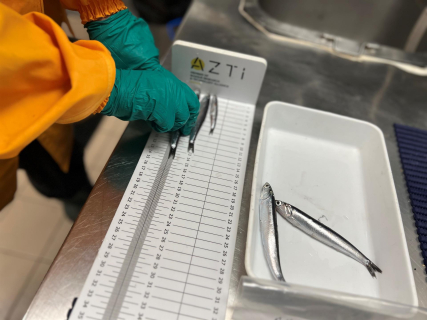

The Ministry of Agriculture, Fisheries and Food will launch this Saturday the oceanographic campaign Juvena 2026, focused on the study of the juvenile phases of anchovy in the Bay of Biscay.
For 40 days, the scientific team will be dedicated to estimating "the abundance, biological situation and will analyze the environmental conditions that will allow making forecasts of recruitment for next year."
According to the department's statement, the Juvena 2026 campaign will take place aboard the ministry's oceanographic vessel Emma Bardán, which departs this Friday from the port of Pasaia (Guipúzcoa), and will also have the support of the oceanographic vessel Ángeles Alvariño, belonging to the Spanish Institute of Oceanography (IEO).
The work will extend over 40 days, during which specialists will quantify the abundance and examine the biological state of the anchovy, a fishing resource of great relevance for the purse seine fleet of the Cantabrian Sea. At the same time, the characterization of the environmental conditions will be carried out with the aim of being able to anticipate the recruitment of the species for next year.
The Azti Foundation assumes the responsibility for the design, development, and supervision of the campaign, in which research personnel from the IEO also collaborates.
Study of the pelagic ecosystem and hydrographic conditions
Within the framework of Juvena 2026, the hydrographic conditions will also be studied, as well as the abundance and distribution of the main components of the pelagic ecosystem, key aspects to understand the dynamics of the recruitment process. In addition, data will be collected on the distribution and abundance of top predators, such as mammals and seabirds, along with information related to human activities and the presence of marine debris.
The scientists' objective is "to advance in the knowledge of the mesopelagic species of the gulf and in the fine-tuning of broadband acoustic methodology for the discrimination of species and sizes of pelagic species," as stated by the Ministry.
For the evaluation of pelagic stocks, echo sounders and fishing gear aimed at the identification of species and the obtaining of biological parameters will be used. Ecology studies will be completed through sampling with different types of nets and probes to gather data on plankton and the water column, along with the observation of top predators and the detailed recording of marine debris.