BOE

BOE of today, Saturday, September 5: controls on travelers from Italy until September 22

Interior extends for another fifteen days the controls at Spanish ports and airports for arrivals from Italy. The measure responds to the prolongation of the Italian restrictions after the Ceuta crisis.

2 minutes

WhatsApp Image 2026 08 26 at 12.59.31

WhatsApp Image 2026 08 26 at 12.59.31

Add DEMÓCRATA to Google

Ask FREN

Published

Last updated

2 minutes

Most read

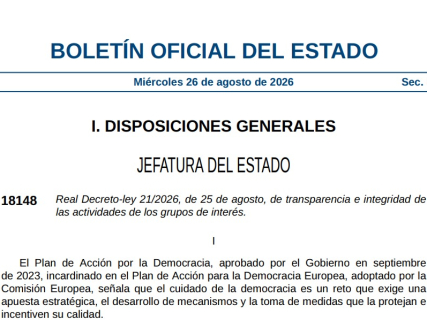
The Official State Bulletin of this Saturday, September 5, 2026, publishes the order of the Ministry of the Interior that extends border controls for travelers coming from Italy until September 22.

The extension will apply from September 8 to September 22 and will continue the checks that were scheduled until the 7th. It affects arrivals from Italy to Spanish ports and airports.

The publication formalizes Spain's response to the Italian government's decision to maintain controls on travelers coming from Spanish territory for another two weeks. The restrictions began after the migration crisis in Ceuta.

What changes with the extension published in the BOE

The main novelty is the calendar. The controls will not end on September 7, as was planned, but will continue for an additional fifteen days.

The new period runs from Tuesday, September 8, to Tuesday, September 22. Therefore, the order maintains checks on maritime and air connections coming from Italy, without establishing an interruption between both periods.

The described measure consists of extending border controls. It should not be confused with an announcement of flight cancellations or boat connections between the two countries.

Why Spain maintains controls on arrivals from Italy

The origin of the restrictions lies in the Italian decision of July 31 to reintroduce border controls in its ports and airports for travelers coming from Spain.

Rome then justified the measure for national security reasons in light of the Ceuta crisis. The Spanish government demanded that the restrictions be lifted and, upon failing to achieve this, responded by establishing controls on arrivals from Italy.

The Italian extension has led to a new Spanish extension. The decision to extend them had already been announced on August 31; the novelty of this Saturday is its publication in the BOE.

What reasons does the Interior order include

According to the content of the provision, the Interior considers that the reasons for urgency and the serious threat to public order and internal security that motivated the adoption of the controls persist.

That is the basis that the Ministry presents to maintain the measure during the new period.

The order establishes, furthermore, that the restrictions will be subject to permanent evaluation. Their duration is not disconnected from the evolution of the circumstances that justified their approval.

The controls could end before September 22

Although the calendar sets September 22 as the final date for this extension, the measure contemplates the possibility of being lifted earlier.

The controls will be rendered ineffective prematurely if the threats that motivated their adoption disappear or if these can be effectively addressed through less restrictive measures.

The published date marks, therefore, the expected end of the authorized period. It does not allow for a new subsequent extension to be confirmed.

Where to consult today's BOE

The edition corresponding to Saturday, September 5, can be consulted here in the summary of the Official State Bulletin.

For those planning to travel from Italy to Spain in the coming weeks, the main point is the continuity of controls on arrivals by port and airport: the extension covers from September 8 to 22, unless an early lifting is agreed upon.

More key points, information and questions with FREN

AI-GENERATED CONTENT

What are the parliamentary procedures required to extend border controls in Spain?

In Spain, the decision to introduce or extend controls at internal borders (for example, at border crossings with other Schengen States) is primarily a Government competence within the framework of the Schengen Borders Code. There is no mandatory and automatic “specific parliamentary procedure” for each extension; rather, there is a set of political control instruments that the Congress and the Senate can activate to oversee that decision and its extensions.

1. What the Government decides alone and what may require parliamentary intervention

The material decision to temporarily re-establish controls at internal borders for reasons of public order or internal security:

  • Is adopted by agreement of the Council of Ministers and is notified to the European Commission and other Schengen States according to EU law.
  • Does not, in itself, require prior authorization from the Congress or the Senate.

However, the Cortes can come into play if:

  • The Government frames that measure in a law-level regulation (for example, a royal decree-law that includes security measures linked to border control). In such a case, the parliamentary procedures for validation or processing as a bill apply.
  • The situation justifying the controls is connected to exceptional states (alarm, exception, or siege), which do require authorization or direct participation of the Congress.
  • Parliamentary groups decide to use ordinary control instruments to demand explanations or politically condition the extensions.

2. Common types of parliamentary control

In response to the introduction or extension of border controls, the range of instruments that can be used is the general parliamentary control over the Government:

  • Oral questions in Plenary or in the relevant Interior Committee / Joint Committee, for the minister to explain reasons, duration, geographic scope, and evaluation of the measure.
  • Written questions, in which deputies or senators request specific data (statistics, risk reports, coordination with other States, impact on fundamental rights, etc.).
  • Interpellations to the Government about its policy on border security or migration flow management, which can lead to a broader debate on the appropriateness of maintaining or lifting controls.
  • Motions and non-legislative proposals (PNL) urging the Government to limit the extensions in time, modify them, strengthen guarantees, or even abolish the controls.
  • Appearances of the Interior Minister or other officials before committees, on their own initiative or at the request of groups, to inform before or after adopting the extensions.
  • Requests for information and documentation about notifications sent to the European Commission, impact assessments, or reports from security forces and bodies.

3. Specific role of the Congress and the Senate

In practice, the Congress of Deputies is the chamber that concentrates the most intense political control over Government action:

  • Weekly Government control debates, where questions about the extensions can be raised.
  • Greater use of interpellations and motions that set political positions on the duration, scope, and proportionality of the controls.
  • Greater media visibility, which pressures the Executive to better justify the need to maintain the measures.

The Senate also exercises control, although usually in a more technical or territorial manner:

  • Questions and motions in Plenary or committees, often with special attention to specific border communities.
  • Possibility for senators appointed by regional parliaments to convey specific territorial concerns (cross-border traffic, local economy, etc.).

Neither chamber generally has a direct legal veto over a specific extension of controls, but both have a strong capacity for political conditioning through these instruments.

4. Usual practice in control extensions

In practice, when Spain has re-established or extended border controls for reasons of security, public order, or major events:

  • The Government adopts the decision by executive agreement or provision, within the framework of EU law.
  • A parliamentary group requests the appearance of the Interior Minister to explain the reasons, legal justification, and expected duration of the controls.
  • Written and oral questions are formulated requesting data on application and evaluation of results.
  • Occasionally, PNLs or motions are approved in which the chambers set political criteria (proportionality, time limitation, respect for rights) intended to guide future Executive decisions.

In summary, the core decision to extend border controls lies with the Government, but it is subject to continuous parliamentary control through the ordinary instruments of the Cortes Generales, without a unique, automatic, and specific authorization procedure unless the measure is inserted in an exceptional state or in a law-level regulation.

What are the competences of the Ministry of the Interior regarding border control according to Spanish legislation?

Under Spanish legislation, the Ministry of the Interior assumes the main responsibility for controlling external borders, within the general framework established by Law 40/2015, on the Legal Regime of the Public Sector, the royal decrees of basic organic structure of the Ministry itself (for example, Royal Decree 734/2020, of August 4, and its subsequent amendments concerning the Ministry of the Interior) and the immigration regulations, especially Organic Law 4/2000 and its Regulation approved by Royal Decree 557/2011. All this is integrated with obligations derived from the Schengen area and the Schengen Borders Code.

1. General framework of competences

Law 40/2015 and the royal decrees of organic structure assign to the Ministry of the Interior the policy of citizen security, the direction of the State Security Forces and Corps (National Police Corps and Civil Guard) and the management of immigration and borders within the national territory. On this organic basis, Organic Law 4/2000 on the rights and freedoms of foreigners and its 2011 Regulation specify which executive functions correspond to the Interior Ministry in controlling entries, irregular stays, expulsions, returns, and border refusals.

2. Border surveillance and custody

Physical surveillance of borders is organized through bodies dependent on the Ministry:

  • The Civil Guard assumes, according to the organizational regulations of the Directorate General of the Civil Guard, surveillance of land and maritime borders, including coasts, territorial sea, and certain land border areas (for example, border areas with France or Portugal), as well as support for control operations in ports.
  • The National Police Corps, pursuant to Order INT/859/2023 on its structure and immigration regulations, exercises border control at authorized crossings, especially in international ports and airports where there is a police border post.

Additionally, various orders authorizing border crossings (such as Orders PRE/23/2010, PRE/2506/2010, PRE/1670/2011, PCI/7/2019, etc.) designate which airports or facilities are “border posts” or “border crossings.” This authorization implies the presence and action of the National Police (and, where applicable, the Civil Guard) as migration control authority.

3. Control of entry and exit of persons

Organic Law 4/2000 and its Regulation establish the entry requirements (documentation, visa when required, means of subsistence, purpose of stay, absence of entry prohibitions) and set that verification corresponds to the border control authorities, that is, the Interior Ministry through the National Police.

Specifically, the Interior Ministry exercises competences in:

  • Verification of travel documents and visas at authorized border posts.
  • Consultation of national and European databases (records, alerts, inadmissible lists, etc.).
  • Application of Schengen regulations on systematic or random checks on persons at the external border.
  • Control of exit of nationals and foreigners, under terms provided by European and Spanish regulations (for example, for minors or persons subject to judicial measures).

The granting of visas mainly corresponds to the Ministry of Foreign Affairs, but the Interior Ministry participates through reports, security checks, and subsequent border control.

4. Expulsion, return, and border refusal

Organic Law 4/2000 typifies immigration infractions and regulates the figures of expulsion, return, and border refusal. The Ministry of the Interior is responsible for:

  • The initiation, processing, and resolution of sanctioning procedures for expulsion and return (through Government Delegations and Subdelegations, integrated in the Interior or Home Affairs organization).
  • The material execution of expulsions and returns by the National Police and Civil Guard.
  • The practice of border refusal of persons attempting to enter without meeting requirements, including the particularities of the border regime of Ceuta and Melilla, subject to interpretation by Constitutional Court Ruling 172/2020.
5. Foreigners' internment centers (CIE)

Although the internment of foreigners in irregular situations can only be ordered by a judge, Organic Law 4/2000 and its regulatory development assign the Ministry of the Interior the material management and security of the CIE:

  • Organization, staffing, and operation of the centers.
  • Custody of interned persons through the National Police.
  • Collaboration with judges and prosecutors in supervising the internment.
6. Coordination and international cooperation

The Interior Ministry coordinates, by virtue of the royal decrees of organic structure, the actions of the Civil Guard and National Police with other Administration bodies (Health, Agriculture, Customs, etc.) that carry out health, veterinary, or customs controls at the border. This is reflected, for example, in recent orders that delimit official control competences at the border of other ministries.

Likewise, the Ministry of the Interior participates in international police cooperation and information exchange for border management:

  • Implementation of bilateral agreements, such as the Cross-Border Cooperation Agreement on Police and Customs Matters between Spain and France, which strengthens joint patrols and controls in border areas.
  • Practical execution at the border of visa exemption agreements for diplomatic or official passports with third States, published in the BOE.
  • Participation in EU information mechanisms (including passenger data according to Organic Law 1/2020 on PNR), relevant for risk filtering at the border.

Overall, Spanish legislation configures the Ministry of the Interior as the central authority for migration and security control of borders, while other ministries assume specific controls (health, phytosanitary, customs) coordinated with it at points of entry and exit of the territory.

What legal requirements must Spain meet to establish temporary controls at its internal borders within the Schengen area?

Spain can only re-establish temporary controls at its internal borders within the Schengen area if certain material and procedural conditions are met, mainly established by the Schengen Borders Code (Regulation (EU) 2016/399). In summary, there must be a serious threat to public order or internal security, the control must be proportionate and limited in time and space, and it must be accompanied by formal notification and justification to European institutions and other Member States.

From a material point of view, the enabling premise is always the existence of a serious threat to public order or internal security. The concept has been interpreted strictly: terrorism, hybrid threats, uncontrolled migration crises, major events generating high risk (international summits, major sporting events), or health emergencies. Spain cannot re-establish controls for purely economic reasons or political convenience; it must be able to argue that without border control it could not adequately manage that threat.

Additionally, the control must meet the requirements of necessity and proportionality. This implies, on the one hand, that there are no less restrictive alternative measures to address the threat (reinforcement of internal police, police cooperation with other States, mobile controls within the territory, etc.) and, on the other hand, that the geographic scope and intensity of controls strictly correspond to the detected risk. For example, controlling a specific border crossing for a few hours a day is not the same as re-establishing systematic controls along the entire land, maritime, and air border.

Regarding duration, the Schengen Borders Code distinguishes several scenarios. In a threat forecast scenario (for example, a scheduled international summit), the reintroduction of controls may initially be authorized for a maximum period of 30 days, extendable while the threat lasts, with a general cap that, depending on the type of situation, can reach several months. In an immediate emergency scenario, where there is no time for prior planning, the State may re-establish controls almost instantly, but for a much shorter period, which can only be extended following reinforced notification and justification procedures.

Procedurally, the re-establishment of controls is an Executive decision. In practice, the Spanish Government, at the proposal of the Ministry of the Interior and after coordination with other affected ministries (Foreign Affairs, Transport, etc.), adopts an agreement specifying the affected border crossings, the expected duration, the nature of the threat, and the control modalities. This act must be legally motivated, so that there is a record of why ordinary measures within the free movement area are considered insufficient.

At the same time, Spain is obliged to notify its decision to the European Commission, other Schengen States, and, in certain cases, the European Parliament. This notification must be made in advance when the threat is foreseeable, indicating at least: reason for re-establishment (type of threat), territorial scope, duration, affected crossing points, and, as far as possible, an assessment of proportionality. If the threat is sudden and does not allow prior notice, the notification must be made immediately after the measure is adopted.

The European Commission and other States may make observations on the measure, especially if it is prolonged over time or significantly affects the functioning of the internal market and free movement. Although the final decision to maintain or lift controls remains national, Spain must take those observations into account and could face infringement procedures if an abusive or disproportionate use of the mechanism is found.

During the validity period of the controls, Spain must also respect the individual guarantees of the Schengen Borders Code and Union law: prohibition of discrimination based on nationality within the EU, respect for the dignity of persons subjected to control, limitation of checks to what is strictly necessary, and maintenance of the general principle of freedom of movement for Union citizens and their family members, except in specific cases where individual grounds for refusal of entry exist.

Finally, at the end of the authorized period, Spain must lift the controls, unless it justifies a new extension within legal margins. The rule is that internal controls remain exceptional, temporary, and controlled at the European level, to preserve the core of the Schengen system: an area without internal border controls, compatible with States’ capacity to react to serious and punctual threats.

Play

Test your knowledge with FREN!

How much do you know about this topic? Answer the following 3 questions.

Until what date are border controls for travelers from Italy extended according to the order published in the BOE on September 5?

Question 1 of 3

What is the main reason justifying the extension of border controls according to the Ministry of the Interior?

Question 2 of 3

What option does the order consider in case the threats that motivated the controls disappear?

Question 3 of 3

Hola, soy Fren. ¿Cómo te ayudo?