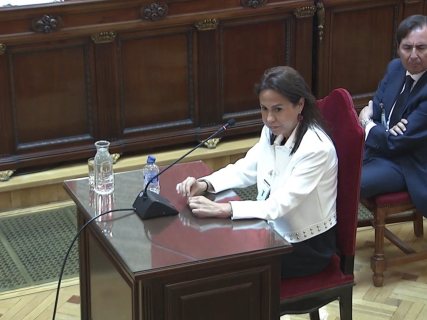
Pardo de Vera points to former ministers and high-ranking officials of the Government in the Koldo case

Investigated in the Koldo case, she claims that she rejected appointment proposals and that she is willing to provide the Justice with information about people and companies with whom she had contact during her time at the Ministry.

3 minutes

fotonoticia 20260501141130 1920

fotonoticia 20260501141130 1920

Add DEMÓCRATA to Google

Ask FREN

Published

Last updated

3 minutes

Most read

The box of thunder has been opened. The one who activated the key has been the former president of Adif and former Secretary of State for Transport Isabel Pardo de Vera, who has broadened the scope of her accusations, has spoken about the alleged pressures she suffered during her time in the Ministry, and has pointed to former political officials for their contacts to inquire about certain companies. In two interviews published by ABC and El Mundo, the engineer defends her actions in railway management, denies having participated in irregularities, and assures that she is willing to collaborate with Justice.

In El Mundo it is stated that former ministers José Bono and José Blanco called her several times to inquire about companies. According to her account, they conveyed to her that certain companies were suffering or that they were not receiving adequate treatment. Pardo de Vera does not claim that those calls resulted in irregular awards and states that she is not aware that both also approached José Luis Ábalos to talk about those firms.

The former head of Transport also claims that other political officials proposed names for executive positions at Adif, but that she rejected those suggestions because, in her opinion, the proposed individuals did not meet the necessary qualifications. She does not identify those who raised it and indicates that she would provide that information to the judge if it were relevant to the investigation.

In ABC it links her dismissal as Secretary of State, in February 2023, with decisions she made in the department and, in particular, with the request for travel expenses of Iñaqui Carnicero, then general director of Urban Agenda and Architecture. According to her version, she received the documentation a few days before she was informed of her departure and barely had time to analyze it.

Pardo de Vera maintains that she tried to curb the pressures from Koldo García and that she conveyed to Ábalos the actions she considered inappropriate. "I want to collaborate," she states in El Mundo, where she offers to provide the Prosecutor's Office and the judge with information she may have about individuals and companies during her time in the Administration.

From the Presidency of Adif to the investigation of the Koldo case

Civil Engineer, Pardo de Vera developed a good part of her professional career in the railway sector. In 2018 she was appointed president of Adif, the public entity responsible for the administration of railway infrastructures, and in July 2021 she took over the Secretary of State for Transport, Mobility and Urban Agenda. She was dismissed in February 2023, during Ábalos's tenure at the Ministry.

Her trajectory was linked to the judicial investigation into the hiring of Jésica Rodríguez, Ábalos's ex-partner, in public companies, as well as to the alleged irregularities in public works contracts. Pardo de Vera is being investigated in the National Court for these facts. In Rodríguez's case, she has acknowledged that she sent her resume to the president of Ineco at Koldo García's request, but she maintains that she did not intervene in the decision to hire her nor did she have authority over that company.

In February 2026, in her first interview after being investigated, she had already questioned Ábalos's influence within the Government and described Koldo García as an intermediary who controlled access to the minister. She also denied having favored contracts and defended that Adif's contracting procedures included numerous controls. That version has been maintained in her subsequent statements.

Her statements before Justice and the Senate

On April 15, 2026, Pardo de Vera testified as a witness in the Supreme Court during the trial for the mask contracts. There she said that she was surprised to find Víctor de Aldama in the minister's circle and that she had conveyed her concern about that presence to Ábalos. She also explained that she received information from Koldo García about a supplier company and that she forwarded it to her team as one more offer, without, according to her version, determining the award.

In May 2025 she had appeared before the Senate investigation committee on public contracts related to Koldo García and the plot investigated in Operation Delorme. More recently, in June 2026, she sent the judge five reports prepared by herself to defend that the contracts under suspicion could not be easily rigged due to the number of technicians and controls involved in each procedure.

More key points, information and questions with FREN

AI-GENERATED CONTENT

What is the current status of the judicial investigation into the Koldo case and what are the next steps in the proceedings?

As of October 14, 2026, the so-called Koldo case is in a mixed phase:

  • The part related to former minister José Luis Ábalos that was under the jurisdiction of the Supreme Court (mask contracts) has already gone to trial and ended in conviction.
  • The main piece and several derivatives remain in the investigation phase at the National Court, with the investigation extended at least until March 8, 2027 and room for new charges.
1. Dual level of the procedure

It is advisable to clearly distinguish between:

  • Case in the Supreme Court (Ábalos's privileged jurisdiction, mask contracts piece):
    • In December 2025, the Supreme Court instructor, Leopoldo Puente, agreed to open oral trial against Ábalos, his former advisor Koldo García, and businessman Víctor de Aldama for the mask contracts awarded during the pandemic, maintaining provisional detention for the first two.
      See the Demócrata report: opening of oral trial in the Supreme Court.
    • Subsequently, that trial was held and the Supreme Court issued a conviction sentence, with 24 years imprisonment for Ábalos, 19 and a half years for Koldo García, and 7 years for Aldama, according to resolutions and later news cited by the National Court itself.
    • This piece is therefore closed in the trial phase, pending only possible appeals against the sentence.
  • Case in the National Court (other investigated persons and lines of investigation):
    • After Ábalos lost his privileged jurisdiction, part of the case was referred to the National Court, where it is being investigated by Judge Ismael Moreno.
    • The investigation covers:
      • Alleged irregularities in mask contracts (original piece).
      • Alleged rigging of public works contracts and awards in public companies, with investigated persons such as businessman Juan Carlos Cueto or former Adif president Isabel Pardo de Vera, who has submitted expert reports defending the regularity of the works (Demócrata details it here).
      • A derivative concerning cash payments by the PSOE, initially connected to the Supreme Court case and referred to the Central Investigative Court No. 2 to assess whether to open a specific investigation into the management of cash at the Ferraz headquarters (order described in this information).
2. Current status of the investigation at the National Court

According to the latest known resolutions and recent judicial news:

  • Judge Ismael Moreno has agreed to extend the investigation by six more months, counting from March 8, precisely due to the volume of seized material (documentation, cash, and especially numerous electronic devices: mobiles, computers, storage media) that the UCO is still analyzing to issue its technical reports. This extension is considered “appropriate” and responds to an express request from the Anti-Corruption Prosecutor's Office (extension order).
  • The judge leaves open the possibility of new charges, indicating that the progress of the device analysis may lead to new proceedings or the inclusion of more investigated persons.
  • Meanwhile, the Criminal Chamber of the National Court has been resolving appeals from investigated persons. For example, it has confirmed the indictment of Jéssica Rodríguez, Ábalos's ex-partner, considering her inclusion in the case “appropriate” due to contracts in public companies where she allegedly received payment without working (order on Jéssica Rodríguez).
  • New summons of investigated persons have occurred (including relatives of Koldo García and Adif officials) and statements have been taken in which some have exercised their right not to testify, evidencing that the investigation phase remains active to this day.
3. Expected next procedural steps

With the available information, the procedural milestones that will likely mark the case's evolution in the coming months are:

  • Completion of UCO reports: once the analysis of phones, computers, and other devices is completed, the Civil Guard will send its final reports to the court. Their content will be key to confirm or discard indications regarding each investigated person.
  • Execution and closure of pending proceedings: the judge must decide which additional proceedings – statements, official requests, expert reports – are essential, both those requested by the Prosecutor's Office and by the accusations and defenses, and resolve any remaining appeals.
  • Definition of facts and responsible parties: with the material already incorporated, Moreno will have to specify which behaviors are considered indicatively criminal and against whom. This may imply:
    • Partial dismissals regarding persons or facts.
    • Maintenance of the status of investigated person.
    • Possible new charges, if police reports point to more implicated individuals.
  • Closure of the investigation: if it is understood that the investigation is exhausted, the judge will issue the order to end the investigation, which opens the intermediate phase.
  • Accusation and defense briefs: the Anti-Corruption Prosecutor's Office and the accusations will submit their briefs specifying crimes and requested penalties; the defenses will respond with their defense briefs, raising, if applicable, nullities or requests for dismissal.
  • Order to open oral trial (or dismissal): if the court finds sufficient indications against certain investigated persons, it will order the opening of oral trial and refer the case to the competent court for trial; if not, it will proceed to total or partial dismissal.

In summary, the Koldo case is not closed: a piece already in the phase of a final or appealable sentence in the Supreme Court coexists with an ongoing investigation at the National Court, whose immediate horizon is marked by the extension of the investigation until March 2027 and the completion of the UCO reports.

Can you detail which persons remain charged in the main piece of the Koldo case at the National Court and for what specific facts? What differences exist between the Supreme Court sentence on the mask case and the lines of investigation open at the National Court? How might the November 29 electoral calendar influence the procedural timing of the Koldo case?

What are the legal powers and functions of a Secretary of State for Transport in Spain?

In Spain, the figure of the Secretary of State for Transport is a senior official of the General State Administration, positioned immediately below the competent minister (currently, the Minister of Transport) and above the undersecretaries, secretaries-general, and directors-general who depend on them. Their general statute is defined by Law 40/2015, on the Legal Regime of the Public Sector, and, in detail, by the royal decree establishing the ministry's organizational structure.

Briefly, their functions and powers can be grouped into five main blocks: political and strategic direction, regulatory promotion, coordination and supervision of bodies, management of public policies, and institutional representation.

1. Political and strategic direction of the transport area

The Secretary of State is the main political responsible for concretizing, under the minister's guidelines, the strategic planning of transport policy. This usually includes:

  • Defining the strategic lines in infrastructure and transport services (rail, road, air, maritime, and, where applicable, logistics).
  • Proposing to the minister the multi-year plans and programs (for example, infrastructure plans, sustainable mobility, territorial connectivity, freight corridors, etc.).
  • Establishing priorities based on technical, budgetary, environmental, and social and territorial cohesion criteria.

In this sense, they act as a link between the Government's general political orientations and the operational design of transport policies.

2. Regulatory and normative powers

Without being a “legislator” in the strict sense, the Secretary of State plays a central role in promoting sector regulations:

  • Promotion and drafting of regulatory projects in the transport field: bills, royal decrees, ministerial orders, and other regulatory norms, which must then be approved by the minister, the Council of Ministers, or, where applicable, the General Courts.
  • Coordination of sector regulation (e.g., railway safety, air navigation, road transport, ports of general interest), ensuring coherence with European Union law and with other involved ministries (Economy, Ecological Transition, Interior, etc.).
  • Supervision of the technical drafting of norms, guides, instructions, and internal or sectoral circulars that develop the current legislation.

Their signature does not replace the minister's in the highest-ranking regulatory provisions, but they direct the process and, in many cases, sign resolutions and development provisions within their competence.

3. Direction and coordination of sector bodies and entities

The Secretary of State exercises the superior direction of the directorates-general, secretariats-general, and units that make up the Secretariat of State for Transport, and often has assigned functions over public sector bodies and companies in the sector. This includes:

  • Directing and coordinating the activity of the directorates-general (for example, Roads, Civil Aviation, Merchant Marine, or Land Transport, according to the current structure).
  • Exercising functional oversight over public business entities or state companies in the transport field (rail infrastructure managers, public operators, state-owned port authorities, airport managers, etc.), within the framework set by laws.
  • Approving instructions, circulars, and action criteria to ensure a homogeneous application of transport policy.

In practice, they are the key piece that articulates the daily relationship between the ministry and the broad state public transport sector.

4. Budget and program management

Within their material scope, the Secretary of State usually has relevant powers in budget programming and execution:

  • Participating in the preparation of the ministry's budget in the transport-related part, proposing the distribution of credits among programs, chapters, and investment projects.
  • Authorizing certain expenses and contracts within the limits set by public sector contracting regulations and the minister's delegations of powers.
  • Promoting and monitoring programs financed with European funds linked to infrastructure, sustainable mobility, transport digitalization, or decarbonization.
  • Supervising the evaluation of transport policy results (service indicators, safety, punctuality, environmental impact, territorial cohesion, etc.).
5. Institutional representation and external relations

The Secretary of State for Transport is also a key actor in the representation of the State in this area:

  • Representing the ministry in government collegiate bodies and interministerial commissions when so designated.
  • Leading Spanish delegations in international and European Union forums related to transport (sectoral EU Councils of Ministers, specialized bodies, international conferences, etc.).
  • Maintaining relations with autonomous communities and local entities on infrastructure and service coordination aspects, through sectoral conferences and working groups.
  • Exercising dialogue with the private sector and civil society (transport companies, concessionaires, user associations, unions, professional organizations), especially in public consultations and sector dialogue processes.
6. Political and administrative responsibility

As a senior official, the Secretary of State is politically accountable to the minister and, ultimately, to Parliament, which may require their presence to explain policies or decisions. From a legal-administrative point of view, their acts are appealable in administrative and contentious-administrative proceedings, and they are subject to incompatibility, conflict of interest, and responsibility regimes established for senior officials.

In sum, the Secretary of State for Transport is not a mere technical manager: they are the main responsible for designing, coordinating, and executing the state's transport policy, articulating the broad institutional and business ecosystem of the sector, and representing Spain in this field, always under the general guidelines of the minister and the Government.

Can you detail what Law 40/2015 says about the general functions of Secretaries of State? What differences exist between the powers of a Secretary of State for Transport and those of a Minister of Transport? How does the Secretary of State for Transport coordinate with autonomous communities regarding transport infrastructure and services?

What results did the PSOE obtain in the last general elections and how many deputies does it currently have in Congress?

In the last general elections held in Spain, on July 23, 2023 (23J), the Spanish Socialist Workers' Party (PSOE) obtained its best vote result since Pedro Sánchez has been a candidate, although it was not the leading force in seats. To date, those elections remain the reference for knowing both its electoral results and the current size of its group in Congress.

PSOE results in the July 23, 2023 general elections

According to the analysis published by the newspaper Demócrata in the article "Pedro Sánchez at the polls: from 85 seats in 2016 to his record votes in 2023", the definitive data for PSOE in the Congress of Deputies in the July 23, 2023 elections were as follows:

  • Votes obtained: 7,821,718 ballots.
  • Percentage of valid votes: 31.68%.
  • Seats in Congress: 121 deputies.
  • Relative position: second force in Congress, behind the Popular Party.

These 121 seats include the entire socialist space at the state level: PSOE, PSC in Catalonia, and associated candidacies integrated into the overall socialist count in Congress. The vote count and percentage refer to the national total of valid votes for socialist lists, once the final scrutiny was completed.

Compared to the previous general election (November 10, 2019), PSOE improved in votes and seats. It went from 6,792,199 votes (28.00%) and 120 deputies to 7,821,718 votes (31.68%) and 121 deputies in 23J. That is:

  • It gained just over one million votes compared to 2019.
  • It increased its representation by one deputy (from 120 to 121).

However, despite this record in votes and percentage, PSOE was behind the PP in seats, so it was neither the most voted party nor the one with the highest number of seats in the Lower House. This combination — record votes but second position in representation — is one of the most characteristic features of the 23J result for the socialists.

Deputies PSOE currently has in Congress

Based on these results, and according to information collected by Demócrata in its comparative analyses of polls and actual results (for example, in this SocioMétrica tracking and other articles on vote estimates), the constant reference for PSOE is that:

  • PSOE obtained 121 deputies in the 2023 general elections.
  • This number of 121 is systematically used as a basis to compare new poll projections against the real 23J result.

Although during the legislature there have been numerous resignations and replacements of deputies in all groups — something analyzed, for example, in Demócrata's report "More than fifty deputies have left Congress since the start of the legislature" — these vacancies are covered by the entry of the next persons on the electoral lists. That is, the specific names may change, but not the number of seats assigned to each party, except in very specific exceptional cases that have not occurred in this legislature.

Therefore, according to available data, it remains that:

  • The Socialist Parliamentary Group currently has 121 deputies in the Congress of Deputies, the same number assigned to it in the final count of the July 23, 2023 general elections.

In summary: in the last general elections (23J 2023) PSOE obtained 7,821,718 votes, 31.68% of the total valid votes, and 121 seats in Congress; and to date its parliamentary representation in the Lower House remains 121 deputies.

How were the 350 seats in Congress distributed among all parties in the July 23, 2023 general elections? What differences exist between PSOE's results in the 2019 and 2023 general elections in votes, percentage, and seats? How have resignations and replacements of PSOE deputies affected the profile of the Socialist Parliamentary Group since the start of the legislature?

Play

Test your knowledge with FREN!

How much do you know about this topic? Answer the following 3 questions.

What position did Isabel Pardo de Vera hold before becoming Secretary of State for Transport?

Question 1 of 3

What connection did Pardo de Vera establish between her dismissal and the request made about Iñaqui Carnicero?

Question 2 of 3

What did Pardo de Vera defend in her reports sent to the judge about the suspicious awards?

Question 3 of 3