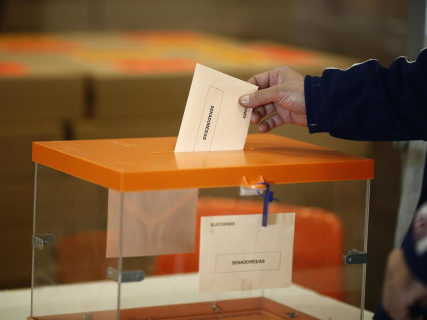

The Supreme Court maintains the precautionary suspension of the right to vote for thousands of Spaniards naturalized through the so-called "grandchildren's law" in view of the general elections on November 29. The Fourth Section of the Administrative Litigation Chamber has rejected the requests submitted by the State Attorney's Office and the Prosecutor's Office, which sought to lift the measure due to the material impossibility of reviewing the affected files within the deadlines established by electoral legislation. According to the latest data provided by the Government to the court, 163,020 people are included in the group affected by the controversy over registrations in the census of residents abroad.
The decision was made known this Monday, October 12, coinciding with the opening of the electoral census consultation period. The high court thus maintains the measure adopted on September 8, when the elections had not yet been called. The advance of the elections has substantially changed the scenario: an administrative review that was initially proposed with a broader horizon must now fit into a calendar of just a few weeks. The suspension is precautionary and does not imply the loss of Spanish nationality, although it may prevent those included in it from exercising their right to vote in this election.
Why the Supreme Court maintains the suspension of the vote
The origin of the litigation lies in the appeals promoted by Iustitia Europa and Vox against the electoral application of the Democratic Memory Law and a subsequent instruction from the Ministry of Justice. In September, the Supreme Court partially accepted the precautionary measures requested and ordered the review of certain registrations in the Census of Absentee Residents (CERA), considering that the requirements justifying some of the nationalizations used for electoral registration should be verified.
The judges then warned of a possible risk to the objectivity and transparency of the electoral process given the notable increase in voters added to the foreign census. The controversy does not consist of the fact that every descendant of Spaniards lacks the right to vote, but rather in how an administrative instruction that allows presuming the status of exile in certain cases has been applied. There is no definitive ruling on the merits of the matter and the measure that is maintained is provisional, while judicial discussion continues.
The Prosecutor's Office and the State Attorney's Office warn of the risk to a fundamental right
The Prosecutor's Office and the State Attorney's Office requested the Supreme Court to reconsider the suspension upon learning of the early call for elections. Their main argument is that there is not enough time to individually differentiate those who obtained nationality by directly fulfilling the conditions set out in the law from those who relied on the presumption provided in the Justice instruction. That distinction requires reviewing files and consular records individually, a task that, according to the Government's legal services, is "materially impossible" within the available timeframe.
The Attorney's Office also warned that maintaining the suspension without being able to verify each case could result in the electoral exclusion of individuals whose nationality and registration have not been annulled. In their view, priority must be given to the protection of the fundamental right to political participation, especially when a provisional decision can have irreversible effects for specific elections. The Public Prosecutor's Office also raised the need for those affected to be able to intervene in the procedure to defend their interests, a complex issue due to the volume of files.
What is the grandchildren's law and who is affected by the decision
The so-called "grandchildren's law" is part of the 2022 Democratic Memory Law and opened avenues for descendants of Spaniards who suffered exile, among other cases provided for in the regulation, to acquire Spanish nationality. An instruction from the Ministry of Justice approved that same year established a presumption linked to those who left Spain between July 18, 1936, and December 31, 1955. It is the application of that administrative criterion that is at the center of the judicial controversy.
Therefore, the suspension should not be interpreted as the widespread withdrawal of the vote from all individuals naturalized under the Law of Democratic Memory. The Supreme Court had limited the measure to certain registrations whose justification had to be verified. The practical problem is that the records do not allow for immediate identification of which citizens belong to each category, which forces manual checks to be carried out. The figure of 163,020 potential affected corresponds to the census applicable to these elections and not to the total number of people who applied for or obtained nationality through this route.
The census of 29N, closed on August 1: key dates
The electoral calendar adds urgency to the conflict. According to the Organic Law of the General Electoral Regime (LOREG), the reference census for the general elections on November 29 is the one closed on August 1, 2026, with administrative movements incorporated until the end of July. Citizens can consult their data from October 12 to 19 at town halls and consulates, as well as through the electronic services of the National Institute of Statistics, and submit claims during that same period.
The Electoral Census Office must resolve the claims by October 22 and publish the resolutions on October 23, without prejudice to the legally provided resources. This calendar leaves a very narrow margin to study thousands of consular files and, if applicable, restore affected registrations in time due to the measure. It is not enough for a person to have obtained Spanish nationality to know, without reviewing their file, if they are included in the judicial suspension.
The conflict reaches 29N with external participation at the center of the debate
The controversy occurs in elections where 38,728,356 Spaniards will be able to vote, according to the INE, of which 2,769,645 reside abroad. Since the elimination of the requested vote, voters registered in the CERA automatically receive electoral documentation, without needing to request it beforehand, a circumstance that has increased the relevance of the external census in the campaigns.
The dispute has also acquired a political dimension. Vox and Iustitia Europa have defended the review of the questioned high positions to guarantee the regularity of the process, while the Government has warned of the consequences of depriving citizens who already have recognized Spanish nationality of the right to vote. Iustitia Europa even went so far as to request measures to suspend the elections due to the difficulties in executing the precautionary measure, a request that must be distinguished from the decision to maintain the suspension of the vote.
With less than seven weeks until the polls, the practical scope of the measure concerning the 163,020 affected and the possible ways to defend their rights become essential issues for the electoral process. The Supreme Court maintains its provisional decision, while the proximity of the deadline for census claims narrows the possibilities of resolving a controversy that pits the legal security of the census against the protection of the right to vote.