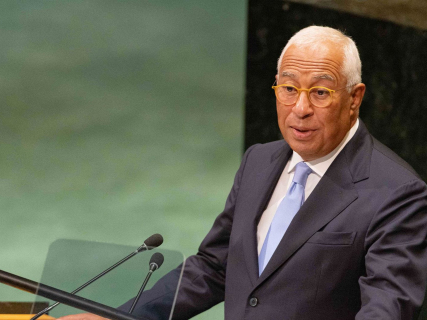

The president of the European Council, António Costa, has inaugurated a new edition of the European Week of Regions and Cities with a clear message to the European Commission: in the negotiation of the next multiannual financial framework, cohesion policies must not be relegated. At the same time, he has positioned the housing crisis, energy transformation, and reduction of bureaucracy as the main challenges facing the Union.
After highlighting the role of cities and regions as "essential" for territorial cohesion for "being the closest to citizens," he has warned of the challenges that these levels of government face and has encouraged them to "protect their prosperity" in a context marked by "demographic change, climate transition, and energy changes."
According to Costa, these challenges "require common priorities and determined actions," which he has grouped into three main areas, starting with energy.
"Energy prices are central to the equation. The current crisis in the Middle East and its impact on energy supplies require the need for decarbonization and greater efficiency towards independence based on our renewable and nuclear energy sources," he has considered.
In his opinion, "the benefits are already seen in regions with more renewables, which enjoy significantly low electricity prices." Therefore, he has urged to "accelerate the energy transition for a better long-term strategy that guarantees autonomy in Europe and low prices."
Without losing sight of the short term, he has reminded that "objectives and temporary measures are necessary to protect families and businesses," and has valued that the European Commission "has already made some proposals to provide immediate relief."
ENERGY, HOUSING, AND BUREAUCRACY
For the president of the European Council, the energy transition "is not just about generating renewable energy," but also about "transforming mobility and improving efficiency." In this sense, he has advocated for strengthening public transport, promoting electric vehicles, and expanding the network of charging points, along with efficiency policies in homes, "something that will not be possible without the support of the European Commission."
Costa has also focused on the difficulties of access to the rental market, a problem that, he said, extends "from Copenhagen to Lisbon and from Dublin to Athens" and that "has been one of the main urgent problems for citizens."
He has described a crisis that "affects low incomes, but also the middle class," and has admitted that the shortage of supply is starting to "disillusion." Although he has recalled that renting is "a responsibility of national, regional, and local authorities, but the EU can complement efforts and can help," he has pointed out that the European Council is already analyzing how to achieve that "the European Union can support efforts through better regulation and more innovation." "We need a response at all levels in this crisis to strengthen social cohesion," he asserts.
Simplifying Bureaucracy
The third line of his intervention has been the need to "simplify through better rules and fewer directives" the bureaucracy in the EU "to ensure greater consistency and reduce fragmentation in each market."
"We need faster, simpler, and more predictable procedures to help businesses invest and grow," he added, before calling for a long-term budget "that responds to the challenges of this historic moment."
For Costa, "it's not just about numbers," but about a political decision "on the future and the Europe" that must be built "together."
He has argued that "the next long-term budget must kickstart industrial transformation, defense, security, and strategic resilience, and continue supporting cohesion and agricultural policies, the pillars of regional development."
From his position, he has promised to urge "all those involved to negotiate with an open mind and the spirit of collective responsibility, with the aim of reaching an agreement by the end of the year."
"In these turbulent geopolitical times, Europe must be stable and have means to act and unity to face challenges," he has indicated. "A strong Europe is built from the bottom up and through empowered regions."