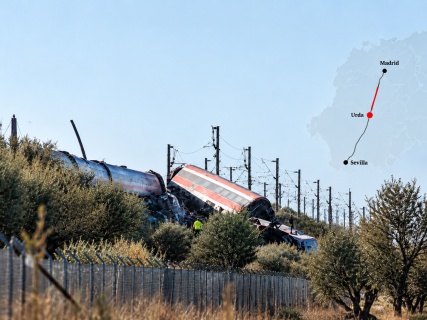

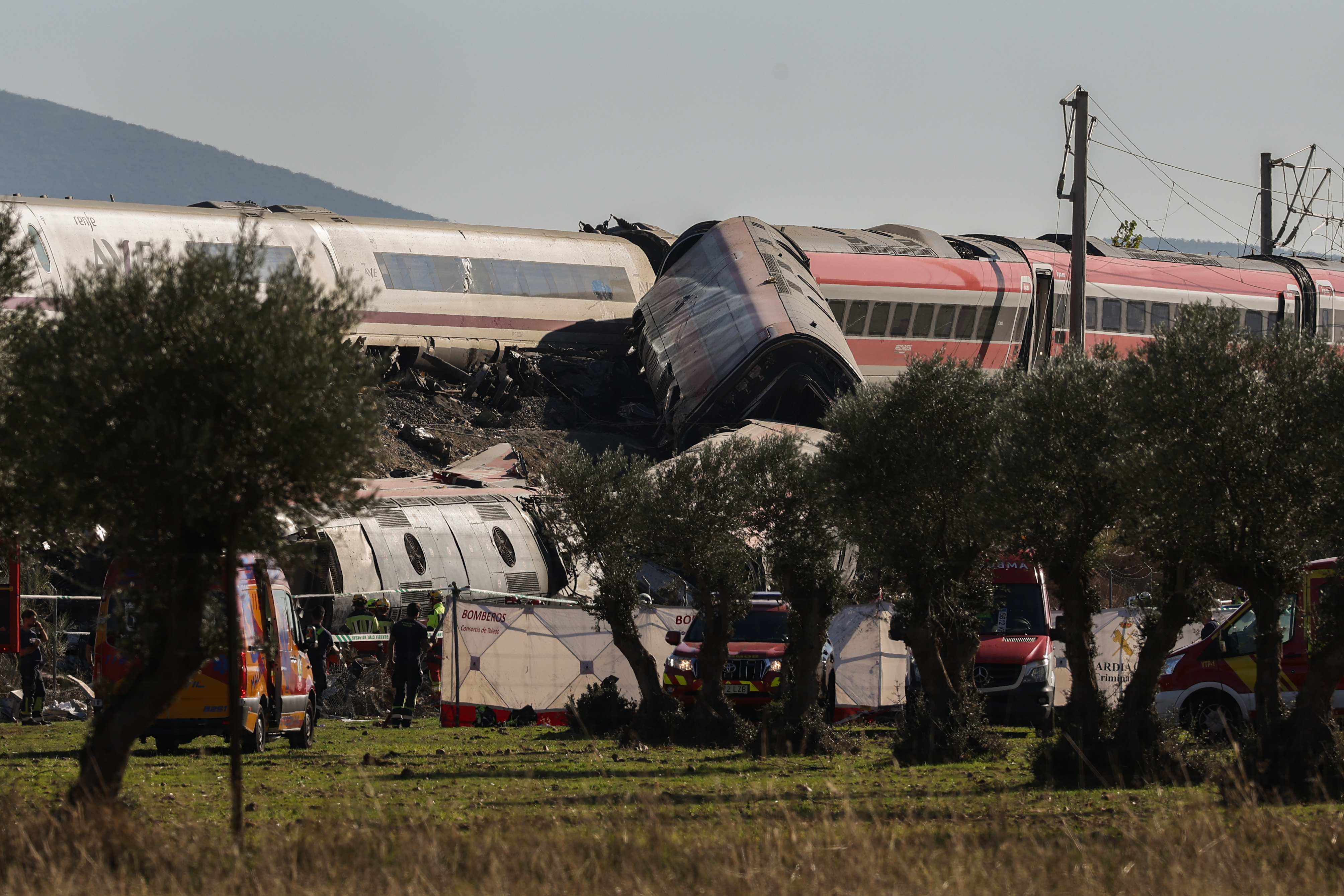
The investigation into the Urda railway accident (Toledo), which this Wednesday, October 28, has left at least 68 dead according to the provisional toll released during the afternoon, is focusing on the 17 minutes elapsed between the authorization for an AVE train from Renfe to resume its journey and its collision with an Iryo train that remained stopped on the same line. The sequence begins with a computer failure of the LZB safety system and continues with a decision made from the Adif control center that the Minister of Transport, Óscar Puente, has publicly questioned.

Urda railway accident
What happened before the collision and how the casualty toll evolved
Select a moment to consult the provisional reconstruction.
The collision occurred around 8.53 a.m. The AVE had left Madrid-Puerta de Atocha at 8.00 bound for Seville and was carrying 378 passengers; on the Iryo there were 147 passengers and five crew members, according to the data provided by the companies and the authorities.
How the Urda accident happened, minute by minute
The reconstruction offered by the Ministry of Transport allows four decisive moments to be identified. Around 8.30 a.m., a computer failure affects the LZB system on the Madrid-Seville line, which causes the stoppage of six trains on a stretch of more than 60 kilometers. The Adif control center in Madrid-Atocha then takes charge of managing traffic.
At 8.36 a.m., the control center authorizes the AVE to resume its journey. As Óscar Puente explained, the train continues despite the system outage and the existence of a red signal. During the 17 minutes that follow, it travels approximately 25 kilometers, until it reaches the stopped Iryo at the entrance to Urda, around 8.53 a.m.
This sequence is provisional and must be contrasted with the circulation records, the communications and the equipment of both trains.
What the LZB system is and why its failure does not by itself explain the crash
LZB is a railway protection system that continuously monitors train traffic and speed. Its function is especially relevant on high-speed lines, where braking distances require protection mechanisms that complement the actions of the driver.
As the spokesperson for the Institute of Engineering, José María Pérez Revenga, explained on TVE, when the LZB stops working, alternative traffic procedures must be applied, based on lateral signaling and the instructions of the control center.
In Urda, the fault did not initially cause the trains to move forward uncontrolled, but rather their stoppage. The investigation is focused on what happened afterward, when the AVE was authorized to continue.
The authorization by Adif, at the center of the investigation
The Minister of Transport, Óscar Puente, has described as "inconceivable" a rear-end collision between two high-speed trains. After the fault, according to his account, the control center "orders or authorizes" the AVE to "resume its journey normally".
Puente has confirmed that the worker who authorized the movement has been identified. The investigation must determine what information he had available, what instructions he conveyed to the driver, and what protocols were applicable. The identification of that employee does not mean that there is proven individual responsibility.
The 17 minutes that investigators must clarify
Between the authorization at 8:36 and the impact at 8:53, 17 minutes elapsed. During that interval, the AVE traveled approximately 25 kilometers. Investigators will have to verify the communications between the control center and the drivers, the existing signals, and the possibilities of detecting the presence of the stopped Iryo.
It will also be necessary to consult the technical records of Adif and of the trains to establish whether there was a communication, interpretation, or operational error. It has not yet been established that the cause was exclusively human error.
How the victim toll has evolved
As emergency services accessed the most damaged areas, the provisional toll kept rising. The first reports counted at least ten dead; later 30 were reported, then 64 and finally at least 68, according to the data released during the afternoon.
The evolution reflects the moment when the victims were counted, not necessarily the time when the deaths occurred. According to the Government of Castilla-La Mancha report cited by RTVE, 53 people remained hospitalized, 15 of them in serious condition. The figures are subject to updating.
What remains to be clarified about the causes
The investigation will have to determine the origin of the computer failure, check which procedures were activated after the trains were stopped, and reconstruct the instructions given to the AVE. It will also have to establish what information Adif had about the position of the Iryo and why the collision was not avoided.
The Prime Minister, Pedro Sánchez, has promised to go "to the very end" in clarifying the causes. For now, the two central facts are the failure that stopped the convoys and the subsequent authorization that allowed the AVE to continue. The full causal relationship and responsibilities remain pending investigation.