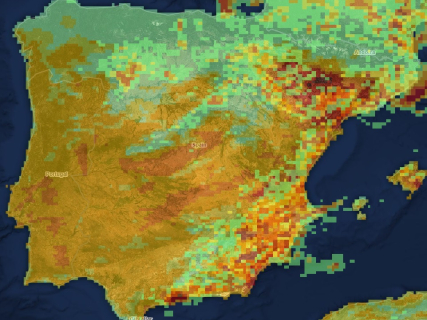
Copia de Map of fires in Spain today, August 21: Las Hurdes improves and a new fire in the Sierra Calderona concentrates attention

The fire in Pinofranqueado is evolving favorably and allows for the flexibilization of some security measures, while a fire declared between Segorbe and Gátova keeps a wide extinguishing device activated.

5 minutes

mapa incendios 21 agosto

mapa incendios 21 agosto

Add DEMÓCRATA to Google

Ask FREN

Published

Last updated

5 minutes

Most read

The wildfire map of this Friday reflects a change in the main hotspots of Spain. The fire in Pinofranqueado, in the Cáceres region of Las Hurdes, continues with extinguishing work, although its favorable evolution has allowed for the lifting of some restrictions and the authorization of the return of some neighbors.

The main novelty is found in the Sierra Calderona, where a wildfire declared between Segorbe and Gátova concentrates the attention of emergency services. The fire, originated after a lightning strike, has forced the activation of situation 1 of the Special Plan against the Risk of Wildfires.

Official map of active fires from Copernicus

The European Forest Fire Information System, EFFIS, offers a public viewer to locate fires, heat points, and burned areas in Spain and the rest of Europe.

The map allows observing the perimeters detected by satellite, but the appearance of a heat point does not necessarily mean that there is an active wildfire. To know the official status of each emergency, the autonomous services of 112 and extinction must also be consulted.

Pinofranqueado improves and relaxes safety measures

The fire in Pinofranqueado remains active, but shows a more favorable evolution than during previous days. The improvement has allowed for the authorization of the return of the neighbors of Robledo, Castillo, and Avellanar, as well as lifting the confinement that affected Nuñomoral.

The device maintains surveillance over the perimeter and continues working in the sectors that still require consolidation work. The evolution of the wind will continue to be one of the determining factors to avoid possible reactivations.

A fire caused by lightning activates the emergency in the Sierra Calderona

The main new hotspot is located between Segorbe, in Castellón, and Gátova, in Valencia, in a forest area near the Natural Park of Sierra Calderona. The fire was declared during a storm episode and its origin is linked to the fall of a lightning strike.

The emergency has forced the activation of situation 1 of the special wildfire plan and the deployment of ground and aerial resources. The CV-25 road remains affected by the operation, while teams work in a difficult-to-access area and remain attentive to the meteorological evolution.

Las Peñas de Riglos remains stabilized and maintains restrictions

The fire in Las Peñas de Riglos, in Huesca, remains stabilized after ten days of emergency. The improvement has allowed for the progressive return of the evacuated population and reduced the level of extraordinary response.

However, the fire is still not extinguished. The operation continues to work on the affected perimeter and the Government of Aragón maintains access restrictions in certain areas while surveillance and consolidation work is completed.

Aldea del Fresno maintains a favorable evolution

The fire in Aldea del Fresno, in the Sierra Oeste de Madrid, continues stabilized and has left behind the situation of greater emergency. The confinements and evacuations adopted during the first hours have already been lifted.

The teams are maintaining surveillance and finishing work on the ground to eliminate possible hot spots. The favorable evolution allows for a reduction in pressure on the device, although the fire remains under monitoring until the extinction work is completed.

Niebla is controlled after the great emergency in Andalucía

The fire in Niebla, between Huelva and Sevilla, has been declared controlled after nearly two weeks of work. The fire was one of the major forest hotspots in August, but its favorable evolution has allowed for a transition from the emergency phase to surveillance work.

The teams are now maintaining perimeter monitoring and the necessary tasks to prevent re-ignition until it can be definitively declared extinguished.


To know the specific situation of a municipality, these sources should be used:

  • EFFIS-Copernicus: satellite location, perimeters, and hot spots.
  • Protección Civil: emergencies and state deployment.
  • DGT: closed or affected roads.
  • AEMET: daily fire risk level.
  • Autonomous services of 112: official status of each fire, evacuations, and confinements.

Searcher: check the fire risk today in your municipality

Enter the name of your municipality in the searcher to know the level of forest fire risk forecasted today according to AEMET. The searcher is updated daily and shows the situation in over 8,000 Spanish municipalities through the Forest Fire Danger Index (IPIF).

↔ Slide the table sideways to check all days.

Slide the table sideways to check all the days.

The system classifies the risk into six levels:

  1. Very low.
  2. Low.
  3. Moderate.
  4. High.
  5. Very high.
  6. Extreme.

Each municipality appears classified according to the predominant level expected for that day.

How the fire risk map works

The search engine uses the information published daily by the State Meteorological Agency through its *Forest Fire Danger Index (IPIF).

This system combines different meteorological variables that directly influence the possibility of a forest fire starting and spreading, among them:

  • Temperature.
  • Relative humidity.
  • Wind speed and direction.
  • Accumulated precipitation.
  • State of the vegetation.

With all this data, AEMET prepares a forecast map that allows estimating the level of danger present at each point in the national territory.

What each risk level means

The index used by AEMET divides the fire risk into six categories:

  • Very low* and low indicate that the weather conditions are not very favorable for the start of a large fire.
  • The moderate level advises taking extra precautions, especially in activities that may generate sparks or flames.
  • When the risk becomes high, very high, or extreme, the chances of a fire starting and spreading rapidly increase considerably, especially if episodes of intense wind or very high temperatures coincide.

More key points, information and questions with FREN

AI-GENERATED CONTENT

What is the current processing phase of the Special Plan against the Risk of Forest Fires in the Valencian Community and what are the next planned steps?

The Special Plan against the Risk of Forest Fires in the Valencian Community (PEIF) appears in the consulted sources as a plan already approved and fully in force, operationally used by the Generalitat to classify risk, declare pre-emergency levels, and activate civil protection measures. It is not currently subject to a new formal processing (public consultation, public information, or approval of a new text) in the DOGV or the BOE.

Official publications and Generalitat notes treat it as a consolidated instrument, on which recent resolutions and decisions rely. Therefore, the “processing phase” of the PEIF, in the strict sense, is that of a plan already approved, in force, and in ordinary use, not a draft pending approval.

1. What do the sources indicate about the status of the Plan?

Several official provisions and communications cite the PEIF as an already existing framework, without referring to it as a project under development:

  • The Resolution of August 5, 2026, published in the DOGV on August 7, 2026, declares pre-emergency level 3 and imposes restrictions and suspensions of activities “within the framework of the Special Plan against the risk of forest fires in the Valencian Community (PEIF).” The full text can be consulted in the DOGV: joint resolution on extreme risk.
  • That same resolution explains that it is the PEIF itself that establishes the pre-emergency levels and links, for example, level 3 to the prohibition of lighting any type of fire in forest lands and influence zones, as well as the possibility of restricting the movement of people and vehicles.
  • Other environmental documents (for example, environmental impact statements) use the PEIF as a reference to classify fire risk in the territory, reinforcing the idea that it is an operational plan already incorporated into the regional planning system.
  • Generalitat notes on prevention and emergencies refer to the PEIF as the basis for planning, risk levels, and action protocols in the Community, without mentioning any open formal review phases.

Overall, this evidence points to the PEIF not being “in processing” as a new plan project, but rather approved, implemented, and applied routinely.

2. Recent actions linked to the PEIF

Although there is no record of a formal plan review procedure in the DOGV, recent actions relying on it are observed:

  • The resolution of August 5, 2026 declares pre-emergency level 3 throughout the Community and activates a broad package of prohibitions and restrictions (movement on tracks and trails, fire use, camping, recreational activities, etc.), explicitly based on the PEIF.
  • In recent emergency communications (for example, fires in Castellón or the Sierra Calderona), it is indicated that situations 1 or 2 of the Special Plan against the Risk of Forest Fires are activated, confirming its use as a current framework.
  • At the same time, the Generalitat has approved agreements and programs (contracts with Vaersa, reinforcement of preventive surveillance, aid to municipalities with local prevention plans, etc.) aligned with the logic of the PEIF, although they are different instruments from the plan itself.

3. Expected next steps

The consulted sources do not record, as of August 22, 2026, a formal announcement of:

  • Start of a complete review of the PEIF.
  • Specific public information procedure on a new regional forest fire plan.
  • Draft decree of the Consell to approve a completely new PEIF.

However, the State Basic Guideline for civil protection planning against forest fires, in force since April 2026, grants autonomous communities several years to adapt their special plans. In this context, and considering the experience of other Autonomous Communities, the reasonably expected steps in the Valencian Community would be:

  • An internal technical review of the PEIF to harmonize terminology, emergency levels, and procedures with the new state basic guideline.
  • Updating risk mapping, fire scenarios, and available resources, incorporating lessons learned from recent major fires.
  • If the review is substantial, processing a new Consell agreement approving the revised version of the PEIF and its publication in the DOGV; possibly including a prior public information phase, although this depends on how the Generalitat configures the file.

In any case, with the available information, these steps should be understood as reasonable forecasts derived from the state framework and comparative practice, not as procedures already convened or officially scheduled for the Valencian PEIF.

4. Summary

In summary, the Special Plan against the Risk of Forest Fires in the Valencian Community is currently in a phase of validity and application, not in the initial approval phase or public information of a new text. The most recent DOGV resolutions use it as a basis to declare pre-emergency levels and adopt restrictions, and no new processing of the plan itself has been found in the official journals. The next steps will likely involve its technical adaptation to the state basic guideline and, if applicable, the approval and publication of a revised version by the Consell.

What specific competencies does the Military Emergency Unit have in forest fire extinction according to current regulations?

The current regulations configure the Military Emergency Unit (UME) as an extraordinary state resource for intervention in civil protection emergencies, including serious forest fires, with functions mainly of support and reinforcement to the ordinary extinction services of the Autonomous Communities, and with a directive role only in very qualified cases of national interest.

Firstly, the Law 17/2015, of July 9, on the National Civil Protection System recognizes the UME as a public emergency intervention and assistance service, integrated into the National Civil Protection System and linked to the mission of the Armed Forces to preserve the security and welfare of citizens in cases of serious risk, catastrophe, or calamity. The Law positions the UME as the main collaboration structure of the Armed Forces with other Administrations in civil protection, and foresees that, when an emergency is declared of national interest, the UME may assume the Operational Direction of the emergency under the authority of the Minister of the Interior.

The Royal Decree 399/2007, of March 23, approving the UME Intervention Protocol, specifies the situations in which it can be activated: it expressly includes forest fires among the serious emergencies justifying its intervention, along with floods, earthquakes, extreme weather phenomena, technological risks, or terrorist attacks. This protocol establishes that:

  • The UME intervenes when ordered, in serious emergencies, and its actions focus on safeguarding the life and integrity of people, their property, the environment, natural spaces, and historical-artistic heritage.
  • Its operational actions are focused on planning, training, and intervention, performing only strictly necessary prevention tasks to face an already declared emergency; ordinary structural prevention remains with the autonomous and local services.
  • The order to intervene corresponds to the Minister of Defense, by delegation of the President of the Government, at the proposal of the Minister of the Interior.
  • The competent civil protection authorities of the Autonomous Communities and other Administrations may request the Ministry of the Interior for UME collaboration; Interior assesses the emergency's dimension and, if appropriate, formally requests the Ministry of Defense to activate the unit.

The Order DEF/160/2019, of February 21, on the organization and functioning of the UME reinforces this framework by specifying that:

  • The UME is a joint emergency intervention force, organizationally dependent on the Minister of Defense, and its operational actions are governed by the aforementioned Intervention Protocol.
  • When acting in civil protection, its missions are oriented to immediate intervention throughout the national territory, with permanent availability, to contribute to the security and welfare of citizens.
  • In case of a declared emergency of national interest under Law 17/2015, the UME must be prepared to exercise the Operational Direction under the political direction of the Ministry of the Interior.

In the specific field of forest fires, the State Civil Protection Plan for Emergencies due to Forest Fires, approved by Resolution of October 31, 2014, integrates the UME within the so-called “extraordinary state resources”. The Plan foresees that:

  • The UME intervenes when the Autonomous Community's own resources are insufficient, or when circumstances of special severity or national interest concur.
  • The UME is incorporated into the command structure through the Integrated Operational Command and the Integrated Operational Coordination Center (CECOPI), where its actions are coordinated with the autonomous extinction services and other state resources.
  • In fires affecting several Autonomous Communities or requiring extraordinary state resources, a Single Extinction Command (MUE) may be designated, in whose structure the UME commands integrate alongside the autonomous responsible authorities.

In summary, the current regulations establish that the UME does not assume the ordinary competence of forest fire extinction —which corresponds to the Autonomous Communities and, within their scope, to local entities— but acts as an extraordinary state resource to:

  • Intervene immediately in serious and complex forest fires, especially when there is risk to people, critical infrastructures, or large natural areas.
  • Reinforce and support the autonomous and local extinction services with specialized military capabilities and great logistical capacity.
  • Assume the Operational Direction in emergencies of national interest within the National Civil Protection System, always under the political direction of the Ministry of the Interior and in close coordination with the competent autonomous authorities.
Can you detail how the UME is operationally coordinated with the autonomous extinction services during a large forest fire? What exactly constitutes an “emergency of national interest” and how does it affect the role of the UME in forest fires? What differences does the regulation establish between ordinary and extraordinary resources in fighting forest fires?

What requirements must be met for situation 2 of the Special Plan against the Risk of Forest Fires to be activated in an autonomous community?

Situation 2 in the Special Plans against the Risk of Forest Fires of the autonomous communities is based on a common framework defined by the State Basic Guideline (Royal Decree 893/2013, still essentially applied for this point) and by the State Civil Protection Plan for Emergencies due to Forest Fires. On that basis, each community then specifies its own criteria, but the essential features are very similar throughout the territory.

Placement of situation 2 in the level scale

Autonomous plans usually contemplate, at minimum, four operational emergency situations:

  • Situation 0: fires that only affect or are expected to affect forest assets, controllable with ordinary local or autonomous means.
  • Situation 1: fires that may seriously affect forest assets and, to a limited extent, population or non-forest assets, but remain manageable with the community's means (although additional state support may be requested through usual channels).
  • Situation 2: fires with serious risk to the population and non-forest assets, requiring immediate civil protection measures and possibly needing extraordinary state resources or leading to a national interest scenario.
  • Situation 3: emergency already declared of national interest, assumed by the State (Minister of the Interior) as the highest directing authority.

Typical requirements to activate situation 2

Autonomous plans, following the Basic Guideline for civil protection planning of forest fire emergencies, define situation 2 based on several groups of criteria. In summary, these elements are usually required:

  • Severity of risk to people:
    • That one or more fires, in their foreseeable evolution, may seriously affect the population (inhabited nuclei, urbanizations, isolated homes, campsites, tourist areas, etc.).
    • Need to adopt immediate protection and relief measures: evacuations, confinement, sheltering people, emergency medical assistance, psychosocial support, etc.
  • Affectation to non-forest assets:
    • Serious risk to critical or strategic infrastructures (main roads, power lines, fuel depots, industrial facilities, communication networks, water supplies).
    • Danger of significant damage to heritage or economic assets (tourist facilities, agricultural and livestock operations, industrial parks, or essential equipment).
  • Need for extraordinary resources:
    • That, in the autonomous community's judgment, the fire cannot be adequately addressed only with its ordinary extinction and civil protection means.
    • That the incorporation of extraordinary resources is necessary or very likely, for example:
      • Military Emergency Unit and other Armed Forces resources.
      • State extinction resources outside their preferred area of operation.
      • Resources from other administrations without prior agreement, mobilized through the State Plan.
      • Even international resources, channeled through the EU Civil Protection Mechanism or bilateral agreements.
  • Possible derivation to national interest:
    • That the magnitude, territorial extension, simultaneity of fire fronts, or potential impact of the fire may lead to an emergency of national interest, which would open the door to moving to situation 3.

Authority that declares situation 2

The Basic Guideline establishes that the qualification of the operational situation (0, 1, or 2) corresponds to the competent body of the autonomous community, according to its own Special Plan. In practice, it is usually:

  • The director of the Autonomous Community Plan against the risk of forest fires (normally a ministry with competencies in interior, security, or civil protection).
  • Supported by the operational coordination center (CECOP/CECOPI) and by the technical extinction management.

This authority may modify the qualification (raise from 1 to 2 or lower from 2 to 1) as the emergency evolves. Situation 3, however, is only activated when the Minister of the Interior declares the emergency of national interest.

In summary, situation 2 is reserved for forest fires with real or imminent serious impact on people and non-forest assets, which require fully deploying the autonomous civil protection system and, likely, resorting to extraordinary resources from the State or other territories.

Play

Test your knowledge with FREN!

How much do you know about this topic? Answer the following 3 questions.

What area has been affected by the forest fire near the Sierra Calderona that has caused the evacuation of Gátova?

Question 1 of 3

Which system offers a public viewer to locate fires and hotspots in Spain and Europe?

Question 2 of 3

What risk level does the Forest Fire Danger Index (IPIF) indicate when conditions are unfavorable for a large fire to start?

Question 3 of 3

Hola, soy Fren. ¿Cómo te ayudo?