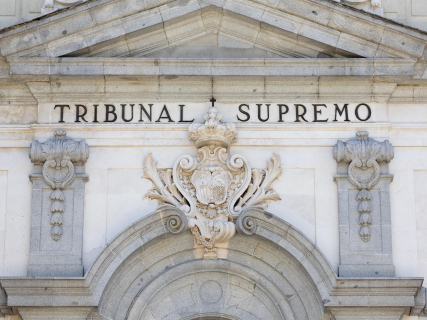

The Vacation Chamber of the Supreme Court issued on Saturday an order rejecting the precautionary measure proposed by three senators of the Popular Parliamentary Group, representing the party, regarding the absence of several ministers in the Senate during the month of August following the migratory crisis unleashed in Ceuta.
The court reasons, among other points, that "in view of the allegations made, it is not deemed appropriate to grant the precautionary measure requested inaudita parte, since the special urgency legally required to proceed in this manner with the sacrifice of the right to be heard of the opposing party has not been proven."
"In particular --adds the order--, it is not sufficiently justified that the parliamentary control that the appellants link to the effective exercise of their 'ius in officcium' as senators, recognized in article 23.2 of the Constitution, must necessarily occur, to be effective, within the extraordinary period of the month of August (of which only one week remains), considering that the resolution of the precautionary measure through its ordinary procedure will not be excessively delayed."
The judicial resolution emphasizes that "no reason is offered to justify that the appeal would lose its legitimate purpose of safeguarding or protecting the fundamental right whose violation is invoked, the right to exercise the representative office that the condition of senator entails, to which the power of government control is inherent, solely by the circumstance that such control could be carried out after the precautionary measure is substantiated with the hearing of the opposing party."
"Above all because it is not observed that the public interest in the substantive issue that, according to the allegations, underpins the requests for appearance convened, focused on the serious migratory crisis that the Autonomous City of Ceuta has been suffering in recent days, will disappear," it adds.
The Chamber concludes that "in weighing the interests at stake, therefore, the special urgency that would justify sacrificing the right to be heard of the opposing party prior to the adoption of the precautionary decision, which would also be immediately enforceable, does not occur, so that this right to be heard could turn out to be merely illusory, which, if applicable, requires greater justification of the genuine urgency of the measure requested."
Consequently, the Supreme Court dismisses the request for an urgent precautionary measure and orders that the precautionary incident be processed through the ordinary channel, with the intervention of the opposing party, granting a period of ten days to the State Attorney's Office to present its allegations.
The order also emphasizes that the ruling is strictly limited to the issue of the urgent precautionary measure and does not imply any advance opinion on jurisdiction, competence, or the admissibility of the main procedure.