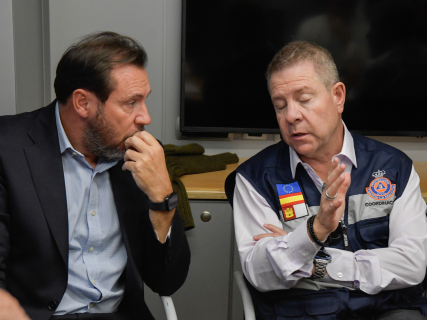

Óscar Puente arrived at the Ministry of Transport in November 2023 with a political career built in Valladolid and a notable profile within the PSOE.
His intervention during the investiture debate of Alberto Núñez Feijóo had made him one of the party’s most visible leaders. Three years later, his name is associated with a railway crisis that goes beyond the usual political controversies.
The accident in Urda, in Toledo, is added to that of Adamuz, still under investigation, and places the minister before one of the most difficult moments of his career.
The contrast is significant. The leader who had gained prominence for his ability to confront the opposition now heads a department on which technical decisions, multimillion-euro investments, large public companies and services used daily by millions of citizens depend. A ministry in which political communication has limited importance when a railway line is interrupted, incidents pile up, or a tragedy occurs.
Puente also received, moreover, a particularly delicate portfolio. Transport had been headed by José Luis Ábalos, whose period later came under judicial investigation for alleged irregularities in public contracts.
The investigations linked to his entourage and to the awarding of works and supplies have cast a long shadow over a department that handles an essential part of Spanish public investment.
Puente’s arrival represented, in that context, an opportunity to renew the political and administrative leadership of the Ministry. His record, however, is today conditioned by the evolution of the railway network, by the questions raised by the accidents and by the criteria used to reorganize the teams responsible for the infrastructures where the political character weighs more than the technical one.
From Valladolid to Madrid: the rise of a combative leader
Óscar Puente was born in Valladolid in 1968, studied Law and developed much of his career in municipal politics.
Óscar Puente’s arrival at the Ministry of Transport was not his first experience in national politics.
Mayor of Valladolid from 2015 until 2023, he was one of Pedro Sánchez's main supporters in the 2017 Socialist primaries. After his victory, the president appointed him spokesperson for the Federal Executive of the PSOE, a post he formally held until October 2021, although he had long been away from the party's front line of communication.
His departure coincided with the reorganization of Ferraz driven by Sánchez, who placed Felipe Sicilia in the spokesperson role.
Puente had previously announced his intention to run for the Provincial Secretariat of the PSOE of Valladolid. Two years later, Sánchez brought him back into national politics: first, by entrusting him with the reply to Feijóo during his failed investiture of September 2023 and, later, by appointing him Minister of Transport.
A ministry marked by the legacy of Ábalos
Puente arrived at a department that had gone through several political stages since Pedro Sánchez's first Government.
José Luis Ábalos was minister between 2018 and 2021. He was succeeded by Raquel Sánchez, until Puente's arrival in November 2023.
The Ministry's trajectory was affected by the judicial investigations related to Ábalos's period, especially by the alleged irregularities in public contracts. His judicial situation constitutes one of the most serious episodes in the recent history of the portfolio.
To that context are added the political controversies and the investigations relating to certain business operations, public aid and administrative decisions, among them those related to Plus Ultra and Air Europa.
The relevant question for Puente's period is what changes he introduced in the organization of the Ministry, with what criteria the appointments were made, and to what extent the renewal of its teams strengthened the technical capacity of the bodies responsible for infrastructure.
Cercanías, the daily wear and tear of Transport
Before Adamuz and Urda, railway management already represented one of the minister's main sources of wear and tear.
The problems of Cercanías, particularly in Madrid, had acquired a political dimension because of their daily impact. Breakdowns, delays, service interruptions, infrastructure incidents and disruptions to traffic have repeatedly pitted the Ministry against the Community of Madrid.
The Madrid president, Isabel Díaz Ayuso, has on various occasions blamed the central Government for the deterioration of the service, while Transportes has defended its investments and has attributed part of the incidents to modernization works and to problems accumulated over years.
Behind that controversy lies an issue that directly affects users: the difference between announcing investments and getting the service to function regularly.
Renfe manages the provision of the rail service, while Adif administers the infrastructure. That distribution of functions obliges the coordination of decisions on circulation, maintenance, works and traveler service.
Puente's management has also been subject to controversies in other areas of Transportes, from the state of the roads to airport infrastructures. However, it has been railways that have concentrated the greatest political problems of his term.
From controversies on social networks to jokes about Renfe on television
Óscar Puente has made social networks one of his main instruments of political communication. A regular in the controversies in X, where he responds directly to adversaries and critics, the minister has also not renounced humor to refer to the problems of the rail service. The most recent episode occurred just a week ago, during the promotion of his participation in Cara al Show, the program presented by Marc Giró on laSexta.
In a video released on October 19, Puente appeared inside a fictitious elevator that suffered a breakdown. When a voice announced that it would remain stopped longer than usual, the minister responded: "Vaya por Dios. As if we didn't already have enough with Renfe". Afterwards, the elevator resumed functioning and Puente ended up dancing with the presenter. The minister himself shared the recording on his X account with another comment: "If I survive this...".
Si sobrevivo a esto… pic.twitter.com/ft6oxK4veq
— Óscar Puente (@oscar_puente_) October 19, 2026
The scene sparked criticism, especially among family members and those affected by the Adamuz accident, which occurred in January. Mario Samper, president of the Adamuz Derailment Victims Association, reproached the minister for his lack of sensitivity when the investigations into a tragedy that left 46 dead were still open.
The subsequent Urda rail collision has brought those images back into the news and has reopened the debate over Puente’s public tone. His ease with political confrontation and his casual interventions now contrast with the gravity of the problems facing his department.
Adamuz and Urda: two tragedies under the same minister
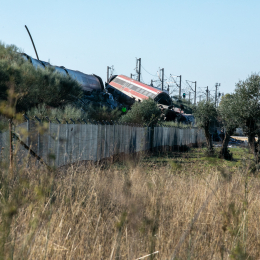
The Adamuz accident, which occurred in January 2026, opened an investigation into the technical and operational circumstances of the accident. Its definitive conclusions are still pending.
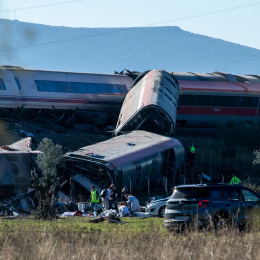
Now, the collision between an AVE from Renfe and a train from Iryo in Urda has once again placed railway safety at the center of the debate.
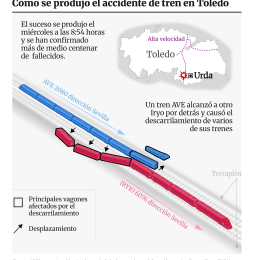
In his appearance this Wednesday, Puente described a sequence that he considers difficult to explain: a failure in the LZB protection system, the automatic stopping of several trains, and a subsequent authorization from the Adif control center in Atocha for one of the trains to resume its journey.
The Renfe train ended up hitting the Iryo, which remained stopped on the same track.
The minister has described as inexplicable the authorization to resume circulation in those circumstances. His reconstruction points to an erroneous decision by the control center, but the investigation will have to determine how it occurred, what protocols were in force and what safety barriers should have prevented the collision.
The distinction is fundamental. A human error can be part of the causal chain of an accident, but it does not in itself rule out the need to analyze the functioning of technical systems, supervision, training and circulation procedures.

The technical question: what should have happened when the LZB failed?
According to the sequence provided by Puente, the LZB system stopped working around 8:30 a.m. The incident affected a stretch of about 63 kilometers and caused the trains traveling on it to stop.
From that moment on, the Atocha control center took over traffic management.
At around 8:36 a.m., according to the minister, Renfe's AVE was authorized to resume its journey. The convoy traveled approximately 25 kilometers before catching up with the Iryo train.
Puente has explained that that authorization should not have been granted under normal conditions because the track was occupied and there was restrictive signaling. He has also pointed out that, in the circumstances described, a limited circulation mode should have been applied, known as "marcha a la vista", with a maximum speed of 40 kilometers per hour.
According to the experts consulted by DEMÓCRATA, the technical question is therefore not limited to identifying the person who transmitted the authorization. It is necessary to know what backup system was available, how the alternative circulation regime was established, and what checks were carried out before allowing the AVE to continue its journey.
They also add that it will be necessary to determine whether the on-board protection devices were operational, what information the drivers received, and what records the signaling and control systems retain. Therefore, our sources maintain, the investigation will have to reconstruct the complete chain of decisions, so that attributing the accident exclusively to human action before having that reconstruction would be to anticipate a conclusion that still belongs to the investigators, especially when judicial actions are underway.
The 780 million for modernization and the pending ERTMS
The Urda crisis has brought attention back to a project begun long before Puente's arrival at the Ministry: the modernization of the Madrid-Seville high-speed line, inaugurated in 1992.
The renewal program is valued at some 780 million euros and includes work on the track, structures, electrification, telecommunications, and safety systems.
One of its fundamental objectives was to progressively replace the LZB system with ERTMS level 2, the European standard for railway signaling and protection.
The Government authorized in November 2020 the bidding for the safety installations, with a planned deadline of 52 months. The contracts were awarded in 2021, but the new system had still not fully entered service in October 2026.
The official documentation sent to Congress in February of this year confirmed that the implementation of ERTMS was still in progress and that LZB remained operational.
This delay introduces a relevant question for Puente's record. Although the project began under his predecessors, the minister has been at the helm of Transport for almost three years and the replacement of the safety system was still pending when the accident occurred.
The changes in the management of Renfe and Adif during the Puente period
Since his arrival at the Ministry of Transport, in November 2023, Óscar Puente has introduced changes in the management of Renfe, Adif and other bodies dependent on his department. The changes have affected both officials appointed during previous periods and executives designated by the minister himself.
One of his first appointments was that of José Antonio Santano as Secretary of State for Transport, replacing David Lucas. Santano, a law graduate, had been the Socialist mayor of Irún for more than two decades.
At Adif, Puente replaced María Luisa Domínguez, a civil engineer, with Ángel Contreras, also an engineer. Contreras was dismissed in September 2024, after a summer of numerous railway incidents and while reports were being published about his contacts with Koldo García, former adviser to José Luis Ábalos.
The Ministry expressly dissociated his dismissal from those reports and appointed in his place Luis Pedro Marco de la Peña, a civil engineer and former vice-minister of Infrastructure and Transport of the Basque Government.
At Renfe, Puente initially kept Raül Blanco, who left the presidency in January 2025 citing personal reasons. His replacement was Álvaro Fernández Heredia, a civil engineer, former manager of Auvasa, the municipal bus company of Valladolid during Puente's mayoralty, and later a councillor for Más Madrid.
During his presidency, other executives from public administrations were brought in, among them Josep Enric Garcia Alemany, former manager of EMT Valencia; Nacho Padilla, with experience in the city councils of Madrid and Barcelona; and Reyes Montiel, with a political career on the left. These appointments were the subject of critical reports in El Confidencial, while Renfe defended that those selected met the established requirements.
The changes also reached the structure of the Ministry. Puente appointed Rafael Guerra Posadas deputy secretary, previously in charge of the Legal Advisory Office of the Valladolid City Council, and replaced Álvaro Rodríguez Dapena at the head of Puertos del Estado with Gustavo Santana. According to Diario del Puerto, in May 2025 more than a dozen changes had taken place in top-level positions since the minister’s arrival.