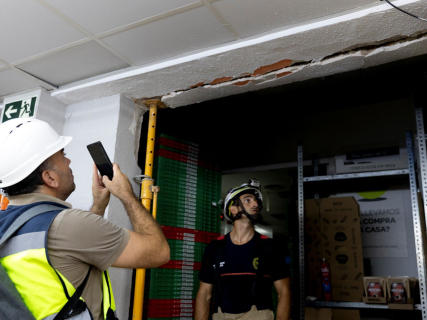

The professor of Building at the University of Granada (UGR) Javier Lafuente points to new construction techniques, such as hydraulic systems that function as shock absorbers and energy dissipators, to reinforce the safety of buildings against seismic movements
These systems act like the pistons of a vehicle, absorbing and dissipating the telluric energy so that the structures do not collapse, and could be measures to incorporate into building protocols to thus reinforce the safety of buildings in areas sensitive to seismic activity, such as Spain, and more specifically Andalusia, Murcia, and a good part of the Spanish Levant.
In statements to Europa Press, Lafuente highlights that the construction of Granada capital and the metropolitan area has responded "very well" to the sequence of earthquakes that began on August 14 because the buildings have been erected since the 1970s taking this reality into account. "We must remain calm," emphasizes this professor from UGR.
In fact, any construction project in Granada starts, first of all, with a geotechnical study of the land, followed by a foundation on a concrete slab and not on individual pillars. An anti-seismic construction system that gives "certain elasticity" to the constructions so that they "do not collapse." That a building sways when there is an earthquake is, therefore, a good sign, explains Professor Lafuente.
Review protocols for greater safety
The president of the Junta de Andalucía, Juanma Moreno, emphasized this Thursday that "the province of Granada is the province where the most seismic activity occurs in all of Spain" and stressed that "it will have to be prepared even more and better so that if a larger scale earthquake occurs, the consequences are as minimal as possible."
Moreno announced that "the protocols" will be reviewed and highlighted that "fortunately, since 2003 - after the Lorca earthquake (Murcia) - there has been anti-seismic regulation in construction with which buildings have been built since that year with seismic resistance capacity," although he also committed to "reinforce everything so that over the next few years we can have, if possible, even more safety."
At this point, Professor Lafuente points out that the Spanish protocol will have to adapt to the European building code that seeks to "standardize" the way of building throughout Europe, where Spain and Italy are the two countries with the highest seismic risk.