When school starts in each community: school calendar 2026-2027

The school calendar 2026-2027 starts this Friday in Navarra and will continue in a staggered manner until September 15. These are the dates for returning to school and to the institute in each autonomous community.

3 minutes

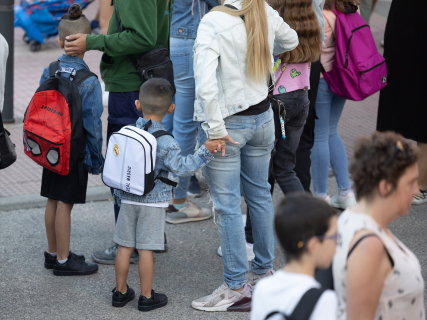
EuropaPress 6199213 varios ninos esperan entrar colegio primer dia curso escolar septiembre

EuropaPress 6199213 varios ninos esperan entrar colegio primer dia curso escolar septiembre

Add DEMÓCRATA to Google

Ask FREN

Published

Last updated

3 minutes

Most read

The school year 2026-2027 starts this Friday, September 4, in Navarra. Its students of ESO and Bachillerato are the first to return to the classrooms, while Navarra schools can set the start of Infantil and Primaria between the 4th and the 8th.

The majority of the more than eight million students in non-university education will return to class during the next week. There is no single date for all of Spain: each autonomous community approves its calendar and, in several territories, differentiates the start according to the educational stage.

The return to school will extend until Tuesday, September 15. On that day, classes for ESO and Bachillerato will start in Andalusia and, with some exceptions, in Castilla y León.

When classes start in each autonomous community

Madrid and the Basque Country will be the next territories to start the school year. Students in Madrid of Infantil, Primaria, and Special Education will return on Monday, September 7, while ESO and Bachillerato will start on Tuesday, the 8th.

Castilla-La Mancha, Catalonia, Ceuta, and Aragón will also concentrate a good part of the return to the classrooms on September 8. In Aragón, however, Bachillerato students will start a day later.

Autonomous community Infantil and Primaria ESO and Bachillerato
Navarra Between September 4 and 8 September 4
Basque Country September 7 September 7
Community of Madrid September 7 September 8
Castilla-La Mancha September 8 September 8
Catalonia September 8 September 8
Ceuta September 8 September 8
Aragón September 8 ESO: September 8
Bachillerato: September 9
Cantabria September 8 September 9
Region of Murcia September 8 September 10
Asturias September 9 September 9
Comunitat Valenciana September 9 September 9
Galicia September 9 September 9
La Rioja September 9 September 9
Melilla September 9 September 9
Canarias September 9 ESO: September 10
Bachillerato: September 11
Castilla y León September 9 ESO in Primaria centers: September 9
Rest of ESO and Bachillerato: September 15
Extremadura September 10 September 10
Andalusia September 10 September 15


The communities that return to school earlier

Navarra opens the national calendar. The community allows each school to set the start of Infantil and Primaria between September 4 and 8, but establishes the 4th for ESO and Bachillerato.

The Basque Country sets the start from September 7, although the centers have leeway to specify their calendar. That same Monday, the students from Madrid in Early Childhood and Primary will return.

September 8 will be one of the days with the most incorporations. Classes will begin in Castilla-La Mancha, Catalonia, and Ceuta, as well as in various stages of Aragon, Cantabria, and Murcia.

Andalusia and Castilla y León, the last to start

The latest return corresponds to a part of the students from Andalusia and Castilla y León.

In Andalusia, Early Childhood, Primary, and Special Education begin on September 10. Students in ESO, Baccalaureate, and Vocational Training will have to wait until Tuesday the 15th.

Castilla y León also sets September 15 for the majority of Secondary and Baccalaureate students. The exception is the ESO students enrolled in Primary centers, who start on the 9th. Distance education has its own calendar.

Attention to the dates of Vocational Training and other teachings

The dates in the table correspond to Early Childhood, Primary, ESO, and Baccalaureate. Vocational Training, official language schools, artistic education, adult education, and sports education may start on different days.

There are also variations by centers and municipalities. The regional calendars must include local holidays and non-school days approved by the educational authorities or municipal school councils.

For this reason, families must consult the specific calendar of the center before the start of classes.

More key points, information and questions with FREN

AI-GENERATED CONTENT

What procedures must autonomous communities carry out to officially approve their school calendar each year?

Each autonomous community approves its school calendar through its own administrative procedure, but always following the same scheme: technical drafting of the draft by the education department, consultations and reports from the educational community and legal services, union negotiation, formal approval by the competent body, and publication in the official autonomous bulletin. All of this must comply with the basic state regulations, which set limits such as the minimum number of school days.

From a legal point of view, the common basis is in the Organic Law 2/2006, on Education (LOE), amended by Organic Law 3/2020 (LOMLOE). The fifth additional provision of the LOE, after its reform, establishes that the school calendar is set annually by the educational administrations and must include a minimum of 175 school days in compulsory education. It is a basic state regulation: the communities have room to specify the rest, but they cannot lower that threshold or contradict the general principles.

Furthermore, the royal decrees on minimum teachings — for example, Royal Decree 157/2022 for Primary Education and Royal Decree 217/2022 for Compulsory Secondary Education (ESO) — distribute competencies between the State and the communities regarding curriculum, schedules, and evaluation. Although they do not set the calendar day by day, they condition its design: the autonomous calendar must allow compliance with the minimum teachings, diagnostic evaluations, and the promotion and certification criteria provided in that basic regulation.

Typical phases of the procedure in autonomous communities

Based on that state framework, each community regulates the calendar through an order from the education department or, in some cases, a decree from the Government Council. The typical procedure includes:

  • Internal planning: at the end of the calendar year or at the beginning of the second term of the current school year, the technical services of the department (general directorate of planning or similar) prepare a first calendar draft taking into account:
    • The minimum of 175 school days.
    • The already established state and autonomous holidays.
    • The coordination needs with evaluation tests and with the university or vocational training calendar.
  • Consultation with the educational community: the draft is usually sent to the Autonomous School Council, which issues a mandatory (but not binding) report on the distribution of school days, holidays (Christmas, Easter, summer), and non-school days.
  • Union negotiation: the conditions of service provision by teachers (working days, continuity of school periods, discretionary days, etc.) are negotiated in the education sector table with the most representative union organizations. The students' school days are not directly negotiated, but aspects that condition the schools' calendar are.
  • Internal reports: the final text is submitted to the legal advisory of the department to verify its compliance with the LOE/LOMLOE and autonomous regulations, and, if applicable, to the intervention or budget bodies if the calendar involves measures with economic impact (cafeteria, transport, complementary activities).
  • Formal approval:
    • If it is an order, it is signed by the education minister.
    • If a decree is chosen, it is approved by the Government Council and usually a prior opinion from the Autonomous Advisory Council is sought.
  • Official publication: the calendar comes into effect with its publication in the official bulletin of the autonomous community, which details at least:
    • Start and end dates of classes by educational stages.
    • Holidays and non-school days common throughout the autonomous territory.
    • The decision margin of the schools or provincial directorates to set some discretionary days.

Indicative deadlines and margin of the communities

Although there is no uniform state deadline, the general practice is that the calendar is approved and published between April and June, so that schools can organize enrollment, complementary services, and programming for the following year. Some communities bring it forward to March to facilitate family reconciliation, others close it later if they depend on internal agreements on local festivities.

Within the framework of 175 minimum school days, the specific distribution (length of terms, which week Easter is set, long weekends, discretionary days, etc.) is an autonomous competence. This allows them to adapt the calendar to their climatic reality, traditional festivals, or coordination with neighboring territories, as long as they respect:

  • The students' right to attend compulsory education under equal conditions.
  • Full compliance with the minimum teachings and evaluations provided in the basic regulation.
  • The general rules of administrative procedure (Law 39/2015) and the government laws of each community.

In summary, the procedures combine a technical dimension (calculation of days and coordination of stages), a participatory dimension (reports from the School Council and union negotiation), and a legal-formal dimension (approval by the competent body and official publication), all under the umbrella of the LOE/LOMLOE and the royal decrees of minimum teachings.

What are the competencies of the autonomous Education departments in the preparation of the school calendar?

In Spain, the Education departments of the autonomous communities play a central role in preparing the school calendar, but their competencies are exercised within a basic framework set by the State. That is, they do not decide “from scratch,” but develop and specify general common rules for the entire country.

General framework of competency distribution

The Constitution assigns the State the competence to set the foundations of education, while the autonomous communities assume legislative development and management in their territory. The basic state regulations establish, among other aspects, the minimum number of school days and some general criteria (for example, ensuring a reasonable course duration, compliance with curricula, and coordination with the evaluation calendar).

From this framework, the autonomous Education departments are those that prepare and approve the official school calendar each year for non-university levels (Early Childhood, Primary, Secondary, Baccalaureate, Vocational Training, etc.).

Main competencies of the Education departments

Generally, the departments exercise at least the following competencies regarding the school calendar:

  • Determining the start and end dates of the school year in each educational stage, respecting the minimum school days and basic state criteria.
  • Establishing the distribution of school and non-school periods, that is, setting Christmas, Easter, and other rest holidays, as well as autonomous non-school days.
  • Adapting the calendar to territorial reality (for example, adverse weather conditions, socioeconomic or productive characteristics of the area, such as agricultural or tourist campaigns).
  • Coordinating the calendar between stages and teachings (general regime, artistic teachings, languages, vocational training, adult education), being able to establish differentiated regimes when the nature of the teachings requires it.
  • Regulating, essentially, the school day (although details are usually specified at the school level), in terms of number of daily sessions, general schedules, and possible adaptation to special schedules (school transport, cafeteria, complementary activities).
  • Integrating state, autonomous, and local holidays into the educational calendar, adjusting the course so that both the minimum school days and official holidays are respected.
  • Setting periods for evaluations, tests, and administrative procedures related to academic life (final evaluations, extraordinary calls, enrollment periods, etc.).

Participation of other levels and social dialogue

Although the formal competence to approve the calendar lies with the department, the process usually includes:

  • Consultation or negotiation with teachers' union organizations in education sector tables, since the calendar directly affects working conditions.
  • Reports or opinions from autonomous school councils, collegiate bodies where teachers, families, students, administration, and other social sectors are represented.
  • Coordination with local entities, because municipalities set their local holidays and provide information on specific needs (patron saint festivals, major local events, etc.).

Additionally, many autonomous regulations allow educational centers, through their teaching staff and school councils, to propose certain punctual adaptations (for example, choosing some discretionary days specific to the center), within the margins set by the department.

Limits and coordination with the State

The main limitation to autonomous autonomy is respect for the state foundations, especially the minimum number of school days and the guarantee that the effective teaching time allows compliance with official curricula. The calendar must also be compatible with:

  • Indications from the Ministry of Education in the Sectoral Conference, to maintain a certain basic homogeneity throughout the State.
  • Calendars of tests and evaluations of state or general scope (for example, university access, external evaluations, etc.).

Summary

In summary, the autonomous Education departments are the competent authorities to design and approve the school calendar in their territory: they set the start and end of the course, holidays, school and non-school days, coordinate holidays, and adjust the calendar to their own characteristics. However, they do so within a basic state framework that guarantees common minimums for all students and under consultation and negotiation processes with unions, school councils, and local entities.

What legal requirements must autonomous school calendars comply with according to state regulations?

Autonomous school calendars are approved by each autonomous community, but must conform to a basic framework set by the Constitution and state education regulations, especially Organic Law 2/2006, on Education (LOE), amended by Organic Law 3/2020, and by the royal decrees establishing minimum teachings. This framework conditions both the minimum duration of the course and the general distribution of school and vacation times.

1. Distribution of competencies between State and Autonomous Communities

The Constitution, in its article 149.1.30.a, assigns the State the competence to set the “basic rules for the development of article 27” (right to education), including basic conditions for obtaining degrees and the guarantee of common training. On that basis:

  • The State defines the basic framework of the educational system organization through the LOE and the royal decrees of minimum teachings (for example, Royal Decree 157/2022 for Primary, 217/2022 for ESO, and 243/2022 for Baccalaureate).
  • The autonomous communities, exercising their competencies in education, specify and approve each year the autonomous school calendar, always within that basic framework.
2. Minimum number of school days

The core piece for calendars is the LOE itself, which in its final part (provision on the school calendar, in the wording in force after LO 3/2020) expressly establishes that:

“The school calendar, which will be set annually by the educational administrations, shall include a minimum of 175 school days for compulsory education.”

This is the main direct state requirement:

  • The minimum of 175 school days applies, as a basic standard, to Primary Education and Compulsory Secondary Education.
  • Communities may set more school days, but not fewer, except in very justified exceptional cases agreed within the framework of the Sectoral Conference or other cooperation instruments.
3. School day and distribution of times

The LOE and its regulatory development do not impose a closed model of school day (continuous, split, etc.), but they do condition the organization of school time on several elements:

  • The royal decrees of minimum teachings (RD 157/2022, RD 217/2022, RD 243/2022) set the minimum number of hours per area or subject throughout the stage. The autonomous calendar and schedule must allow covering at least those times.
  • The LOE foresees the autonomy of centers for organizing times and expressly allows the extension of the school calendar or school hours, “under the terms established by the educational administrations and within the possibilities allowed by applicable regulations, including labor regulations,” always without discrimination or requiring contributions from families.
  • The State also introduces material obligations linked to the school day: for example, the LOE, after the 2020 reform, mandates educational administrations to “promote the daily practice of sport and physical exercise by students during the school day,” which conditions the organization of the schedule.
4. Material principles the calendar must respect

Beyond days and hours, the calendar must respect the general principles that the LOE sets as the system's axes (initial articles of the law):

  • Equality of opportunities and non-discrimination: the calendar structure (start and end dates, holidays, evaluations) cannot generate unjustified inequalities among students from different territories or centers.
  • Rights of mothers, fathers, and guardians as primary responsible for their children's education: the design of schedules and school periods must be compatible with family participation and, as far as possible, with reconciliation, although this dimension is mainly developed by autonomous and labor regulations.
  • Attention to the best interests of the child and their integral development: school times must allow a reasonable balance between school workload, rest, and complementary activities.
  • Respect for linguistic competencies: the distribution of times must allow achieving the minimum objectives in official languages established by the State and by each autonomy statute, according to constitutional doctrine.
5. Autonomous margin and limits

Within this basic framework, communities have broad margin to:

  • Decide the specific start and end dates of the course.
  • Set holidays (Christmas, Easter, summer) and their own non-school days.
  • Choose school day models and adjustments in daily schedules.

But that margin is limited by:

  • The state minimum of 175 school days.
  • The obligation to guarantee compliance with the state's minimum teachings and stage objectives.
  • Respect for the LOE principles (equality, non-discrimination, participation of the educational community, autonomy of centers within the common framework).
  • Applicable labor regulations for teachers and school staff.

In summary, autonomous school calendars express the educational autonomy of the communities, but must always remain within the basic framework set by the Constitution, the LOE, and the royal decrees of minimum teachings, with the central requirement of 175 minimum school days in compulsory education.

Play

Test your knowledge with FREN!

How much do you know about this topic? Answer the following 3 questions.

Which autonomous community starts the 2026-2027 school year earliest?

Question 1 of 3

On what date do ESO and Baccalaureate classes begin in most schools in Andalusia?

Question 2 of 3

What does the news recommend to families before classes start?

Question 3 of 3

Hola, soy Fren. ¿Cómo te ayudo?