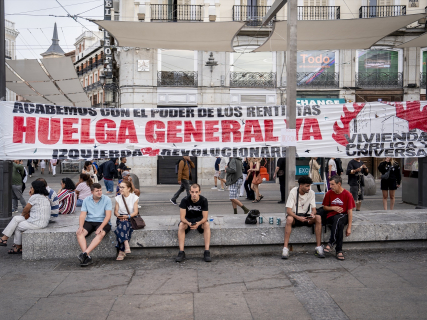
General strike for housing: the requirements that CCOO and UGT must meet for it to be legal

The Constitution protects the right to strike, but its exercise is subject to limits on the purpose of the call, the notice, essential services, and the freedom of those who decide not to support it.

5 minutes

EuropaPress 7803867 numerosas personas pancarta lema acabemos poder rentistas huelga general ya.jpg

EuropaPress 7803867 numerosas personas pancarta lema acabemos poder rentistas huelga general ya.jpg

Add DEMÓCRATA to Google

Ask FREN

Published

Last updated

5 minutes

Most read

The decision of CCOO and UGT to call a 24-hour general strike linked to the housing crisis, raised at the request of the Tenants' Union and still pending a definitive date, has opened a debate that transcends the political opportunity of the mobilization and fully enters its legal fit. CEOE and CEPYME have questioned the call understanding that its demands exceed the strictly labor field and that, furthermore, the strike is proposed in the midst of an electoral process, before the general elections on November 29.

Spanish legislation, however, does not automatically make a strike illegal because it includes demands directed at the Government or because it has a political dimension. The determining question is whether the objectives pursued are related to the professional interests of the workers, a boundary that will have special importance in a call focused on access to housing and in which the unions also intend to incorporate salary and collective bargaining demands.

The starting point is found in article 28.2 of the Constitution, which recognizes the fundamental right to strike of workers to defend their interests, while a good part of the rules that determine how it should be exercised are still contained in Royal Decree-Law 17/1977 on labor relations, interpreted and partially corrected since then by constitutional jurisprudence.

A political strike is not the same as a strike with political content

The main question raised by the mobilization announced by CCOO and UGT is related to its purpose. Article 11 of the Royal Decree-Law of 1977 establishes that a strike is illegal when it is initiated or maintained "for political reasons or for any other purpose unrelated to the professional interest of the affected workers", a provision that might seem especially relevant when the recipient of part of the demands is the Government.

The interpretation of this prohibition, however, does not allow us to conclude that any strike aimed at influencing political decisions is necessarily illegal. The Constitutional Court has constructed a broad conception of the interests that workers can defend through this instrument and has also recognized that unions can call strikes to defend claims that collectively affect workers, even when they cannot be satisfied directly by each employer.

There lies one of the keys to the future call for housing. CCOO and UGT are not merely proposing a protest against the government's policy, but have linked the mobilization to the cost of housing for working people, to the need for sufficient wages to access it, and to labor-related issues such as collective bargaining and the renewal of the Agreement for Employment and Collective Bargaining. The unions defend precisely for this reason that it would be a mixed-character strike and not an exclusively political protest.

The legal boundary would therefore be to determine whether there is a sufficient link between the claims made and the professional, economic, or social interests of the workers. If the strike pursued exclusively political objectives completely unrelated to those interests, it could fall into one of the cases of illegality provided for by the regulation.

The strike must be called by legitimized subjects

The right to strike belongs individually to the workers, although its exercise is necessarily collective. This means that each worker decides whether or not to support a call, while certain collective powers, including the call itself, can be exercised by the representatives of the workers and by the trade union organizations.

The Constitutional Court already established in its ruling 11/1981 that unions can organize, direct, and control a strike, as long as they have a presence in the labor area to which the mobilization extends. This doctrine is particularly relevant in a general strike, where the call is not limited to a single company or workplace.

For this reason, although the political and social impetus of the protest comes from the Tenants' Union, the incorporation of CCOO and UGT is legally relevant to turn the social mobilization into a labor call for a general strike aimed at salaried workers.

The notice must be given at least five days in advance

The strike cannot be called from one day to the next. Once the decision has been formally adopted, the organizers must communicate it in writing to the affected employers and to the labor authority with a minimum of five calendar days' notice.

When the strike affects companies responsible for public services, the period increases to ten calendar days, and the representatives of the workers must give sufficient publicity before it begins so that users can be aware of the call.

The communication must identify the objectives of the strike, the actions taken to resolve the conflict, the start date, and the composition of the strike committee. In the case of the mobilization announced by CCOO and UGT, this procedure has not yet been completed, since the unions have announced their decision to call the strike but still need to specify its date and formalize the call.

A strike committee of a maximum of twelve people

Every call must also have a strike committee, responsible for intervening in the union, administrative, or judicial actions related to the conflict and for participating in the negotiations aimed at resolving it.

The legislation establishes a maximum of twelve members, although the Constitutional Court corrected the originally planned limitations to determine who could be part of this body when the mobilization affects several workplaces, as necessarily occurs in a general strike.

Furthermore, from the moment the notice is given and during the development of the strike, the strike committee and the employers are obliged to negotiate to try to reach an agreement, without preventing the workers from ending the mobilization at any time.

Essential services must be guaranteed

The fundamental character of the right to strike does not imply that any activity can be completely paralyzed. The Constitution itself establishes that there must be guarantees to maintain the essential services of the community, which allows the governmental authority to establish minimum services when the call affects activities whose interruption may compromise fundamental rights, constitutionally protected goods, or essential needs of the population.

These minimum services, however, cannot be set arbitrarily nor empty the right to strike of its content. Constitutional jurisprudence requires that the Administration justify its decision and explain the criteria used to determine which services must be maintained and to what extent, so that the measure can be subsequently reviewed by the courts.

Aside from these essential services, during any strike, the indispensable actions to preserve the safety of people and property and the maintenance of facilities, machinery, or premises that are necessary for the activity to be resumed once the conflict is over must also be guaranteed.

Abusive strikes also have limits

The law distinguishes between directly illegal strikes and certain modalities that can be considered illicit or abusive due to the way they are carried out. Among them are rotating strikes, certain strikes carried out by workers in strategic sectors with the aim of interrupting the production process, and the so-called strikes of zeal or regulation.

During the strike, the freedom of those who decide not to support it must also be respected. Striking workers can publicize the call and raise funds, but they must do so peacefully and without exerting coercion on those who choose to continue working. At the same time, the company cannot generally replace strikers with workers hired after the call has been communicated.

More key points, information and questions with FREN

AI-GENERATED CONTENT

What is the current status of the parliamentary process for a possible reform of the right to strike in Spain?

At this moment, there is no general and comprehensive reform of the right to strike in Spain in an advanced stage of processing. The core of the right in article 28.2 of the Constitution continues to be regulated, in practice, by Royal Decree-Law 17/1977 and by the Constitutional Court's jurisprudence, without the long-awaited “organic law on strike” yet existing.

What does exist is a set of partial initiatives, mostly registered in the Congress during the XV Legislature, which indirectly affect the exercise of the right to strike or its protection, but without yet forming a complete and substitutive regime of the current framework.

Main initiatives in process affecting the right to strike
  • Bill for the protection of trade union freedom and the right to strike in the workplace (122/000276, Plurinational SUMAR Group, Congress).
    • Registered and admitted for processing by the Board on April 28, 2026, published on May 4, 2026.
    • Aims to strengthen protection against retaliation and discrimination for union activity or participation in strikes, for example by prohibiting “blacklists” of workers linked to the exercise of these rights.
    • It is pending consideration by the Plenary, meaning it has not even passed the first substantive political debate.
  • VOX's bills that reopen the debate on “pickets” and the balance between strike/right to work:
    • Organic Law Bill to amend the Penal Code for the protection of the right to work (122/000192, 2025), which aims to reintroduce a specific criminal offense against coercion to start or continue a strike, expressly linked to article 28.2 CE.
    • Organic Law Bill for the protection of workers' constitutional rights (122/000048, 2024), which includes the reversal of the repeal of the old article 315.3 of the Penal Code on pickets.
    • Both initiatives have been admitted for processing but remain pending debate on consideration, with no further progress.
  • Reforms of Organic Law 4/2015 on citizen security (“gag law”), which affect the environment of the right of assembly, demonstration, and strike:
    • Organic Law Bill to reform LO 4/2015 presented by the Plurinational SUMAR Group (122/000098).
    • Organic Law Bill to reform the same law presented by the Mixed Group / Podemos (122/000103).
    • Both emphasize the need for a more guarantee-based interpretation of freedoms of assembly, expression, trade union freedom, and the right to strike, correcting administrative infractions that today can be used against mobilizations and pickets.
    • They are also admitted and awaiting consideration.
  • Other broad labor initiatives —such as the Bill on the Statute of Workers (122/000095, Mixed Group) or the failed Bill for the recovery and expansion of labor rights (122/000221, rejected in 2023)— contain references to the right to strike but do not constitute specific regulation of its exercise.
Absence of a general organic law on strike

Searches both in parliamentary databases and specialized press agree that, to date, there is no:

  • A government organic law bill specifically dedicated to developing article 28.2 CE.
  • Nor an integral text on the right to strike that has passed the consideration phase or is in committee with advanced progress in Congress or Senate.

Doctrine and legal press continue to speak of a partial “regulatory vacuum”: the exercise of the right continues to rely on Royal Decree-Law 17/1977 on labor relations, “refined” by STC 11/1981 and subsequent jurisprudence. A 2024 FIDE analysis expressly recalls that the pending clarification has been left to the courts due to the lack of legislative development required by the Constitution.

Practical regulation via minimum services and sectoral rules

Meanwhile, much of the “micro-regulation” of the right to strike occurs through:

  • Ministerial and regional orders on minimum services (health, transport, education, waste, RTVE, etc.), which repeatedly cite article 28.2 CE and Royal Decree-Law 17/1977 to justify the compatibility of the right to strike with essential services.
  • Recent rulings, such as the Constitutional Court ruling on the 2022 Ryanair strike, which found violations of the right to strike due to excesses in minimum services.

These decisions show a case-by-case adjustment of the balance between strike and essential services, but do not replace the absence of a systematic organic law.

Conclusion on the status of processing

In summary, the “reform of the right to strike” in the strict sense is not currently in an advanced parliamentary phase. What exists is:

  • A set of partial bills (SUMAR, Vox, Mixed) that touch on protection against retaliation, criminal response to pickets, or the sanctioning regime of citizen security, all in initial phases and pending consideration.
  • An intense political and doctrinal debate on the need to update regulation, against a framework still centered on a pre-constitutional 1977 norm and the practice of minimum services.

Therefore, to date, there is no new organic law on the right to strike in advanced processing, but rather a scenario of fragmented proposals and political discussion without a global reform underway.

Can you detail the main content of the SUMAR Bill for the protection of trade union freedom and the right to strike? What changes do the Vox initiatives propose regarding pickets and the right to work, and how would they affect the exercise of the right to strike? How has the Constitutional Court interpreted Royal Decree-Law 17/1977 and what aspects of the right to strike has it clarified in its jurisprudence?

What powers and functions do the general secretaries of CCOO and UGT have according to current legislation?

The Organic Law 11/1985, on Trade Union Freedom (LOLS), does not directly regulate the powers of the general secretary of each specific union (CCOO or UGT). What it does is recognize unions a broad organizational autonomy to draft their statutes, organize their internal administration, and set their bodies and functions. Therefore, the powers of the general secretaries of CCOO and UGT derive mainly from their confederal statutes, always within the framework of the Constitution and the LOLS.

1. Common legal framework according to the LOLS

The LOLS recognizes unions, in general:

  • Legal personality and full capacity to act once their statutes are deposited in the corresponding public office.
  • The right to freely draft their internal statutes and regulations, organize their administration, and formulate their action program.
  • The right to constitute federations, confederations, and international organizations.
  • The right not to be suspended or dissolved except by a final judicial resolution.
  • Capacity to exercise judicial and extrajudicial actions in defense of the economic and social interests of the workers they represent.
  • Faculty to negotiate collective agreements, promote collective conflicts, participate in social dialogue and institutional participation bodies.

The powers that the Law attributes to the union (collective bargaining, institutional representation, participation in social dialogue, etc.) are exercised in practice by the person or persons designated by their statutes as legal representatives. In CCOO and UGT, that central figure is the confederal general secretary.

2. General Secretary of CCOO

The Confederal Statutes of the Workers' Commissions Confederation (CCOO) define the general secretary as the person who legally and publicly represents CCOO. According to the statutory information collected:

  • Holds the legal and public representation of the Confederation before public authorities, courts, business organizations, and social interlocutors.
  • Exercises the powers that labor and union legislation recognizes to the union's legal representative.
  • Has a set of patrimonial, contractual, procedural, and administrative powers detailed in a statutory annex (for example, signing contracts, acting in court on behalf of the Confederation, or managing certain assets).
  • Presides over meetings of the main confederal bodies: Confederal Council, Confederal Steering Committee, and Confederal Executive Commission.
  • Submits to the Confederal Congress the report prepared on behalf of the Confederal Council.
  • Submits to the Confederal Council the periodic reports prepared on behalf of the Confederal Steering Committee, unless otherwise decided for a specific session.
  • Can delegate or revoke certain functions to other members or bodies of the Confederation, as provided in the statutes.

At the same time, CCOO explicitly emphasizes a model of collective leadership and representation. The general secretary:

  • Must act in accordance with the law, the Confederal Statutes, and the Congress resolutions.
  • Is bound by the agreements of the Confederal Council, the Confederal Steering Committee, and the Confederal Executive Commission.
  • Cannot exceed a certain maximum number of terms, statutorily set, which limits tenure in office.

3. General Secretary of UGT

The Confederal Statutes of the General Union of Workers (UGT) also establish that the general secretary holds the legal and public representation of the Confederation.

According to those statutes:

  • Is the legal representative of UGT throughout the State territory.
  • Acts before authorities, public administrations, courts, business organizations, and other entities on behalf of the Confederation.
  • Can exercise judicial and extrajudicial actions in defense of UGT's interests.
  • Has broad powers of administration of the confederal patrimony: entering into contracts, managing assets and rights, intervening in operations on real estate, leases, accounts, etc., as detailed in the statutes.
  • Can grant powers of attorney, as well as delegate totally or partially their powers to other members of the Confederal Executive Commission or competent bodies.

The Confederal Executive Commission is UGT's permanent governing body and represents the union internally and externally. The general secretary heads it, but their actions must comply with:

  • The Confederal Statutes themselves.
  • The resolutions of the Confederal Congress.
  • The decisions of the Confederal Committee and other governing bodies.

4. Comparative summary

In both cases, the general secretary is the person who concentrates the legal and public representation of the union, with relevant powers externally (social dialogue, negotiation, litigation) and internally (presiding over bodies and executing agreements). The most notable difference lies in the emphasis:

  • In CCOO, it is expressly highlighted that leadership is collegial and that the general secretary's actions are closely linked to the agreements of the confederal bodies.
  • In UGT, the statutes formulate particularly broad and exclusive legal representation of the general secretary, detailing precisely their patrimonial and procedural powers, although always subject to the control of the congress and governing bodies.

In short, the legislation (LOLS) sets the framework of autonomy and functions of the union as a collective subject, while the statutes of CCOO and UGT specify that the general secretary is their highest legal and political representative, but without detaching from the principles of internal democracy, collective representation, and submission to the organization's decisions.

How many general strikes have been called in Spain in the last decade and what have been their main demands?

In the last decade — between October 2016 and October 6, 2026 — there have been, broadly speaking, seven general strikes or general stoppages in Spain at a state or near-state level, although several were promoted by minority unions, the feminist movement, or territorial centers.

If a strict criterion is used (only 24-hour state general strikes called by CCOO and UGT against the Government's socioeconomic policy), there have been none since the two in 2012. This is recalled by Demócrata in a historical review of general strikes since the Transition, which places the last “classic” ones on March 29 and November 14, 2012, both against labor reform and austerity of Mariano Rajoy's Government.

However, in those same articles and other journalistic sources, several calls are identified that present themselves as “general strike” or “general stoppage” in the last decade, with diverse motivations. Counting them broadly, they would be:

  • March 8, 2018 – Feminist general strike (statewide, with full labor coverage by unions such as CGT and CNT, and partial stoppages by CCOO and UGT). Its central demands were pay equality, ending employment discrimination, recognition of care and domestic work, and rejection of gender-based violence.
  • March 8, 2019 – Second feminist general strike, again at the state level, with calls from alternative unions and the feminist movement. It repeated the previous year's agenda: effective equality between women and men, closing the wage gap, improving conditions for precarious female workers, and eradicating gender violence.
  • January 30, 2020 – General strike in the Basque Country and Navarre, promoted by nationalist unions and other centers. Although territorial, it is presented as a “general strike” in those areas. The main demands: repeal of the 2010 and 2012 labor reforms, decent pensions, stable employment, reduced working hours, and wage increases linked to the cost of living.
  • March 30, 2023 – New general strike in the Basque Country and Navarre, also territorial. The demands focused on wages indexed to inflation, reduction of working hours (to 32 hours per week), improvements in pensions and public services, and a fairer productive model.
  • September 27, 2024 – Statewide general strike for Gaza, called by unions such as CGT and Solidaridad Obrera. Its main goal was to demand the end of the Israeli military offensive in Gaza, the cessation of military and commercial cooperation with Israel — especially arms trade — and a stronger position from the Spanish Government against the war.
  • October 15, 2025 – General strike for Gaza, again promoted by alternative unions. According to Demócrata, the CGT calls a 24-hour general strike under the slogan “General strike: against genocide and apartheid of the Palestinian people.” Its demands: ceasefire in Gaza, breaking diplomatic and commercial relations with Israel, and a total arms embargo, denouncing international complicity with the war.
  • Autumn 2026 – Statewide general strike announced by CCOO and UGT. On October 5, 2026, CCOO issued a note in which both unions agree to call a 24-hour general strike, pending ratification and a definitive date. Its demands focus on the right to housing: wages “dignified to access dignified housing,” increases between 4% and 7% with revision clauses, a permanent public stock of protected housing, rent limitations, and effective application of the Housing Law throughout the territory.

Besides these, the press and Demócrata recall that in recent years there have been multiple national sectoral strikes (especially in health and education) and partial stoppages registered as “general strike” in specific areas — for example, the 2025 national doctors' strike — but which are not posed as a general strike of the entire labor market.

In summary: according to the sources consulted, in the last decade at least seven calls presenting themselves as general strike or general stoppage are identified, with three major demand axes: internal labor and social rights (labor reforms, wages, working hours, pensions, housing), gender equality (March 8), and positioning regarding international conflicts (mainly Gaza).

Can you explain in more detail the legal differences between a state general strike and a territorial general strike like those in the Basque Country and Navarre? What real impact did the feminist strikes on March 8, 2018 and 2019 have in terms of participation and subsequent regulatory changes? How are minimum services legally regulated in Spain during a general strike like the one on October 15, 2025 for Gaza?

Play

Test your knowledge with FREN!

How much do you know about this topic? Answer the following 3 questions.

What is the minimum notice period to call a general strike according to Spanish regulations?

Question 1 of 3

What is the maximum number of members that the strike committee can have according to Spanish legislation?

Question 2 of 3

What criterion is decisive for a strike with political demands to be considered legal in Spain?

Question 3 of 3