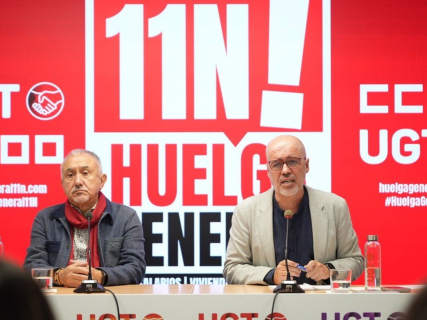

CCOO and UGT have assured this Tuesday that the general strike for housing on the upcoming November 11 is also connected to their labor demands, by claiming salary increases that allow the population to access and maintain housing.
In a joint appearance, the general secretaries of both unions, Unai Sordo and Pepe Álvarez, have detailed that the intention is to provide labor coverage to the protests for housing and to articulate a large social mobilization in which all involved actors participate.
Sordo has indicated that the call seeks to channel social discontent in the face of increasing difficulties in finding housing and has insisted that the day will also incorporate a package of labor and salary demands.
Álvarez has admitted that the case of Maricarmen has been one of the factors that have precipitated the strike, as her situation "overflowed the streets" and has emphasized that a part of the citizenry expressly demanded that the union organizations join the protests.
The head of UGT has also emphasized that the involvement of the unions in the housing issue is not new and has recalled that they already placed this matter among their priorities at the central event of May 1 held in Málaga.
Sordo has also claimed the full legality of the call and has stressed that "there are no doubts" in this regard, since the strike will not be limited exclusively to the housing problem, but will also incorporate strictly labor demands. "If it were only linked to housing, I think it could be perfectly explained, but since it will not be solely linked to housing, I believe there is no doubt regarding its legality," he has pointed out.
"A PARK OF 1.5 MILLION HOUSES"
The leader of CCOO has pointed out that the great deficit of housing policy in Spain is the non-existence of a sufficiently large public stock that ensures affordable prices and can influence the dynamics of the market. To change this scenario, he has proposed mobilizing resources equivalent to 1% of GDP for a decade in order to build "a park of 1.5 million houses" at moderate prices.
As he has explained, this objective should be achieved by combining the construction of new homes, both for rent and for ownership, with the use of vacant properties.
Among the specific actions, Sordo has demanded to stop the evictions of vulnerable people when there is no housing alternative, limit the accumulation of housing in the hands of investment funds for speculative purposes, and restrict the use of tourist apartments in pressured areas.
Likewise, he has advocated for strengthening public affordable rental programs that ensure property owners receive payment and maintain the good condition of the homes, while setting rents for tenants that do not exceed 30% of their income.
SALARY INCREASES OF BETWEEN 4% AND 7%
The trade unions maintain that the strike should also serve to push for salary improvements and unblock collective bargaining, although Sordo has warned that the rising cost of housing cannot be corrected solely with salary increases.
"Salaries need to be raised, but the housing problem is above all the housing problem," reiterated the general secretary of CCOO, who defends addressing the housing crisis and labor conditions separately.
In terms of remuneration, Sordo has demanded increases of between "4% and 7%" and has insisted that companies distribute their profits through widespread salary increases.
Additionally, CCOO and UGT propose to raise the minimum interprofessional salary (SMI) by at least 7%, so that it is above 1,300 euros in 14 payments, and to incorporate salary review clauses in the agreements. They have also called for the restoration of time registration and to ban the absorption and compensation of certain supplements.
Álvarez has reported, on the other hand, that UGT and CCOO have been waiting "for more than a year" for the CEOE to resume negotiations for the renewal of the Agreement for Employment and Collective Bargaining (AENC).
Both leaders have directed their demands to both the employers and public administrations, from municipalities and autonomous communities to the central government. Sordo has argued that the mobilization should serve to keep housing at the center of political debate and force institutional commitments that extend beyond the current cycle.
Strike 11-N and political context
The strike was announced last Wednesday, October 8, by the Confederation of Tenant Unions (CSI), along with other organizations such as UGT, CCOO, CGT, CNT, Social Action of Workers' Solidarity, and Co.Bas.
The call comes in a scenario where the president of the Government, Pedro Sánchez, has decided to bring forward the general elections to November 29, after the Plenary of Congress rejected two royal decree-laws on housing. The Executive approved them again last week, with the expectation that the Permanent Deputation will validate at least the first one.
"The general strike of 11N is the response to the insatiable real estate greed that speculates with one of the main citizenship rights, making it practically impossible for the majority to access decent housing," a joint statement from CCOO and UGT states.
The announcement of the general strike came just minutes after the death of Maricarmen Abascal, the Madrid neighbor evicted on September 23 from the rental housing where she had lived for more than 70 years.
Her eviction triggered protests and encampments in various cities across the country. The elderly woman had been hospitalized at the Gregorio Marañón hospital since September 23.