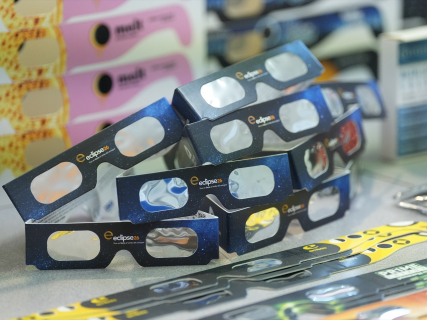

Observing an eclipse without the proper protection can cause eye damage, but that is not the only incident that can occur during a phenomenon that will mobilize thousands of people. Falls, blows, or accidents during travel are other possible scenarios.
The first issue that must be clear is that insurers do not determine coverage simply because the damage occurred during an eclipse. The Insurance Contract Law establishes that the insurer is liable when the risk subject to coverage occurs and within the limits agreed upon in the contract.
Therefore, the same situation can have different responses depending on the insurance contracted. An eye injury may involve healthcare assistance, while a fall could fall under the scope of an accident insurance, and a collision during travel would have to be analyzed according to the car insurance.
What happens if you suffer an eye injury while looking at the eclipse
A person who suffers eye damage after directly observing the Sun must receive the appropriate healthcare. If they have private health insurance, the specific coverages and conditions of their contract must be checked.
The Insurance Contract Law establishes that, when the insured risk is illness, the company can assume certain amounts and expenses for medical and pharmaceutical assistance within the limits of the policy. In health assistance insurance, the insurer can directly assume the provision of medical and surgical services.
Therefore, it cannot be generally stated that an eye injury caused during the eclipse is automatically covered or excluded. The response will depend on the insurance contracted, the included coverages, and the conditions established in the policy.
Health insurance and accident insurance are not the same
Receiving medical assistance for an injury and collecting financial compensation for an accident are different matters. A health insurance is primarily aimed at providing or covering the healthcare included in the contract.
An accident insurance, on the other hand, can contemplate economic benefits when a covered accident occurs that generates the consequences foreseen in the policy. The Insurance Contract Law defines the accident as a bodily injury derived from a violent, sudden, external cause and alien to the intentionality of the insured that produces temporary, permanent disability, or death.
This definition is especially relevant in the face of the eclipse. An accidental fall while contemplating the phenomenon may present a different fit than an injury caused by looking directly at the Sun, so it should not be taken for granted that both situations will receive the same treatment.
Does accident insurance cover an injury from looking at the Sun?
There is no universal answer. For an accident insurance to intervene, it will be necessary to analyze whether what happened fits within the definition of accident and the risk delineated by the contract.
This requires checking the general and specific conditions of the policy. An insurer can delineate the risks it covers and establish the conditions under which a certain benefit applies.
For that reason, suffering an injury during the eclipse does not automatically generate compensation from an accident insurance. The origin of the injury, the circumstances in which it occurred, and the contracted coverages will be decisive.
Looking at the eclipse without protection does not automatically mean losing the insurance
Another mistake would be to assume that any recklessness automatically allows an insurer to reject a claim. The Insurance Contract Law specifically states that, if the insured intentionally causes the accident, the insurer is released from its obligation.
Intentionality and possible reckless behavior are not necessarily equivalent concepts. Therefore, it cannot be generally stated that a person who has looked at the eclipse without the recommended protection will automatically be left without coverage.
The company will have to analyze the claim according to the contract and the applicable legislation. Hence the importance of not assuming that a specific behavior alone implies that the insurance will pay or reject the damage.
The medical expenses of an accident insurance have their own rules
An accident insurance does not necessarily mean that any medical expense is included. Legislation establishes that healthcare expenses will be assumed by the insurer when that coverage has been expressly included in the policy.
Assistance must also be provided according to the conditions established in the contract. Therefore, it is advisable to check issues such as the agreed centers, the procedures provided to report the accident, or the existing economic limits.
The Insurance Contract Law introduces, however, an important guarantee: the conditions of the policy cannot exclude necessary urgent assistance in the regulated case for the healthcare coverage of accident insurance.
What happens if you have a car accident during the eclipse
Traveling to view the eclipse presents a completely different scenario. If a collision occurs while a person is traveling to a viewing location or during the phenomenon itself, the coverage must be analyzed according to the car insurance and the circumstances of the accident.
That the driver was traveling to see the eclipse does not alone determine whether the incident is covered. It will be necessary to differentiate, among other issues, the liability to third parties from the coverages contracted for the damages to the vehicle or the driver.
A policy that only covers mandatory civil liability cannot be equated with another that includes own damages and other guarantees. The type of insurance contracted will be essential to determine what damages the company can assume.
A distraction while driving during the eclipse can also end in an accident
The eclipse can create particularly delicate situations on the road if a driver tries to observe it while driving. In the event of any accident, it will be necessary to reconstruct the circumstances to determine responsibilities and apply the corresponding coverages.
In this case, it is also necessary to differentiate the possible damages suffered by third parties from the own damages. The fact that there is car insurance does not mean that absolutely any harm to the insured is covered in all circumstances.
For this reason, the safest way to contemplate the phenomenon during a displacement is to stop the vehicle in a permitted and safe place before making any observation, avoiding that the eclipse becomes a distraction while driving.
What happens if you get injured at an organized event to see the eclipse
Another possible situation is that the accident occurs during an organized activity. Town halls, establishments, associations, or other entities may enable spaces or hold events to contemplate the eclipse.
If a person suffers an injury from a fall or any other incident, it will be necessary to analyze how the accident occurred and if there is responsibility from a third party. It is not the same to trip due to a fortuitous cause than to suffer damage related to a defective installation or a circumstance attributable to the organizer.
In these last cases, civil liability could come into play and, if applicable, the corresponding insurance of the responsible party. Again, the eclipse would only be the context in which the accident occurred and not the cause that solely determines the coverage.
What you should keep if you suffer an accident during the eclipse
Documenting what happened correctly can be fundamental for any subsequent claim. If there is an injury, it is advisable to keep medical reports, diagnoses, invoices, and any documentation related to the assistance received.
In an accident, it may also be useful to keep photographs, witness data, and any document that allows verifying how it happened. In traffic accidents, the usual procedures established for this type of accident must also be followed.
The next step will be to review the general and particular conditions of the insurance to identify exactly what coverage may intervene and to report the incident to the insurer following the procedure provided in the policy.
What to do if the insurer rejects the coverage
If the company considers that the incident is not covered, the insured can request that the decision and its reasons are clearly explained and contrast them with the conditions of their policy.
When there is disagreement, a claim can be submitted to the customer service or attention department or, when available, to the customer defender of the insurance entity.
Once the corresponding avenue before the entity is exhausted, there are other mechanisms for claiming. Among them is the Claims Service of the General Directorate of Insurance and Pension Funds, in addition to mediation avenues, arbitration when applicable, and the courts.
The key is in the policy, not in whether the damage occurs during an eclipse
The question "Does my insurance cover eclipse damage?" does not have a single answer because there is no general category of damage caused by eclipses in insurance legislation.
An eye injury, a fall, and a traffic accident are different situations that can affect different insurances. Even within the same type of insurance, two policies may contain different coverages, limits, and conditions.
That is why, before the eclipse on August 12, it is advisable to check what insurances are contracted and what their coverages are. If a claim ultimately occurs, it will be the specific damage, its circumstances, and the conditions of the contract that determine whether coverage exists.