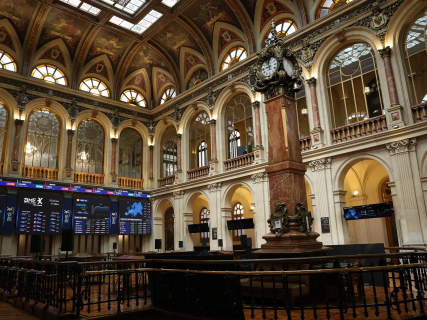
Ibex 35 today, Tuesday, September 8: the index loses 20,000 points with oil above 98 dollars

The Madrid selective index starts the session with a decline of 0.22% while Repsol resists upwards and Merlin collapses more than 2%

2 minutes

fotonoticia 20260828181749 1920

fotonoticia 20260828181749 1920

Add DEMÓCRATA to Google

Ask FREN

Published

Last updated

2 minutes

Most read

The Ibex 35 of the Madrid Stock Exchange has started this Tuesday's session with a decline of 0.22%, down to 19,977.9 points, thus losing again the level of 20,000 units. The Spanish index had closed on Monday at 20,020 points, after a drop of 0.1%.

The evolution of the markets is once again conditioned by the situation in the Middle East and the impact that the escalation of tensions between the United States and Iran is having on energy prices. Brent oil is already above 98 dollars per barrel.

Oil rises amid tension in the Middle East

The Iranian Foreign Ministry has accused the Canadian government of yielding to pressures from the United States after Canadian authorities condemned the threats against ships attempting to cross the Strait of Hormuz, in addition to criticizing the Iranian nuclear program and Tehran's support for groups in the region.

The new episode of tension is once again being transferred to the energy market. The Brent, the benchmark in Europe, rose 1.8% at the opening of European stock exchanges, up to 98.7 dollars per barrel, while West Texas Intermediate advanced 2.9%, up to 94.1 dollars.

Merlin leads the declines of the Ibex

In the first moments of trading, Repsol stood out among the rising values, while Amadeus, Logista, Telefónica, and Acerinox also advanced. The subsequent evolution also showed advances in values such as Grifols, Rovi, and Unicaja.

On the side of the declines, Merlin led the drops with a decrease of over 2%, followed by ACS, Acciona Energía, and Inditex. At 9:30 a.m., the decline extended to a good part of the large values of the index, with notable drops also in CaixaBank, Banco Sabadell, BBVA, and Santander.

Japan and the Spanish Treasury focus the agenda

Before the opening of European markets, the definitive GDP data of Japan was released, whose economy grew by 0.4% during the second quarter. The advance represents a tenth less than in the first three months of the year, although it exceeds the preliminary estimate published in mid-August by a tenth.

In Spain, the Public Treasury expects to place this Tuesday between 2,000 and 3,000 million euros in letters for three and nine months. Investors also have several business news on their radar. Indra, Alpha Impulsion, CT Ingenieros, and Mecano ID have created the European alliance '2030+' to promote 'Garnet', a rocket engine intended for the next generation of European microlaunchers.

For its part, Squirrel Media has reported a net profit of 8.23 million euros during the first half, 38.6% more than in the same period of 2025, and has maintained its forecasts for the entire fiscal year.

The European Stock Exchanges open in negative

The rest of the major European markets also began the session with declines. Paris and Milan fell by 0.2%, while Frankfurt and London dropped by 0.1% at the opening.

In the foreign exchange market, the euro lost ground against the dollar and was exchanged at 1.162 dollars. In the debt market, the yield of the Spanish ten-year bond fell to 3.82%.

More key points, information and questions with FREN

AI-GENERATED CONTENT

What is the process for placing Treasury bills in Spain and what requirements must investors meet to participate?

In Spain, Treasury bills are short-term fixed-income securities (usually 3, 6, 9, and 12 months) issued by the State to finance itself. Their placement is mainly carried out through auctions organized by the Public Treasury, with the collaboration of the Bank of Spain.

1. Placement process: how the bills are issued

The process follows a standardized and quite transparent scheme:

  • 1) Announcement of the calendar and each auction: The Treasury publishes an indicative calendar of bill auctions at the beginning of the year and, before each one, an announcement with the offer submission deadlines, the issue and maturity dates, and the target amount to be placed (indicative or maximum).
  • 2) Submission of offers: Offers are submitted through:
    • Market makers and financial institutions, who participate on their own behalf and on behalf of their clients.
    • Retail investors, who can participate:
      • Directly with the Treasury, through the Public Treasury Electronic Headquarters or the offices of the Bank of Spain.
      • Through their bank or broker, who will transmit the order to the auction.
    Offers can be: competitive (indicating the desired interest rate) or non-competitive (accepting the average price resulting from the auction).
  • 3) Auction execution: On the scheduled date, the Treasury:
    • Orders the competitive offers from lowest to highest yield (from highest to lowest price).
    • Sets the marginal rate (maximum accepted yield) necessary to allocate the desired volume.
    • Allocates the bills to all competitive offers below or equal to that marginal rate, and then satisfies the non-competitive offers at the resulting weighted average price.
  • 4) Settlement and payment: On the issue date, investors pay the purchase price (lower than the nominal value, since the bills are issued at a discount) and receive the securities in their account:
    • In a securities account at a financial institution or broker, or
    • In a securities account registered at the Bank of Spain when they have participated directly.
  • 5) Maturity: On the maturity date, the Treasury returns 100% of the nominal value. The investor's return is the difference between the nominal value and the price paid.

2. Requirements for investors to participate

Both institutional investors and individuals can participate, but practical requirements depend on how they access the auction:

2.1. Retail investors (individuals)
  • Identification: They must have a DNI or NIE (in the case of non-residents, the documentation required by the Treasury and the Bank of Spain).
  • Bank account in the eurozone: A current account is necessary to debit the investment amount and credit the principal at maturity (if operating directly with the Treasury) or linked to the securities account at the bank or broker.
  • Contracting channel:
    • Public Treasury Electronic Headquarters: requires a digital certificate, DNIe, or Cl@ve system, and an associated bank account.
    • Bank of Spain offices: one can attend in person with identification documents and account details.
    • Financial institutions: it is necessary to have a securities account and a cash account at that institution.
  • Minimum amount: The minimum nominal amount is usually 1,000 euros, and requests are accepted in multiples of 1,000.
  • Order type: Small investors usually participate through non-competitive bids, accepting the average price resulting, which simplifies the process (no need to set a specific interest rate).
2.2. Institutional and professional investors
  • Market participant status: They are usually banks, asset managers, and other financial entities with direct access to the securities settlement system and, in many cases, with the status of market makers for the Treasury.
  • Submission of competitive offers: They can submit offers with different interest rates and manage their own or clients' portfolios.
  • Regulatory requirements: They must comply with investment services regulations, anti-money laundering, solvency, etc., supervised by the Bank of Spain and CNMV.

In summary, the placement process of Treasury bills in Spain is based on periodic, transparent, and open auctions to all types of investors, and the participation requirements are relatively simple for individuals: identification, bank account, and respecting the minimum amount, being able to operate conveniently through the Treasury, the Bank of Spain, or their own financial institution.

What are the competencies of the Ministry of Foreign Affairs of Iran according to its national legislation?

No text has been found in the consulted sources that directly reproduces or summarizes the articles of the Constitution of the Islamic Republic of Iran of 1979 nor the organic laws of the Executive Power that explicitly and systematically define the competencies of the Ministry of Foreign Affairs. The press and the documents accessed only provide practical indications about the functions exercised by this ministry, but not the detailed internal normative basis (name of the law, date, article number, etc.).

That said, based on these indications, it is possible to describe, with the aforementioned cautions, the main material spheres of action of the Iranian Ministry of Foreign Affairs as reflected in official statements and recent diplomatic actions.

1. Direction and execution of foreign policy

News about the actions of the Iranian Minister of Foreign Affairs show that this department is the ordinary channel for formulating and executing the State's foreign policy. For example, in coverage of negotiations with the United States and other countries (such as Oman, Germany, South Korea, or Qatar), the ministry appears as a central actor that "explains the position of the Islamic Republic of Iran in favor of peace" and details the "initiatives of our country to end the war" or to reopen diplomatic channels (example link).

In legal-institutional terms, this points to a general competence to:

  • Design, propose, and execute foreign policy under the direction of the highest State authorities (president and Supreme Leader).
  • Coordinate Iran's position in bilateral and multilateral relations.
2. International representation and diplomatic relations

Sources also reflect that the ministry:

  • Organizes and conducts formal contacts with foreign counterparts (official trips, calls, visits to Tehran, and ministerial tours).
  • Manages the network of embassies and consulates, both in Iran's external projection and in relations with foreign missions accredited in Iran (for example, summoning ambassadors for consultations to convey formal complaints).

These practices imply a normative authorization to represent the Iranian State before other States and international organizations, as well as to maintain or modify diplomatic relations (opening and closing embassies, raising or lowering the level of relations, etc.).

3. Participation in defining legal and security responses

In several official statements, the Ministry of Foreign Affairs explicitly cites the application of internal laws and international norms. A relevant example is the statement in which "the Government of the Islamic Republic of Iran, according to the principle of reciprocity and pursuant to Article 7 of the Reciprocal Action Law in response to the designation of the Islamic Revolutionary Guard Corps as a terrorist organization" declares certain foreign armed forces "terrorist," a measure announced by the ministry itself (link).

This suggests that Foreign Affairs:

  • Intervenes in the application of internal norms with an international dimension (for example, "reciprocal action" laws against sanctions or terrorist entity designations).
  • Participates in the development of Iran's legal position on the use of force, sanctions, reprisals, etc., in coordination with other security and defense bodies.
4. Relations with international organizations

In pieces related to the International Atomic Energy Agency (IAEA) and the United Nations, the Ministry of Foreign Affairs appears as a channel to:

  • Request meetings of international bodies (for example, extraordinary sessions of the IAEA Board of Governors) to address attacks or controversies affecting Iran.
  • Send letters to the UN Secretary-General invoking Article 51 of the United Nations Charter and justifying the use of force in self-defense (link).

Normatively, this implies competencies to manage Iran's relationship with international organizations, participate in procedures before them, and formulate official positions on behalf of the State.

5. Official communication and public diplomacy

The Ministry of Foreign Affairs' statements and messages perform a public diplomacy function: they denounce attacks (for example, against Iranian territory or allied third countries), defend international legality according to Tehran's interpretation, and announce political or legal measures adopted by the Government. This communicative aspect, although not always very detailed in constitutions, is usually supported by the norms assigning the ministry the conduct of foreign relations and the country's international projection.

6. Limits of available information

The consulted sources do not include:

  • The specific articles of the Iranian Constitution related to the Executive Power and foreign policy.
  • The specific law organizing the Government and detailing the functions of each ministry, including Foreign Affairs.

Therefore, it is not possible, with this documentary basis, to rigorously cite the number of articles, the exact date of the applicable organic law, or a closed list of competencies as they appear in the Iranian internal legal system. Only an approximate reconstruction of the functional areas of the Ministry of Foreign Affairs can be made based on its practice and the statements it issues.

If you need a strictly legal analysis with article-by-article references, one should directly consult the Constitution of the Islamic Republic of Iran of 1979 (and its amendments) and the Iranian organic legislation on the Executive structure, preferably in an official edition or a reliable academic translation.

What results did the main parties obtain in the last general elections in Spain?

The last general elections held in Spain were on July 23, 2023 (15th Legislature). Based on data collected by the newspaper Demócrata — based on official results — the overall picture of the Congress was as follows for the main nationwide parties:

  • People's Party (PP): 33.1 % of the votes and 137 seats.
  • Spanish Socialist Workers' Party (PSOE): 31.7 % of the votes and 121 seats.
  • Vox: 12.4 % of the votes and 33 seats.
  • Sumar (coalition including, among others, Podemos, IU, Más País, and Compromís): 12.3 % of the votes and 31 seats.

These four parties concentrated the vast majority of the nationwide vote and Congress seats: they sum 322 of the 350 deputies. The remaining seats corresponded to regional parties (ERC, Junts, EH Bildu, PNV, BNG, Canary Coalition, UPN, among others), which complete the parliamentary map and are key for investiture and legislative majorities.

Balance between the two major parties

The July 23 results consolidated a system of two major nationwide forces very close in votes, accompanied by two medium-sized parties:

  • The PP was the most voted force, with the mentioned 33.1 % and 137 deputies. Demócrata recalls this data in several of its subsequent analysis pieces, comparing polls with the actual July 23 results (for example, in its coverage of Sigma Dos or Hamalgama Métrica polls).
  • The PSOE was very close in vote percentage, with 31.7 % and 121 seats. Numerous subsequent polling analyses use this figure as a reference to measure the socialists' decline or resilience throughout 2025 and 2026.

In terms of power balance, this left the parliamentary right led by the PP as the first bloc in number of seats, but without reaching an absolute majority (176 seats) on its own. Demócrata articles emphasize that the PP–Vox sum was 170 deputies after the elections (137 from PP and 33 from Vox), a figure that has since served as a comparison point against polls projecting possible majorities exceeding 200 seats for that bloc.

Results of Vox and Sumar

The other two relevant nationwide parties, behind PP and PSOE, were Vox and Sumar:

  • Vox obtained 12.4 % of the votes and 33 deputies. Demócrata repeatedly cites these 33 seats as the starting point from which many subsequent polls project very significant party gains.
  • Sumar achieved 12.3 % and 31 seats. Polling articles note that much of the space occupied by Unidas Podemos in 2019 ran integrated within the Sumar brand in 2023, so their subsequent results are often compared with this 31-deputy figure as a reference.

Overall, the nationwide left (PSOE + Sumar) gathered 152 seats. For investiture and law approval, this base required support from several nationalist and independentist forces, as Demócrata analyses on the "investiture bloc arithmetic" in the 15th Legislature explain, detailing how the Government needed to add ERC, Junts, EH Bildu, PNV, BNG, or Canary Coalition to surpass the 171 deputies threshold that PP, Vox, and UPN summed.

Weight of regional parties

Although your question focuses on the "main parties," it is relevant to mention that a significant part of the Congress resulting from July 23 is formed by regional or nationalist parties. Based on Demócrata's comparisons between the 2023 elections and various subsequent polls, it appears that:

  • Junts had 7 seats in 2023 (when a later poll attributes 6 and notes it would be "one less than in the 2023 elections").
  • PNV had 5 seats in July 23, according to the same comparisons that mention a drop from five to four deputies in certain polling projections.
  • EH Bildu had 6 deputies, a figure that later analyses use as a reference when indicating it "would keep its six seats" in certain scenarios.

These parties, along with ERC, BNG, Canary Coalition, or UPN, complete the 350 Congress seats and are essential to understand why governability after July 23 depends on complex agreements between the coalition Government and a mosaic of regional partners.

Can you also detail how many seats each of the main regional parties (ERC, Junts, EH Bildu, PNV, BNG, CC, UPN, etc.) obtained in the July 23 elections? How are these results distributed by ideological blocs (right, left, and nationalist parties) and what potential majorities arise from each combination? How did the July 23 results differ from the previous general elections (for example, those of November 2019) for PP, PSOE, Vox, and the Sumar/Unidas Podemos space?

Play

Test your knowledge with FREN!

How much do you know about this topic? Answer the following 3 questions.

What was the opening value of the Ibex 35 this Tuesday?

Question 1 of 3

Which company was leading the declines in the Ibex 35 in the early stages of the session?

Question 2 of 3

What was Japan's GDP growth in the second quarter according to the final data?

Question 3 of 3

Hola, soy Fren. ¿Cómo te ayudo?