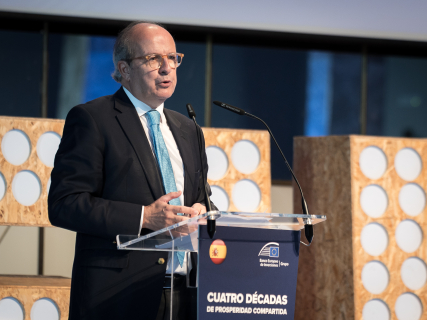

The director of the European Commission Office in Spain, Daniel Calleja, has warned that the model on which Europe has built its prosperity over the last decades "is at risk of not being viable for the future" and has advocated for an acceleration of economic, industrial, energy, technological, and political integration to avoid the decline of the continent.
Calleja spoke this Wednesday in Pamplona at the forum "The Connected Europe", organized by the association Equipo Europa, where he positioned competitiveness and strategic autonomy as "two inseparable concepts that currently mark the roadmap of the European Union."

Featured story
Democrat enters the debate of the European dilemma on AI: regulate without stifling innovation
6 minutes
The community official has framed this shift in a context of "geopolitical tension, uncertainty, conflict, and instability" that has forced Brussels to review some of the foundations of its economic model. "Europe has realized that its model, a model in which we were happily developing in a happy world, is a model that is now in question," he pointed out. In this sense, he cited the rise of autocracies and populism, wars, the use of trade policy for political purposes, migratory pressure, and climate change as some of the factors that are forcing the European Union to adapt to a new reality.
Four Major Dependencies
Calleja has identified four major dependencies that, in his opinion, explain a large part of Europe's current vulnerability: energy, industry, defense, and technology. "We depended on the cheap energy supplied to us by other countries. We have outsourced industry and we have also outsourced defense," he explained, before adding a fourth dependency: technology.
The coronavirus crisis, he recalled, highlighted to what extent Europe had lost productive capacity in sectors considered essential. "When the COVID crisis occurs, we realize that essential items like masks we have to go look for in Asia because we are not capable of producing them here," he pointed out. In the face of this situation, the director of the European Commission Office in Spain has defended the need to strengthen the autonomy of the bloc. "We have to change, we have to be more autonomous. We have to be more competitive," he summarized.
Calleja has also pointed out that the president of the European Commission, Ursula von der Leyen, has raised the tone of the debate and no longer speaks only of strategic autonomy. "The time for Europe's independence has come," he stated, paraphrasing President Ursula von der Leyen.
More industry and less bureaucracy
To respond to this challenge, Calleja has outlined the main pillars of the community competitiveness agenda. The first is the reindustrialization of Europe. "Europe needs more industry. We have to reindustrialize," he argued, claiming the role of the industrial sector as a generator of higher quality jobs, a source of innovation, and an element of resilience in the face of crises.
The objective of the European Commission, as he explained, is to raise the weight of industry from 14% to 20% of GDP in the coming years. Among the proposed measures, he mentioned the future Industrial Acceleration Law, the simplification of permits, the creation of industrial acceleration areas, and greater use of public procurement to boost demand for European products.
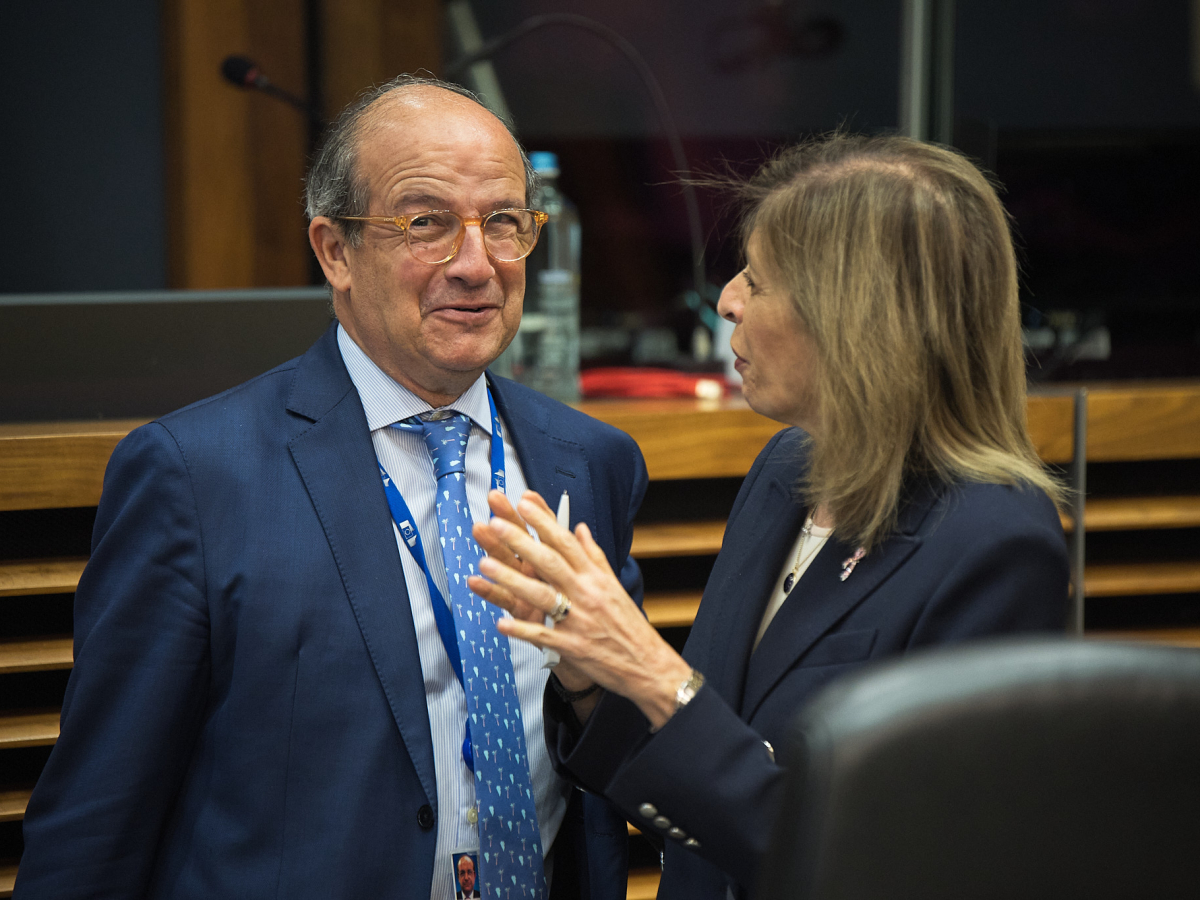
The second major axis will be administrative simplification. The European Union has set a goal to reduce administrative burdens by 25% for companies and 35% for small and medium-sized enterprises. Calleja has also defended the so-called regime 28, an initiative aimed at allowing a company to be established more easily and operate across the entire internal market without having to face 27 different legal systems.
"That a company can be established online in 48 hours and also access the entire internal market," he explained. The initiative aims to particularly favor startups, talent, and innovation.
The cost of energy, a threat to competitiveness
Energy has occupied another of the main points of his intervention. Calleja has been blunt in warning that European companies will hardly be able to compete on equal terms if they continue to bear energy costs that are much higher than those of their international competitors. "There is no competitiveness if European companies pay up to three times more for energy costs than their competitors," he warned.
The community response, as explained, involves strengthening supply security, continuing to invest in renewable energies, advancing the integration of the internal energy market, increasing interconnections, and reducing the tax burden.
Featured story
"Without sufficient energy, the AI is not going to work," warns a former Belgian diplomat
5 minutes
The director of the European Commission's Office has also brought to the table the debate on the so-called European champions. Brussels plans to modify the guidelines for assessing mergers and concentrations with the aim of allowing European companies to achieve a larger scale in increasingly globalized markets. The analysis, he noted, should be "less short-term" and not focus exclusively on price, but also on factors such as innovation, market integration, supply chains, and contribution to the internal market.
Preventing European savings from leaving the EU
Another pillar of the strategy will be the union of savings and investment. Calleja has highlighted that Europeans save 300 billion euros more each year than Americans, but lamented that a significant portion of that capital ends up leaving the European Union.
The challenge, he argued, is to ensure that those resources are channeled towards startups, entrepreneurs, venture capital, and the real European economy. He added the need to accelerate digitalization and the development of artificial intelligence to prevent Europe from falling behind again. In this area, he mentioned artificial intelligence gigafactories, European technological sovereignty, chip legislation, and the construction of a true digital single market.
However, Calleja emphasized that European strategic autonomy does not mean shutting oneself off or renouncing international trade. "Whenever we talk about strategic autonomy, we have to add an adjective in Europe: open strategic autonomy," he stated.
Europe, has reminded, is a great exporting power and must continue to offer its companies the possibility of competing globally. In the face of the use of tariffs as a political tool, it has claimed a model based on multilateralism, legal security, and predictable rules. "The European Union has 80 trade agreements," it has highlighted, mentioning the negotiations and progress recorded this year with Mercosur, India, and Australia. All these initiatives, it has warned, must be put into action within a very limited timeframe. "There is a sense of urgency and we must act," it has insisted.