The EU opens its supercomputing to Canada to boost the development of artificial intelligence

Brussels and Ottawa seal a new Digital Trade Agreement that will complement CETA, facilitate cross-border data flows and strengthen regulatory interoperability and reciprocal access to cloud and AI markets

e657160e 172e 4abe 983a 0eb23153cd2a

e657160e 172e 4abe 983a 0eb23153cd2a

Add DEMÓCRATA to Google

Ask FREN

Published

Last updated

4 minutes

Most read

Elecciones 29N · Encuestas

La media de las encuestas

Media a 27 de octubre de 2026 · 15 institutos

  • PP31,0 %
  • PSOE27,3 %
  • Vox18,9 %
  • Frente Amplio6,3 %
  • Podemos2,9 %
  • ERC2,3 %
010203040ene 2024jul 2024ene 2025jul 2025ene 2026jul 2026

Media del último estudio de cada instituto en 30 días y su evolución semanal desde el 23J. Partidos con al menos un 2 %.

Todas las encuestas

Elecciones generales del 29 de noviembre · Demócrata

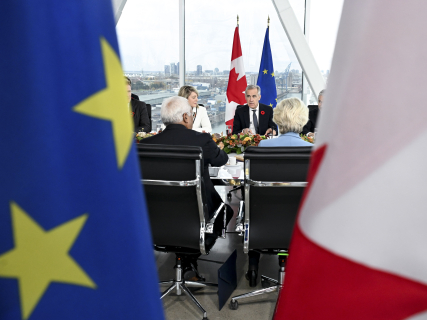
Up to Ottawa have traveled the President of the European Commission, Ursula von der Leyen, and the President of the European Council, António Costa, to seal with Canada their "Alliance for the Future". A new step in the rapprochement that Brussels considers its "most European partner", at a time when the continent seeks to project its political and economic influence beyond its borders. The new relationship, despite not finally incorporating the label of "associated member" initially proposed by the Community Executive, will allow strengthening trade, political and regulatory coordination between both powers.

From this week's summit, the negotiators emerge with a new Digital Trade Agreement under their arm, which will complement the current Comprehensive Economic and Trade Agreement (CETA). The intention is to establish a "modern" framework for this sector, improving "legal certainty and predictability", facilitating cross-border data flows and increasing confidence "in the digital economy for businesses and consumers".

In parallel, Ottawa has committed to participate in the European High Performance Computing Joint Undertaking (EuroHPC). Community sources point out that this move will contribute to strengthening connections "between supercomputing resources and will pave the way to further integrate our AI innovation ecosystems".

In this way, the teams led by Von der Leyen and the Canadian prime minister, Mark Carney, commit to "deepening cooperation" in areas such as research, innovation and emerging technologies. In this sense, one of the objectives now is to integrate Canada into the Horizon Europe program, with special attention to strategic matters such as "artificial intelligence, quantum technologies, semiconductors, photonics and advanced computing".

The negotiations have also reserved a specific space for small and medium-sized enterprises. Both parties want to facilitate that SMEs can access the digital infrastructures, specialized knowledge, financing instruments and relevant research opportunities. The aim is to extend the benefits of this technological cooperation beyond large companies and encourage the participation of the business fabric of both economies.

Regulatory interoperability and reciprocal access to AI markets

The final declaration reserves an explicit section for the safety of artificial intelligence and the interoperability of emerging models and systems, as well as of the respective digital regulatory frameworks. A commitment with which Brussels and Ottawa seek to bring their technological ecosystems closer and facilitate the activity of companies in both markets.

"We will support reciprocal access to our respective digital markets, including in the field of cloud and AI services and infrastructures," the document signed by both parties states.

Cooperation is therefore not limited to trade exchange, but also incorporates a regulatory dimension with which both powers aspire to strengthen the compatibility of their respective regulatory frameworks. An approach especially relevant in a context marked by the development of new digital obligations and the growing strategic importance of computing infrastructures and cloud services.

Critical raw materials, investments and Competition policy

In the economic chapter, the European Investment Bank (BEI) has reached an agreement to facilitate European investments in Canadian resources, especially in the field of critical raw materials. An initiative that is part of community efforts to diversify its supply chains and strengthen access to resources considered strategic for European industry.

Likewise, the executive vice president of the European Commission, Teresa Ribera, would have managed to tighten coordination between the Competition authorities of both powers, with the aim of "addressing anticompetitive conduct more effectively and fostering a more open market".

The declaration that puts an end to two days of work on the other side of the Atlantic also recognizes Canada's intention to join the 90 billion euro support loan to Ukraine that the Europeans agreed a year ago. A move that incorporates a financial and security dimension to the rapprochement between Brussels and Ottawa.

"We aspire to create unprecedented opportunities for our peoples and to offer ambitious cooperation in the following areas: trade and regulatory cooperation; digital, research and communication technologies; critical raw materials and energy; financial services and markets; security and preparedness; and people-to-people relations," the joint communiqué states.

A partnership without the associate member label

Beyond the sectoral agreements, Carney did want to revive during his speech the proposal to turn Canada into the first associate member state of the European Union, a formula put on the table by Ursula von der Leyen herself during her State of the Union address.

The Canadian prime minister has celebrated that both powers are tightening their ties "as closely as possible ever" with the aim of "creating opportunities for citizens". However, the concept of associate member does not finally appear included in the conclusions of the meeting, after some member states expressed their skepticism during the preparatory meetings.

The absence of this designation in the final text does not mean, for now, the abandonment of the initiative, although it leaves pending the definition of its eventual political and institutional scope. Brussels and Ottawa are thus moving forward in the integration of their commercial and regulatory relations without yet specifying Canada's fit in this new partnership formula.

"In the coming months we will determine the complete substantial scale and the scope of this new form of membership," Carney has stated during the press conference after the signing of the agreements.

The Canadian leader will also participate next month in the meeting of the European Political Community that will be held in Dublin, as well as in future meetings of the European Council. A presence with which both sides intend to give political continuity to the rapprochement and transfer the commitments reached in Ottawa to the next meetings of the European leaders.

More key points, information and questions with FREN

AI-GENERATED CONTENT

What is the status of the process for Canada to become an associated member of the European Union and what are the next planned steps?

Canada is not yet an associated member of the European Union. As of October 30, 2026, the process is in the political definition phase: both parties have launched a “Alliance for the Future” and have committed to concretizing a closer partnership by the 2027 bilateral summit. It is not a full accession negotiation nor is there a finalized legal status granting that condition.

What has been agreed so far

The proposal was presented by Ursula von der Leyen on September 16. The most recent development is the joint declaration of the 21st EU-Canada summit held in Montreal: Brussels and Ottawa will work to define an “ever closer” partnership, but “without reaching full accession.” The commitment opens a working phase, it does not conclude the process, as reported by Demócrata on the summit.

The important distinction is that the final declaration avoids the expression “associated member”, although Mark Carney continues to use it to describe the Canadian objective. Some Member States questioned that denomination: Demócrata identified reservations from Italy and Greece during preparations. Therefore, there is a willingness to deepen the relationship, but no agreement on all its terms nor on its definitive name (reservations and design of the alliance).

What it means legally

The Treaties do not contemplate a general category of “associated member state” with predetermined rights. Furthermore, the Commission has recalled that Article 49 of the Treaty on European Union reserves the accession application to European states. The Canadian proposal follows a different logic: to build a specially integrated relationship with an external country, without making it a full member (Commission clarification).

Von der Leyen summarized it on October 29 as an “association without accession”. In her official speech in Montreal, she explained three axes: greater policy alignment, greater institutional cooperation, and greater participation in programs. That ambition does not, by itself, grant Canada the rights of a Member State.

What are the next steps
  • Define the content. Over the coming months, European and Canadian teams will define the dimension and scope of the partnership. The planned cooperation covers trade, industry, climate, energy, artificial intelligence, security, and supply chains.
  • Design governance. Regular consultations between the Commission and the Canadian Government are proposed, as well as cooperation between parliaments and other institutions. How these mechanisms will function still needs to be specified.
  • Expand programs and mobility. The Commission proposes deepening Canadian participation in Erasmus+, strengthening its presence in the next generation of Horizon Europe, and facilitating cooperation on skills and professional qualifications.
  • Advance towards the 2027 milestones. Carney has expressed his expectation to close talks by June, when he plans to attend a European Council meeting. The joint commitment sets the next 2027 EU-Canada summit as a reference to define the new framework (announced timeline).

The key to the timeline: June is an expectation expressed by Carney; 2027 is the agreed political horizon to outline the partnership. Neither of these references constitutes a guaranteed date to acquire a new status. The next decisive outcome will be a concrete design, supported by institutions and Member States, specifying rights, obligations, and cooperation mechanisms.

What are the competencies and functions of the President of the European Council according to the EU treaties?

The President of the European Council is a key figure in the institutional architecture of the European Union. Their competencies and functions are mainly defined in the Treaty on European Union (TEU), especially in Article 15, and are complemented by political practice developed since the creation of the position with the Treaty of Lisbon.

In summary, the President of the European Council has four main blocks of functions: (1) organization and direction of the work of the European Council, (2) promotion of its activity and seeking consensus, (3) external representation of the Union at the level of heads of State or Government, and (4) accountability and information functions before other institutions.

1. Election and nature of the position

According to the TEU, the President of the European Council:

  • Is elected by the European Council itself by qualified majority.
  • Has a mandate of two and a half years, renewable once.
  • Cannot simultaneously hold a national mandate (for example, be head of State or Government of a Member State).

Therefore, it is a figure dedicated exclusively to the presidency of the European Council, distinct from the national leaders who compose it.

2. Organization and chairing of meetings

The core of the President's functions is to direct the functioning of the European Council, which brings together the heads of State or Government of the Member States, the President of the European Commission, and, on certain points, the High Representative for Foreign Affairs and Security Policy.

Among their organizational competencies, the treaties assign:

  • Calling and chairing the meetings of the European Council (ordinary, usually four per year, and extraordinary when necessary).
  • Setting, together with the Member State holding the Presidency of the Council of the EU and the President of the Commission, the agenda of the summits, in line with the strategic priorities of the Union.
  • Ensuring proper preparation of the meetings, coordinating preliminary work, draft conclusions, and contacts with capitals.

In practice, this makes the President the political “conductor” of the European summits, with intense mediation work before and during sessions.

3. Promotion, cohesion, and seeking consensus

The TEU establishes that the European Council “shall provide the Union with the necessary impetus for its development and shall define its general political directions and priorities.” The President is directly responsible for ensuring this happens in an orderly and effective manner.

Their functions in this area include:

  • Ensuring the preparation and continuity of the work of the European Council, guaranteeing follow-up of decisions taken and coherence between different summits.
  • Fostering cohesion and consensus among members of the European Council, which implies an active mediation role in crises, complex negotiations (e.g., multiannual financial frameworks, enlargements, major institutional reforms), and conflict situations between States.
  • Driving the major strategic orientations of the EU, for example on climate, digitalization, economic policy, or crisis response, ensuring summit decisions are clear and applicable.

Although the President has no legislative initiative nor unilateral decision-making power, their capacity to build compromises and articulate political priorities decisively influences the Union's agenda.

4. External representation of the Union

The treaties also assign the President of the European Council a role of representing the EU externally, “at their level and without prejudice to the powers of the High Representative.” Specifically:

  • Represents the Union at the level of heads of State or Government on foreign and security policy issues, especially at summits with third countries or groups of countries (e.g., G7, G20, or EU–strategic partners summits).
  • Coordinates their actions with the High Representative, who is the head of European diplomacy and chairs the Foreign Affairs Council. The President acts as the “political face” of the heads of State or Government, while the High Representative assumes day-to-day and diplomatic management.

This representation does not replace that of the Commission (competent in many external areas, such as trade) nor that of the Member States, but offers a unified political voice at the highest level.

5. Information and accountability

The President of the European Council must also ensure connection with other institutions:

  • Reports to the European Parliament after each European Council meeting, explaining the conclusions reached and responding to MEPs' interventions in a subsequent debate.
  • Coordinates with the President of the European Commission, with whom they must work closely so that the political orientations of the European Council translate into concrete legislative and policy initiatives.
6. Limits of their powers

Although a very visible figure, their powers are clearly limited by the treaties:

  • They do not have own decision-making power over Union policies: decisions are adopted collectively by the members of the European Council.
  • They cannot impose results; their role is to mediate, propose compromise formulas, and facilitate agreements.
  • Their mandate is institutionally separated from national governments and the Commission, aiming to guarantee a relatively neutral presidency oriented to the general interest of the Union.

In sum, according to the EU treaties, the President of the European Council is a “chief facilitator”: organizing, promoting, and personifying the action of the European Council, without replacing the sovereignty of the heads of State or Government nor the prerogatives of the Commission and the High Representative.

How is the President of the European Council practically elected and what political balances usually influence their appointment? How does the role of the President of the European Council differ from that of the President of the European Commission and the High Representative? Could you explain with concrete examples how a recent President of the European Council has exercised these functions?

What legal requirements are necessary for a non-European country to access research programs like Horizon Europe?

Access for a non-European country to EU R&D programs such as Horizon Europe is not done on a country-by-country improvised basis, but is regulated in the Horizon Europe Regulation itself and in international agreements that the EU signs with those States. Legally, there are two levels worth distinguishing:

  • Participate occasionally in projects (as a consortium partner).
  • Become a “associated country” to the program, with rights almost equivalent to Member States.
1. Basic legal framework: Horizon Europe Regulation

The Regulation (EU) establishing Horizon Europe defines who can be a beneficiary and, above all, who can apply for associated country status. Simplified, it requires that:

  • The third country shares fundamental EU values and principles (democracy, rule of law, respect for human rights).
  • It has sufficient scientific, technological, and innovative capacity, so that its participation adds value to the program.
  • It has an adequate legal and administrative framework to manage public R&D funds, with financial controls, audits, and anti-fraud and corruption mechanisms comparable to those of the EU.
  • It guarantees adequate protection of intellectual property and data, and the possibility to enforce rights (effective courts, adherence to international IP treaties, etc.).
  • It accepts the participation rules of the program (eligibility of entities, consortium rules, dissemination obligations, open access, clauses on sensitive data, security, etc.).

These requirements are not applied only in the abstract: they are embodied in an international association agreement between the EU and the interested country.

2. Association to Horizon Europe: the international agreement

If a non-European country wants to “fully access” Horizon Europe, in practice it seeks to become an associated country. Legally this implies:

  • The EU negotiates and signs an Program Association Agreement with that country (an international treaty under EU and third country law).
  • That agreement sets:
    • The financial conditions (annual contribution to the program budget, possible adjustment mechanisms according to the return obtained, etc.).
    • The material scope of the association: to all of Horizon Europe or only certain parts (e.g., pillar II, or certain institutionalized partnerships).
    • Provisions on control, audit, and fund recovery by the European Commission or the European Court of Auditors.
    • Clauses on security, use of results and data, especially in sensitive areas (space, defense, critical technologies).
    • Mechanisms for dispute resolution and grounds for suspension or termination of the agreement.
  • The third country must incorporate into its internal legal order what is necessary to apply these rules (e.g., adapt public procurement, subsidies, or financial control rules to allow its entities to receive EU funds and be subject to European audits).

Only once that agreement is signed and in force, entities from the associated country are, generally, as eligible and fundable as those from Member States (except specific reservations that the agreement or work program bases may contain).

3. Eligibility without association: participation as a third country

Aside from association, Horizon Europe rules allow entities from non-associated countries to participate in projects. Legally, this requires:

  • The third country is not subject to EU sanctions, restrictions, or security measures that prevent scientific cooperation or fund flows.
  • The work program declares that country eligible for automatic funding (usually developing countries) or, if it is a high-income country, that its entities:
    • Participate without EU funding (providing their own national or private resources), or
    • Receive EU funding exceptionally when the topic or call clearly justifies their participation.
  • Entities comply with general beneficiary obligations (financial and operational capacity, acceptance of Commission audits, respect for ethical rules, etc.).
4. Key difference: political requirements vs. purely technical requirements

In summary, for a non-European country to fully access Horizon Europe as an associated country, the main needs are:

  • Political and values alignment with the EU.
  • A solid internal legal framework regarding public finances, control, intellectual property, and effective justice.
  • The signing and ratification of an international association agreement that includes those conditions and the financial contribution to the program.

To participate without association, the requirements are more limited and focus on eligibility of entities and projects, but without the broad rights granted by associated country status.

Could you explain with concrete examples which non-European countries are associated to Horizon Europe and what agreements they have signed? What practical differences exist, for a foreign university, between participating as an associated country or as a non-associated third country in Horizon Europe? How is intellectual property protection legally structured in Horizon Europe projects with partners from third countries?

Play

Test your knowledge with FREN!

How much do you know about this topic? Answer the following 3 questions.

What agreement have the European Union and Canada signed to facilitate cooperation in digital trade?

Question 1 of 3

In which initiative will Canada participate to strengthen supercomputing alongside the EU?

Question 2 of 3

Which aspect was NOT ultimately included in the joint declaration of the EU and Canada?

Question 3 of 3