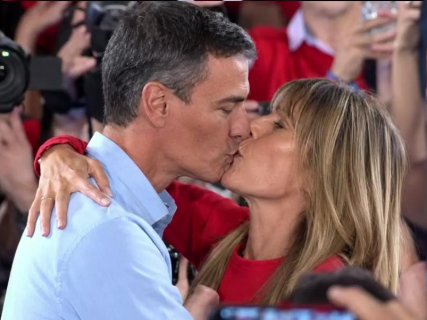
Sánchez to Begoña Gómez in the middle of a rally in Fuenlabrada: "Let them hear it loud and clear: I love you"

The president of the Government dedicates some emotional words to his wife, present at the socialist event, and denounces the attempts to "break" his family. "Today we are more united than ever," he assures amid the applause of the militants, before embracing Begoña Gómez.

WhatsApp Image 2026 10 17 at 12.23.55

WhatsApp Image 2026 10 17 at 12.23.55

Add DEMÓCRATA to Google

Ask FREN

Published

Last updated

5 minutes

Most read

España vota · Congreso y Senado

Elecciones generales 29 de noviembre de 2026

Se eligen 350 diputados y los senadores de elección directa. Encuestas, calendario, candidaturas, programas y todo lo que necesitas saber para votar.

Faltan 42 días y 20 horas para que abran los colegios electorales.Hasta que abran los colegios, el domingo 29 a las 09:00 (hora peninsular).
Entra en el especial

Próximas fechas

  1. Presentación de candidaturas al Congreso y al Senado21–26 oct · Fecha prevista
  2. Voto desde el extranjero (CERA): envío de la documentación24–30 oct · Fecha prevista
  3. Publicación de las candidaturas presentadasFecha prevista
  4. Proclamación de candidaturasFecha prevista
Calendario completo

The president of the Government, Pedro Sánchez has starred this Saturday in one of the most personal moments of the PSOE rally held in Fuenlabrada (Madrid) by dedicating a public declaration of love to his wife, Begoña Gómez, who attended the event to accompany him. In the middle of his speech before the socialist militants, the general secretary of the PSOE interrupted his political discourse to address his wife directly, thank her for her support over the last few years, and claim the strength of their relationship in the face of the controversies that have affected their family environment.

"Let them hear it loud and clear: I love you", Sánchez proclaimed before the attendees, who responded with applause. The president accompanied these words with a defense of the unity of his family and denounced that, over the last few years, they have had to face numerous episodes of political and media pressure. "They have tried to break us in every way and they have not succeeded. Today we are more united than ever", he assured, in one of the most emotional interventions of the day.

The socialist leader also wanted to thank Gómez for her role within the family. "Thank you for being my wife, the mother of my daughters, and for being my woman", he declared before embracing his wife, while the attendees responded with applause. The scene has acquired special prominence in an event initially conceived to present the PSOE candidacies for the general elections on November 29 and to stage the party's support for Sánchez as a candidate for reelection.

Sánchez claims the strength of his marriage in the face of controversies of recent years

The presence of Begoña Gómez at the Fuenlabrada rally comes after more than two years in which the president's wife has been at the center of various political and judicial controversies. Since April 2024, when an investigation into her professional activities began, the so-called Begoña Gómez case has generated intense confrontation between the Government and the opposition, with constant references to Sánchez's wife's situation in parliamentary debate.

The president of the Government has denounced on numerous occasions what he considers a campaign of personal attacks against him and his family, an interpretation that he has also extended to other members of his environment. His words this Saturday have once again placed that personal dimension at the center of his speech, although this time with a message directed expressly to his wife. Sánchez wanted to convey that the difficulties faced during these years have not weakened their relationship, but rather, he has stated, have strengthened their family ties.

The judicial investigation into Gómez continues its course after the magistrate Juan Carlos Peinado agreed to open oral proceedings for alleged crimes of influence peddling and embezzlement. The Prosecutor's Office has requested his acquittal, considering that the investigated facts do not constitute a crime. The president's wife has denied the irregularities attributed to her and maintains her right to the presumption of innocence as long as there is no final sentence.

The message delivered in Fuenlabrada also recalls one of the most significant political episodes of Sánchez's current term. In April 2024, the president suspended his public agenda for five days to reflect on his continuity at the head of the Government, after it became known that judicial proceedings had been opened against his wife. Finally, he announced that he would remain in office and denounced the deterioration of public debate and the attacks directed against his family environment.

Begoña Gómez accompanies the president at a key event for the PSOE before the 29N

Begoña Gómez's participation in the socialist day coincided with one of the most important events of the PSOE's pre-campaign. The Federal Committee of the party unanimously proclaimed Pedro Sánchez as the candidate for the Presidency of the Government and ratified the lists for the Congress of Deputies and the Senate for the general elections on November 29. The meeting was held at the Tomás y Valiente Art Center in Fuenlabrada, outside the usual headquarters of Ferraz, and led to a rally with leaders and militants of the formation.

The socialist leadership has chosen this municipality in the south of Madrid, governed by the PSOE, to promote the mobilization of its supporters and present the general lines of its electoral strategy. The event was also attended by the general secretary of the PSOE of Madrid, Óscar López; the mayor of Fuenlabrada, Javier Ayala; and the general secretary of Juventudes Socialistas, Aránzazu Figueroa. Sánchez's intervention served to close the day and reinforce his prominence as the socialist candidate.

However, the most personal moment of the speech came when Sánchez decided to address Begoña Gómez, stepping away for a few moments from strictly electoral issues. The president publicly thanked her for her support, highlighted the resilience of their relationship, and made a declaration of love that was met with a standing ovation from the attendees.

A rally marked by socialist unity and changes in Ferraz

The gesture towards Begoña Gómez occurred on a day when the PSOE has tried to project an image of internal unity, after several days of movements in its structure and negotiations to finalize its electoral alliances. Sánchez's proclamation as a candidate coincided with the ratification of the lists for the 29N and with the agreement reached between the socialists and the Frente Amplio to present joint candidacies for the Senate, an initiative with which both organizations aim to challenge the Popular Party for the majority it holds in the Upper House.

The Federal Committee has also been influenced by the resignation of Montse Mínguez as federal spokesperson for the PSOE and her replacement by Rebeca Torró, current secretary of Organization. The Federal Executive Commission has also approved the appointments of Cristina Narbona as secretary of Studies and Programs and Javier Alfonso Cendón as general secretary of the Socialist Group in Congress, thus completing a reorganization that comes just a few weeks before the elections.

In this context, Sánchez's intervention combined messages of political mobilization with an appeal to his personal experience. The president has turned the presence of his wife into an opportunity to publicly assert their relationship, linking the difficulties he claims to have faced with the strength of their marriage.

The hug between both and the applause from the audience have closed one of the most outstanding moments of the event. "They have tried to break us in every way and they have not succeeded", Sánchez has insisted, before delivering the message that has concentrated the attention of the attendees: "Let them hear it loud and clear: I love you".

More key points, information and questions with FREN

AI-GENERATED CONTENT

What stage is the judicial investigation into Begoña Gómez at, and what are the next procedural steps planned?

As of October 17, 2026, the case against Begoña Gómez has already passed the investigation phase and has an open oral trial. Judge Juan Carlos Peinado ordered this opening on September 21 for alleged crimes of influence peddling and embezzlement, to be tried by jury at the Provincial Court of Madrid. There is not yet an official date for the hearing, and the opening of the trial does not imply a declaration of guilt.

Current status of the procedure

The September ruling replaced a previous opening that had been nullified following the intervention of the Provincial Court. The court had ordered to revert actions to adjust the accusations and defenses to a more limited scope. After repeating this procedure and holding a preliminary hearing on September 8, Peinado reopened the oral trial, as reported by Demócrata.

The jury procedure is thus defined as follows:

  • Begoña Gómez: alleged crimes of influence peddling and embezzlement. The first is linked to the supposed use of her position to promote activities at the Complutense University; the second, to the work carried out by her advisor from Moncloa for Gómez's activities.
  • Cristina Álvarez: alleged embezzlement for that assistance. She does not face an accusation of influence peddling in this case.
  • Juan Carlos Barrabés: is excluded from this jury procedure. His separation does not necessarily mean the definitive dismissal of all proceedings related to him.

Accusations of corruption in business and misappropriation were also excluded from this case. The Court had also removed the passport withdrawal, the prohibition to leave Spain, and the biweekly appearances previously imposed, as explained by Demócrata in July.

Next procedural steps

The next set of actions focuses on preparing the trial, not extending the investigation. The published information about the schedule identifies these steps:

  • Referral and assignment at the Provincial Court: allocation of the case to the corresponding section and designation of the magistrate who will preside over the jury court.
  • Written submissions and preliminary issues: the parties will specify their positions and may raise procedural objections, including possible nullities or disputes over evidence.
  • Resolution of these issues and preparation of the hearing: delimitation of the facts that will reach the trial and decision on witnesses, documents, and other admissible evidence.
  • Scheduling and constitution of the jury: setting the sessions and selecting nine main jurors and two alternates, with the parties' possibilities of challenge.

These procedures are described in the information about the next steps. They should not be confused with the preliminary hearing in September, which was already held before the instructor.

Prosecutor's Office and time forecast

The Prosecutor's Office has requested the complete acquittal of Gómez and Álvarez, considering that the facts do not constitute a crime and that there was no economic harm to the Complutense University, according to the information published in October. This request does not automatically dismiss the case if other accusations maintain their claims.

Journalistic forecasts place the trial in 2027, but these do not constitute a judicial scheduling. Peinado's retirement does not halt the procedure: his involvement ended with the opening of the trial, and it is up to the Court to continue the preparation, as noted by Demócrata. Gómez fully retains her presumption of innocence.

What are the powers of the Prime Minister in Spain according to the Constitution and current legislation?

The Prime Minister directs the Executive's actions and coordinates its members, but does not concentrate all its powers: ministers retain their own responsibility, and certain decisions correspond to the Council of Ministers. The basic framework is in Articles 97 and 98 of the Spanish Constitution and, especially, in Article 2 of Law 50/1997, of the Government.

1. Political leadership and coordination

He is responsible for representing the Government, establishing its political program, determining the guidelines of domestic and foreign policy, and overseeing their compliance. He may issue instructions to other members of the Executive and resolve conflicts of jurisdiction between ministries. This leadership must respect the competencies and direct responsibility of each minister in their management.

He also convenes and presides over the Council of Ministers and sets its agenda. There is a constitutional exception: the king may preside over it to be informed of State affairs, at the Prime Minister's request.

2. Composition and organization of the Executive

  • Ministerial team: proposes to the king the appointment and dismissal of vice presidents and ministers; the formal appointment and dismissal correspond to the monarch, according to Article 100 of the Constitution.
  • Structure: creates, modifies, and abolishes ministerial departments and state secretariats by royal decree, and approves the organic structure of the Presidency of the Government.
  • Task distribution: entrusts functions to vice presidents and proposes to the Council of Ministers the creation, modification, or suppression of delegated government commissions.

3. Relations with Congress and elections

He has two especially relevant powers, both subject to prior deliberation by the Council of Ministers:

  • Vote of confidence: may ask Congress to endorse his program or a general policy statement. According to Article 112, a simple majority suffices; if he loses the vote, the Government must resign.
  • Parliamentary dissolution: may propose to the king, under his exclusive responsibility, the dissolution of the Congress, the Senate, or both Chambers. Article 115 prohibits doing so while a motion of censure is pending and, as a general rule, before one year has passed since the previous dissolution.

He also proposes to the king the calling of a consultative referendum, subject to Congress authorization. Therefore, he cannot call it unilaterally.

4. Crown, defense, and constitutional control

  • Acts of the king: countersigns those that correspond to him, that is, formally endorses them and assumes responsibility for them. He submits laws and other norms with the force of law to the monarch for sanction. Not all countersignatures correspond to him: certain acts correspond to the president of Congress or ministers.
  • Defense: directs defense policy and exercises, regarding the Armed Forces, the functions provided in national defense legislation and military organization. This direction should not be confused with the supreme command that the Constitution attributes to the king.
  • Constitutional Court: may file appeals of unconstitutionality against laws and norms with the force of law.

5. Limits and responsibility

Leading does not mean deciding everything individually. The approval of bills, the budget draft, royal decree-laws, and certain regulations corresponds to the Council of Ministers. Government decisions on states of alarm and exception and the proposal of the state of siege are also collegiate.

The Prime Minister is subject to parliamentary control through questions, interpellations, and appearances. The Government is collectively responsible before Congress, which may replace it through a motion of censure approved by an absolute majority and including an alternative candidate. Its actions must respect the Constitution, laws, and corresponding judicial control.

What results did the PSOE obtain in the last general elections and how many seats does it currently have in the Congress of Deputies?

In the last general elections held in Spain, on July 23, 2023, the PSOE obtained 7,821,718 votes, 31.68% of valid votes, and 121 seats in the Congress of Deputies. It came in second place, behind the PP. The 121 seats are its reference electoral representation, although it is important to distinguish that result from the composition of Congress at a specific date.

The definitive result of the PSOE

The comparison of definitive results published by Demócrata includes the PSC and associated candidacies integrated into the socialist total. For the July 2023 elections, it records these figures:

  • Votes: 7,821,718 ballots.
  • Percentage: 31.68% of valid votes.
  • Representation: 121 deputies.
  • Position: second candidacy nationwide.

It is important to use the definitive result and not mix it with provisional data from election night. Different sources show varying figures of votes and percentages; for this answer, the comparison that explicitly identifies its figures as definitive and uses the same criteria for all calls is taken.

How it changed compared to previous elections

In the general elections of November 10, 2019, the PSOE had obtained 6,792,199 votes, 28.00%, and 120 deputies. Therefore, in July 2023 it added 1,029,519 votes and one seat compared to its previous result, although it moved from first to second position. These data come from the same comparison of definitive results.

The 2023 result was the highest in votes and percentage of the five general elections in which Pedro Sánchez had been a candidate. However, it was not his highest in deputies: in April 2019, the PSOE obtained 123 seats, two more than in 2023, despite having fewer votes then. The difference illustrates that the national percentage and the number of representatives do not necessarily evolve proportionally.

What the figure of 121 seats currently means

If you ask about the seats the PSOE won in the last general elections, the unequivocal answer is 121. That remains the figure that recent reports use to compare the socialist result of 2023 with estimates for future elections, as shown by this comparison published in October.

However, obtaining 121 seats in an election and having 121 members in a parliamentary group at any later time are different statements. Resignations, substitutions, or changes of affiliation must be checked to give an exact composition at a given date. The sources consulted do not offer a complete verification of that composition as of October 17, 2026; therefore, I do not present the electoral result as if it were an updated count of group members.

Polling figures should also not be confused with seats actually obtained: a survey estimates a possible result but does not itself modify parliamentary representation. In summary: the PSOE won 121 deputies in the last general elections, with 7,821,718 votes and 31.68%; the exact parliamentary composition today requires a different verification from the ballot result.

Play

Test your knowledge with FREN!

How much do you know about this topic? Answer the following 3 questions.

In which Madrid municipality was the PSOE rally held where Pedro Sánchez dedicated a message to his wife?

Question 1 of 3

What words did Pedro Sánchez publicly say to express his support and affection for Begoña Gómez during the event?

Question 2 of 3

What electoral agreement did the PSOE recently reach, announced during the day in Fuenlabrada?

Question 3 of 3