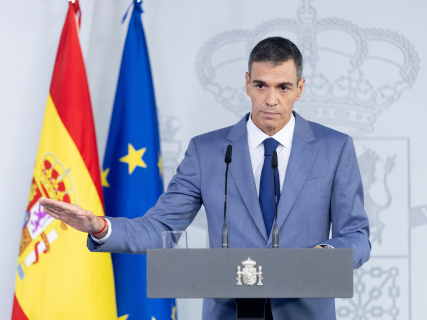
The Electoral Board files a complaint against Pedro Sánchez for asking for a "more resounding majority" from Moncloa after bringing forward elections.

The JEC partially estimates the complaints of the PP and Se Acabó la Fiesta for the statements of the president of the Government after the Council of Ministers on October 6. It orders the withdrawal of the questioned messages from the official channels and opens a procedure that could end with a fine of between 300 and 3,000 euros.

EuropaPress 7824329 presidente gobierno pedro sanchez rueda prensa posterior consejo ministros

EuropaPress 7824329 presidente gobierno pedro sanchez rueda prensa posterior consejo ministros

Add DEMÓCRATA to Google

Ask FREN

Published

Last updated

2 minutes

Most read

The Central Electoral Board (JEC) has agreed this Thursday to open a sanctioning file against the President of the Government, Pedro Sánchez, for his statements during the press conference after the Council of Ministers on October 6, held at the Palace of Moncloa once the general elections of November 29 were called. The body considers that some of his statements may have violated the obligation of institutional neutrality during the electoral period.

The resolution partially upholds the complaints filed by the PP and Se Acabó la Fiesta and orders the removal of the questioned statements from the official channels where they are still published. The opening of the procedure does not imply, for the moment, the imposition of a definitive sanction.

The request for a broader majority, at the center of the file

The Electoral Board considers that Sánchez went beyond the explanation of the housing measures approved by the Executive during that meeting of the Council of Ministers. According to the resolution, the president included references to the achievements of his Government, criticisms of the opposition parties, and allusions to the need to gain greater parliamentary support.

Among the expressions pointed out by the body is his request for "a more resounding, more forceful majority" to respond to the housing crisis. The JEC understands that this type of statement, made from an institutional appearance and once the elections were called, may conflict with the restrictions established by electoral legislation.

Article 50.2 of the Organic Law of the General Electoral Regime (LOREG) prohibits public authorities from organizing or financing events that contain allusions to the achievements obtained by public authorities from the calling of elections until their celebration.

The Electoral Board recalls previous sanctions against Sánchez

The agreement also refers to the president of the Government's background for violations of electoral regulations. The JEC considers that Sánchez "should have sufficiently known" the demands of institutional neutrality, since he had already been sanctioned for statements made at official events during other electoral processes.

Specifically, the resolution mentions sanctioning agreements from 2020, 2023, 2024, and 2026, related to demonstrations made during institutional appearances, including press conferences following meetings of the Council of Ministers.

A possible fine of up to 3,000 euros

The opening of the file initiates a procedure in which Sánchez will be able to present allegations and exercise his defense. The infringement could entail a fine of between 300 and 3,000 euros, although the final amount will depend on the instruction and the resolution adopted by the Electoral Board.

The body grants the president ten working days from the notification to formulate allegations. It also contemplates the possibility of making a voluntary payment of 2,400 euros, an amount that would be reduced to 1,800 euros if, in addition, he acknowledges his responsibility within the established period.

The decision comes after the PP reported on the same October 6 that Sánchez had used his appearance in Moncloa to make electoral statements.

More key points, information and questions with FREN

AI-GENERATED CONTENT

What is the current stage of the sanctioning procedure opened by the Central Electoral Board against Pedro Sánchez, and what are the deadlines foreseen for its definitive resolution?

As of October 15, 2026, the most recent sanctioning procedure opened by the Central Electoral Board (JEC) against Pedro Sánchez is in its initial phase, after its initiation was agreed, due to the appearance on October 6 at La Moncloa. There is not yet a proposal for resolution nor a definitive sanction. Nor has a specific date been publicly communicated to conclude the procedure.

What is being investigated

The procedure examines the possible breach of the duty of institutional neutrality provided in article 50.2 of the Organic Law of the General Electoral Regime (LOREG). The issue is whether Sánchez used an official appearance, already within the electoral period, to make partisan statements. Demócrata reported the complaint from the PP filed on October 6; subsequent reports account for the opening of the procedure.

The JEC has also ordered the removal of statements from institutional channels, maintaining technical information about the agreements of the Council of Ministers. This measure should be distinguished from a possible fine: removing content does not equate to having already imposed a firm sanction. This is reflected in the reports from Onda Cero and El Mundo.

There is also a difference between the appearances on October 5 and 6: regarding the first, prior to the application of electoral restrictions, the issue is its continued presence on official channels afterwards, not its original content, according to Expansión and Vozpópuli.

What procedures remain

The opening initiates the procedure to determine if there is sanctioning responsibility; it does not conclude it. The pending sequence includes:

  • Notification and defense: communication to the interested party and opportunity to present allegations.
  • Instruction: examination of the facts and the arguments provided.
  • Proposal for resolution: formulation of the result of the instruction before the final decision.
  • Resolution of the JEC: agreement determining whether to sanction and, if so, with what amount.

Reports place the possible fine between 300 and 3,000 euros, but this range does not mean that an amount has already been agreed. Servimedia also points out the possibility of voluntary acknowledgment of responsibility and reduction of the fine, as well as judicial appeal if a sanction is imposed.

What deadlines can be considered established

There is no closed public schedule of allegations, proposal, and resolution for this procedure. The consulted sources also do not specify the maximum legal deadline applicable to the case nor the notification date necessary to calculate the deadlines. Therefore, it is not justified to announce a specific deadline or to assure it will end before the elections.

An estimate of weeks or months should not be confused with an official deadline. Also, “definitive resolution” can refer to two different moments: the decision that closes the procedure before the JEC and the subsequent finality, if that decision is judicially appealed. The second moment could be after the first.

It is advisable not to mix this matter with the procedure for the appearance on December 15, 2025, whose opening was published by Demócrata on December 19. The two-month appeal period mentioned in that news was not a deadline to resolve the new procedure. In summary: the current procedure has just been opened and its resolution date is not announced.

What are the functions and powers of the President of the Government of Spain according to the Constitution and current legislation?

The President of the Government of Spain is the highest authority of the Executive Power and the political leadership center of the country. His functions and powers mainly derive from the Spanish Constitution of 1978 (especially articles 97 to 101 and 112 to 116) and Law 50/1997, of November 27, on the Government. Below is a summary of the most relevant ones.

1. Direction of Government action

  • Direct the Government's action: the Constitution establishes that the Government directs domestic and foreign policy, the civil and military administration, and the defense of the State; and that the president directs this collective action, setting the priorities and strategy of the Executive.
  • Coordinate the ministers: the president organizes and coordinates the work of the different ministries, resolves conflicts of competence among them, and ensures the coherence of governmental action.
  • Normative and programmatic impulse: he is responsible for setting the main lines of the Government's legislative action (bills, royal decree-laws, royal legislative decrees) and approving, together with the rest of the cabinet, government programs and plans.

2. Representation of the Government and political responsibility

  • Highest representative of the Government: represents the Government before the Cortes Generales, other State powers, and, in practice, also externally in coordination with the King and the Minister of Foreign Affairs.
  • Political responsibility before the Congress: the Government as a whole is politically accountable to the Congress of Deputies, but this responsibility is mainly articulated through the president, who may be subjected to:
    • Vote of confidence: the president himself can request the Congress's support on his program or a general policy declaration. If lost, he must present the Government's resignation.
    • Motion of censure: the Congress can demand his replacement through a constructive motion of censure, proposing a new candidate for the presidency.
  • Daily parliamentary control: answers questions, interpellations, and appearances in the Chambers, accounting for the Executive's action.

3. Appointment, dismissal, and internal organization of the Government

  • Proposal of appointment and dismissal of ministers: once invested by the Congress and appointed by the King, the president proposes to the King the appointment and dismissal of vice presidents and ministers. In practice, he decides the composition, structure, and adjustments of the cabinet.
  • Configuration of the Government's structure: directs the internal organization of the Executive, deciding the number of ministries, creation or suppression of departments, and setting the main areas of competence, through royal decrees of structure.
  • Direction of collegiate Government bodies: presides over the Council of Ministers and other governmental collegiate bodies created, sets their agenda, and leads deliberations.

4. Relations with the King, the Cortes, and other powers

  • Relation with the Head of State: proposes to the King the appointment and dismissal of ministers, regularly informs him of State affairs, and endorses many of his acts (for example, the call for a referendum or the proposal to dissolve the Chambers).
  • Power to propose the dissolution of the Cortes: can propose to the King the dissolution of the Congress, the Senate, or the Cortes Generales and the calling of general elections, within the limits set by the Constitution (not during a pending motion of censure, respecting certain deadlines, etc.).
  • Government legislative initiative: leads the Government as the subject with legislative initiative to present bills, as well as to request urgent processing of certain initiatives.

5. Powers in extraordinary situations

  • States of alarm, exception, and siege: the Government directs security policy and, under the president's authority, can declare the state of alarm by decree, which must then be ratified by the Congress; and propose to the Cortes the declaration of states of exception and siege. In these situations, the president is the center of political decision.
  • Direction of defense policy: although the King holds supreme command of the Armed Forces, it corresponds to the Government, under the president's direction, the defense of the State and effective political-military command through the Ministry of Defense.

6. Other notable functions

  • Relevant appointments and dismissals: proposes or agrees, according to sectoral regulations, certain appointments of high authorities (for example, positions in the General State Administration, regulatory bodies, etc.), usually through royal decrees agreed in the Council of Ministers.
  • International representation: together with the King and the Minister of Foreign Affairs, leads foreign policy, participates in international summits, negotiates or promotes treaties (which must then be authorized or ratified according to the Constitution).
  • Function of territorial impulse and coordination: directs the Government's policy regarding autonomous communities and local entities, ensuring coordination and respect for the constitutional order of distribution of competences.

In summary, the Constitution and current legislation configure the President of the Government as the true political decision center of the Executive: the one who sets the general orientation, coordinates the cabinet, answers before the Congress, and articulates the State's action both internally and externally.

Could you explain in more detail how the motion of censure against the President of the Government works? What differences are there between the functions of the President of the Government and those of the King in the Spanish constitutional system? How does the President of the Government coordinate with the autonomous communities in matters of shared competences?

What has been Pedro Sánchez's political and professional trajectory before assuming the presidency of the Government?

Before becoming President of the Government in June 2018, Pedro Sánchez combined a career as an economist and professor with municipal politics, parliamentary activity, and leadership of the PSOE. His path was not linear: he temporarily lost his seat, resigned as secretary general, and later regained leadership through primaries. His main stages were as follows.

Economic training and international experience

Born in Madrid on February 29, 1972, he graduated in Economic and Business Sciences in 1995 from the Royal University College María Cristina, affiliated with the Complutense University. He expanded his training with a master's degree in European Union Economics from the Free University of Brussels and studies on European economic and monetary integration at the Ortega y Gasset University Institute. In 2012 he obtained a doctorate in Economics from the Camilo José Cela University (La Moncloa biography).

His first professional experiences had an international dimension. He worked as an advisor in the European Parliament and later was part of the High Representative's cabinet in Bosnia and Herzegovina. Later he worked as a professor of Economics at Camilo José Cela University, where he began teaching in 2008, with subjects related to economic structure and the history of economic thought (CIDOB profile).

Membership and municipal politics

He joined the PSOE in 1993. His first stage of membership was linked to Madrid, before moving to institutions. In 2003 he was on the socialist municipal candidacy headed by Trinidad Jiménez, although he initially did not obtain a councilor seat (Antena 3 biographical profile).

He entered the Madrid City Council in 2004, after Elena Arnedo's resignation, and remained until 2009. During that stage, he served in municipal opposition and participated in bodies linked to the city council, including the General Assembly of Caja Madrid and the boards of the municipal companies for Promotion of Madrid and Housing and Land (CIDOB profile).

Entry and return to Congress

In 2009 he accessed Congress as a deputy for Madrid, replacing Pedro Solbes. He remained until 2011, when he did not obtain a seat in the general elections. During the interval, he reinforced his teaching activity and completed his doctorate. He returned to the Chamber in 2013, after Cristina Narbona's resignation (EFE political profile).

Socialist leadership and 2016 crisis

In July 2014 he was elected secretary general of the PSOE by membership vote, succeeding Alfredo Pérez Rubalcaba. From that responsibility, he led the opposition to Mariano Rajoy and was the socialist candidate in the December 2015 general elections (La Moncloa biography).

In March 2016 he tried to be invested president with an agreement with Ciudadanos, but did not gather enough support. He again led the socialist candidacy in June. The subsequent internal dispute over government formation ended in his resignation as secretary general in October; that same month he also resigned his seat (EFE political profile).

Recovery of leadership and arrival to Government

After traveling Spain seeking support among members, he won the primaries on May 21, 2017, against Susana Díaz and Patxi López. He thus recovered the PSOE leadership and resumed opposition leadership. His previous trajectory culminated on June 1, 2018, when the motion of censure against Mariano Rajoy succeeded, presented after the Gürtel case sentence (EFE political profile).

Play

Test your knowledge with FREN!

How much do you know about this topic? Answer the following 3 questions.

Which body has opened a disciplinary file against Pedro Sánchez for his statements after the election call?

Question 1 of 3

Which article of the Organic Law of the General Electoral Regime (LOREG) prohibits references to Government achievements after the election call?

Question 2 of 3

What is the maximum amount of the fine that could be imposed on Pedro Sánchez for this infraction?

Question 3 of 3