

At this moment of the pre-campaign, two demographic studies that DEMÓCRATA has had access to place Vox close to 75 seats, the PP around 124, and the PSOE below 120. The projections depict a growth of Vox greater than expected in other polls and a general setback of leftist and independentist formations, with the exception of ERC and EH Bildu. The scenario coexists with a pool of about six million undecided voters, concentrated to a greater extent in the leftist electorate, and contrasts with the latest CIS barometer, which gives the PSOE a lead of almost 12 points over the PP.
The distance between private estimates and the public poll again places the electoral behavior of the PSOE at the center of the demographic debate. While the studies consulted by DEMÓCRATA point to a Chamber more favorable to the right, the CIS maintains Pedro Sánchez's party as the first force with a wide difference over the popular party.
The electoral picture, however, is far from definitive. The high volume of voters who have still not decided their ballot and the dispute for the last seats in various constituencies can alter the final distribution. In an electoral system where votes do not translate uniformly into deputies, a few thousand votes can be decisive.
The CIS draws another scenario
The CIS barometer published this Wednesday estimates that the PSOE would obtain 34% of the votes, compared to 22.2% for the PP. Vox would reach 17.1%, while Sumar would be at 6.1% and Podemos at 3.1%. The survey was conducted between October 1 and 6, with 5,025 interviews.
The result gives the socialists a lead of 11.8 points over the popular party. The distance contrasts with the general elections of July 2023, when the PP was the first force with 33.1% of the votes and 137 seats, compared to 31.7% for the PSOE and its 121 deputies. In that election, Vox obtained 12.4% of the votes and 33 seats.
The comparison with the results of 2023 reflects a considerable change in the CIS estimate: the PSOE gains 2.3 points compared to the last general elections, while the PP loses 10.9. Vox, for its part, advances 4.7 points. The movement drawn by the agency chaired by José Félix Tezanos differs from that recorded by other private polls, which place the popular party ahead of the socialists and attribute to Vox sufficient growth to consolidate itself as the third force with a much larger parliamentary group.
The CIS does not publish an official estimate of seats in this barometer. The projection of deputies that accompanies its data comes from external analyses, which have calculated a distribution of around 152 seats for the PSOE, 94 for the PP, and 63 for Vox. It is, therefore, a simulation developed from the vote estimate, not a result offered by the agency itself.
The difference between both photographs raises a relevant question: how is it explained that the CIS raises the socialist estimate and reduces the popular one in just one month, with variations of three points in opposite directions, when the vote transfer matrices published do not seem to reflect an equivalent shift between both electorates. The answer depends on the methodology used, the weighting of the data, and how the undecided are distributed, aspects that the agency must allow to be examined so that its results can be contrasted.

Six million undecided, the challenge for the left
The two demographic studies consulted by DEMÓCRATA estimate that around six million voters have still not decided their vote. The largest pool of indecision would be found in the left space, a factor that introduces uncertainty into the forecasts and could be decisive for the distribution of seats.
Indecision does not necessarily imply that all those voters will change parties or end up abstaining. Some may lean towards the party they voted for in previous elections, while others may choose a different candidacy or not go to the polls. The key is to know how that pending vote is distributed and what capacity the parties have to mobilize it during the campaign.
In the progressive bloc, the dispersion among different candidacies can hinder the conversion of votes into deputies, especially in the constituencies that distribute few seats. The result depends not only on the national percentage that each party reaches: it also influences where their support is concentrated and how many votes are needed to obtain the last deputy in each province.
In that context, political sources consulted by DEMÓCRATA describe the advance of Vox as "Pedro Sánchez's dream." The explanation is that the growth of Santiago Abascal's party may take support away from the PP and complicate its position as the leading force. However, the same sources warn that the effect has a limit: if the seats of both parties are added together, the result that the studies outline comfortably exceeds the absolute majority of Congress, set at 176 deputies.
The evolution of Vox can therefore alter the order among the forces of the right without resolving the issue of governability by itself. The relevant data is not only who is ahead between PP and PSOE, but what parliamentary sum each bloc can gather and what additional support would be needed for an investiture.

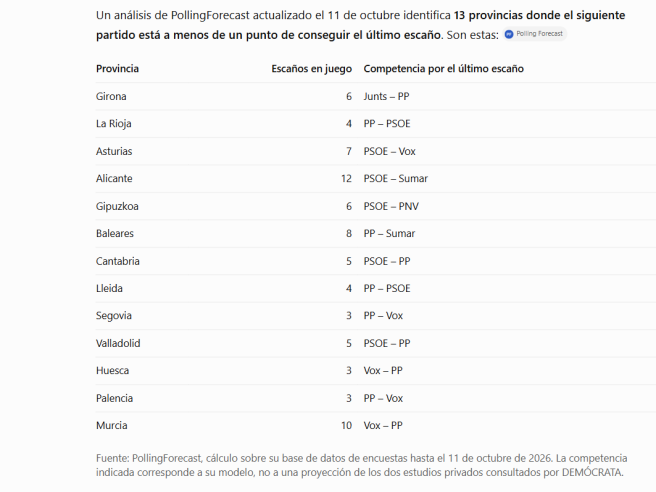
Thirteen provinces can decide the distribution
The studies consulted by DEMÓCRATA also contemplate a scenario in which the PSOE could surpass the PP in the number of seats. The political sources consulted consider that it is not the most likely hypothesis, but they point out that the struggle for the last deputies in up to 13 provinces can modify the final result.
The possibility illustrates the limitations of directly transferring a national vote estimate to the distribution of seats. In small constituencies, a relatively small variation can decide who gets the last deputy. A party can improve its percentage across the country and still not achieve an equivalent increase in representatives if its support does not translate into additional seats.
The opposite can also happen: a party with fewer votes nationally can obtain more favorable representation due to the territorial distribution of its support. Hence, the projections of seats present significant differences even among polls that place the parties at similar voting percentages.
The eventual advance of the PSOE over the PP in deputies would not automatically equate to an alternative majority. The ability to form a Government would depend on the sum of seats and the agreements that could be articulated in Congress. The relative position of the two major parties is an important indicator, but it is not enough to determine who can gather the necessary support for an investiture.
The territorial distribution takes on even more importance in a scenario of growth for Vox. If the party manages to convert the increase in votes into additional deputies in provinces where it already competes for the last seat, the PP may lose representation even if the right-wing bloc expands its joint support. If, on the contrary, part of that growth concentrates in constituencies where Vox already obtains sufficient representation, the effect on the distribution may be different.
Joint lists to reduce losses
The possibility that fragmentation penalizes some candidacies has led parties to explore formulas to reduce the loss of votes in certain constituencies. On the left, possible joint lists for the Senate are being studied in some territories, a strategy that would allow for the concentration of support in a single candidacy.
The Senate has an electoral system different from that of Congress and offers more leeway for formations with similar electorates to compete in a coordinated manner. The formula, however, requires territorial agreements and does not necessarily imply a general coalition among the parties that study it.
The objective would be to prevent the differences between candidacies from reducing their chances of obtaining representation in a scenario of tight competition. The result would depend on the characteristics of each province, the distribution of votes, and the agreements that are ultimately reached.
In the right-wing space, formulas for coordination in certain territories are also being analyzed. The PP may find incentives to negotiate with regionalist forces or adjust its candidacies where electoral competition and local particularities make it more difficult to convert votes into seats. Navarra is an example of a territory where the relationships between the PP and UPN have a specific dimension.
These conversations do not equate to closed agreements nor do they allow for a common strategy for all of Spain to be confirmed. Their scope will depend on the decisions made by the party leaderships and the negotiations in each constituency.
The dispute over the last seats explains why decisions about candidacies can be as important as movements in vote estimation. In a fragmented scenario, coordination can be decisive to improve representation, although it does not guarantee a more favorable outcome by itself.

Tezanos, under scrutiny for the distance between polls
The distance between the CIS and private polls again fuels criticism about the independence and methodology of the public body. José Félix Tezanos, president of the CIS, is a member of the PSOE, a circumstance that his critics consider incompatible with the direction of an institution responsible for measuring public opinion. This political linkage fuels questioning about his impartiality, although it does not by itself demonstrate that there is manipulation of the results.
The controversy also centers on the difference between the estimates of the CIS and those of other polling firms. While the public body places the PSOE clearly ahead, several private studies give the PP an advantage in voting intention and project a lower socialist representation than would be inferred from the simulation developed from the latest barometer.
The comparison requires taking into account that polls are not directly interchangeable. They may use different samples, fieldwork dates, estimation models, and weighting procedures. Furthermore, vote estimation and seat projection are distinct operations: the latter incorporates the territorial distribution of support and the electoral system.
For this reason, the issue is not limited to determining which poll is closest to the final result. It also matters that the methodological decisions are transparent and that changes in estimation can be explained based on the published data. In particular, the monthly variations of several points in the two major parties require an explanation that allows understanding where the movement comes from and how it translates into the final estimation.
In parallel, the political debate has incorporated the interpretations of Iván Redondo, former director of the Cabinet of the Presidency of the Government between 2018 and 2021. Redondo has considered it possible that the PSOE ends up as the leading force and has pointed out that the evolution of the campaign can alter the current positions. On RNE, on October 13, he stated that "the normal thing would be for the PSOE to start surpassing the PP as the campaign progresses".
His forecast is a political and demographic assessment, not an official projection or a guarantee about the result. The evolution of the transfer of votes between PP and Vox, the mobilization of the undecided, and the provincial dispute for the last deputies will be some of the factors that determine whether the distance between the different scenarios narrows or remains.