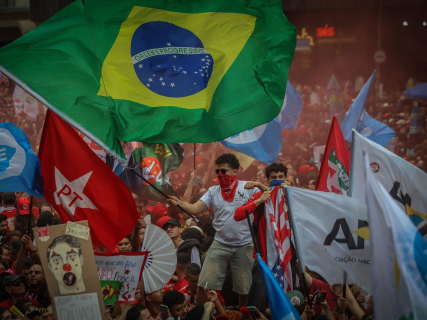

More than 156 million Brazilian citizens are called this Sunday to a decisive vote in which they must choose between two leaders and projects that embody opposite chapters of the country's recent history: the current president Luiz Inácio Lula da Silva, a veteran unionist forged in the struggle against the dictatorship, and Flávio Bolsonaro, son of the military and former president Jair Bolsonaro, who capitalizes on a nostalgic movement of that authoritarian regime.
Lula faces this second round boosted by the latest polls, after the hard setback that his defeat in the first round represented. The head of state faces the challenge of reversing that result, something that no candidate has achieved so far in the largest democracy in Latin America.
The Datafolha poll released on Thursday points to a technical tie, with 50% of the votes for each. For its part, the survey by the consulting firm Quaest gives Bolsonaro 45% against Lula's 44% and also notes that the high level of rejection of the president --a trait he shares with his rival-- has decreased by five points, to 47%.
The strong rejection that both candidates evoke reflects an extreme political polarization that transcends this electoral event. It is an identity and social fracture that directly conditions the behavior of voters, the tone of the campaign, and the future ability to govern Brazil.
With almost half of the electorate declaring their animosity towards one of the two candidates, the margin to expand support is almost nonexistent. The option of a third way was ruled out even before the start of the process, so that the undecided, if they go to vote, will do so for whom they perceive as the lesser evil.
TWO CONFRONTING MODELS
Lula and Bolsonaro symbolize two radically opposed visions of the country and, at the same time, will face different challenges depending on who prevails at the polls.
With a Congress leaning even more to the right, a much more favorable parliamentary climate is expected for Flávio Bolsonaro than the one Lula has had to manage, whose government has been forced into complex negotiations to push forward its initiatives. In contrast, everything indicates that a potential mandate of the far-right candidate would encounter more intense street opposition, with predictable protests from social, environmental, and civil rights movements.
Nevertheless, the role of the powerful lobby group of the "centrão", an informal block of conservative and strongly clientelist parties that revolves around interests such as agribusiness, security, and evangelism, will be key for both, which in Brazil is referred to as the triple B: "Bull, Bullet, and Bible".
Although the policies of previous Lula governments lifted millions of people out of poverty through internationally recognized social programs, such as Bolsa Familia, his project arrives at this election showing signs of wear, as evidenced by his unexpected defeat in the first round.
Lula's model carries the absence of generational change in the Brazilian left, a certain nostalgic view of times of prosperity, and the impact of old corruption scandals. This is compounded by the difficulty in presenting convincing proposals in the face of inflation, despite wage increases.
The economic balance of these four years has not been catastrophic, but it has been insufficient to consolidate the social support of the Government, to the point that in its traditional strongholds in the northeast there has been a slight decrease in backing.
Bolsonaro, for his part, inherits the political legacy of his father and proposes a drastic reduction in public spending and the weight of the State, with an agenda that includes privatizations, widespread tax cuts, cuts in administration, massive exploitation of natural resources, and a security policy inspired by the model of Nayib Bukele in El Salvador, with harsher penalties and a reduction in the age of criminal responsibility.
His possible arrival at the Palácio do Planalto would likely be accompanied by a presidential pardon for his father, Jair Bolsonaro, currently under house arrest for health reasons after being sentenced to more than 27 years in prison for his role as the main ideologue in the attempted coup following his electoral defeat in 2022.
A victory for Flávio Bolsonaro would be decisive for the former president's aspirations for freedom, either through the approval of an amnesty law in a favorable Congress or through a pardon. Jair Bolsonaro is part of the group of 1,400 people convicted for the assault on institutions in January 2023, in Brasília.
THE ELECTIONS ARE ALSO DECIDED ON SOCIAL NETWORKS
The polarization of Brazilian society is largely fueled by the digital battle being fought on social media, where bolsonarism has been able to deploy its structures more effectively than the left, to the point of provoking judicial clashes in the Superior Electoral Court (TSE).
Lula requested the TSE to annul Bolsonaro's candidacy alleging a supposed favoritism from Meta --the parent company of Facebook and Instagram-- regarding content and the algorithm, emphasizing the permissiveness towards electoral disinformation financed by the far-right candidate's team.
The complaint has led the TSE to impose deadlines on Meta to remove those contents and adjust the algorithm in order to ensure strict neutrality, under the threat of heavy daily fines, reopening the debate on the influence of large tech companies in electoral processes and the need for their regulation.