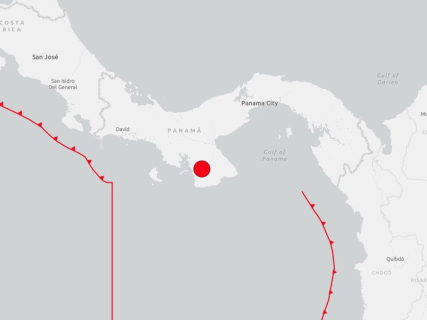
Earthquake in Panama: can the tsunami reach Costa Rica, Colombia, or Ecuador?

The earthquake of magnitude 7.6 registered in Panama raises the possibility of alterations in sea level in other Pacific countries. The distance to the epicenter is not the only factor that determines the risk, and authorities must evaluate each stretch of coast.

1 minute

fotonoticia 20261009201815 1920

fotonoticia 20261009201815 1920

Add DEMÓCRATA to Google

Ask FREN

Published

Last updated

1 minute

Most read

The 7.6 magnitude earthquake registered this Friday in Panama has focused attention on the possible consequences of the seismic movement for other countries in the region, especially Costa Rica, Colombia, and Ecuador, which also have coastlines on the Pacific Ocean.

A tsunami can propagate hundreds or thousands of kilometers from its origin if the earthquake causes a sufficient displacement of the seabed. However, not all large magnitude earthquakes generate tsunamis, nor do all coastlines receive waves of the same height.

Costa Rica and Colombia, watching the evolution of the Pacific

Due to their geographical proximity to Panama, the Pacific coasts of Costa Rica and Colombia are two of the territories that must be considered when evaluating the propagation of a possible tsunami.

The direction of the waves, the ocean depth, and the characteristics of each coastline condition their behavior. Therefore, proximity to the epicenter is not enough to establish which localities could be affected.

The inclusion of a country in a regional risk assessment does not necessarily imply that all its beaches are under an evacuation order. Protective measures correspond to their national authorities.

Can it reach Ecuador?

Ecuador also has an open coastline to the Pacific and has monitoring systems for possible tsunamis.

From a physical point of view, the waves generated by a displacement of the seabed can travel great distances. However, to determine if there is a concrete threat to Ecuador, it is necessary to analyze the official bulletins and sea level measurements.

An arrival time or wave height for its coasts cannot be established solely based on the magnitude of the earthquake.

What to do in the event of a tsunami alert

Authorities recommend leaving low coastal areas when there is an evacuation order and moving to higher places or away from the sea.

Natural signals such as an intense or prolonged seismic shaking, a sudden withdrawal of water, or unusual noise coming from the ocean should also be considered.

The first wave is not always the largest and the danger can last for several hours, so one should not return to the coast until emergency agencies authorize it.

More key points, information and questions with FREN

AI-GENERATED CONTENT

What procedures must the authorities of Costa Rica and Colombia follow to declare a tsunami evacuation order?

My field of expertise is the politics and public institutions of Spain (regulations, procedures, actors, and parliamentary and governmental activity within the Spanish context). The question you raise specifically concerns the procedures that the authorities of Costa Rica and Colombia must follow to declare a tsunami evacuation order, that is, the legal-administrative organization and civil protection of those two countries in particular.

That information depends on the legislation, emergency protocols, and chains of command specific to Costa Rica and Colombia (for example, their risk management laws, civil protection regulations, decrees regulating tsunami alerts, operational manuals of their national emergency systems, etc.). These frameworks differ from those in Spain and are not part of the scope for which I am designed, so I cannot provide you with a reliable and detailed answer about the specific formal steps their authorities must take to decree an evacuation.

To obtain a precise and updated answer about the official procedures in Costa Rica and Colombia, I recommend consulting directly:

  • The official websites of the risk management and emergency systems of each country (for example, the institutions responsible for civil protection and disaster response).
  • The national regulations on disaster risk management, civil protection, and tsunami alerts, generally available on official gazette portals.
  • Guides and technical protocols published by regional or international organizations specialized in tsunamis and natural disasters that work with those countries.

In summary, due to the very definition of my field of work, I cannot rigorously detail the procedures of the authorities of Costa Rica and Colombia to declare a tsunami evacuation. However, I can help you in depth with issues related to:

  • How civil protection and emergency management are organized and regulated in Spain from an institutional and legislative perspective.
  • What procedures Spanish authorities follow to declare emergency situations, adopt population protection measures, or coordinate with other territorial levels.
  • Any aspect of Spanish politics, legislation, and parliamentary activity (Congress, Senate, and regional parliaments), as well as the actions of their main public actors.

If you reformulate your query towards the Spanish context (for example, how civil protection mechanisms would be activated in Spain in the face of a tsunami risk or how evacuation orders would be articulated in terms of competencies and regulations), I will be happy to help you with as much detail as possible.

What competencies do the different administrations in Spain (State, autonomous communities, and municipalities) have in civil protection against risks such as tsunamis? What legal and administrative steps must Spanish authorities follow to order a population evacuation in the event of a major disaster? What Spanish regulations govern emergency management and civil protection and how are they coordinated?

What are the competencies of the national emergency agencies in managing tsunami alerts in Ecuador?

I do not have specific and reliable information about the competencies of the national emergency agencies in managing tsunami alerts in Ecuador, because I specialize in the political and institutional field of Spain (laws, parliaments, government, regulatory agencies, and Spanish public actors). My design and sources are very specifically oriented to that environment, not to the civil protection system or institutional organization of other countries.

For that reason, it would not be rigorous for me to try to detail the names of Ecuadorian institutions, their exact attributions, the distribution of competencies among government levels, or the technical protocols they follow in the event of a tsunami alert. That type of information depends on Ecuador's own regulations, national emergency plans, decrees, and operational manuals, to which I do not have structured or updated access within my scope of work.

In general terms, in many countries tsunami alert management usually involves:

  • A national seismology or oceanography service that detects and evaluates the event (earthquakes, mass displacements, etc.).
  • A civil protection or risk management system that coordinates the response, activates protocols, and communicates with regional and local authorities.
  • Official early warning channels directed at the population (sirens, SMS, radio, television, digital platforms, and institutional social networks).
  • Evacuation plans, risk zoning in coastal areas, and periodic drills.

However, applying these generic guidelines to Ecuador's specific reality (which agency does exactly what, under which laws, with what hierarchy and coordination among ministries, local governments, and scientific services) would require consulting specific sources from that country and its legal framework for risk and disaster management. Given my specialized scope, I cannot offer you that level of detail without risking errors.

What I can do is guide you on the types of documents and institutions you should review to obtain a precise answer in the Ecuadorian case. Normally, the distribution of competencies regarding tsunamis and other natural disasters is found in:

  • Framework laws on risk and emergency management or civil protection laws.
  • Regulations or executive decrees that develop that law and detail the functions of each agency.
  • National disaster response plans, specific tsunami management plans, and early warning protocols.
  • Organizational charts and operational manuals of the national emergency agency or its equivalent.

Regarding how I can help you, my field of action is:

  • Explaining the functioning of Spanish political institutions (Congress, Senate, regional governments, ministries, etc.).
  • Analyzing Spanish laws, royal decrees, decree-laws, and other regulations: their content, parliamentary processing, and effects.
  • Reviewing the role and competencies of Spanish civil protection or emergency agencies from a normative and organizational perspective in Spain.
  • Preparing notes, summaries, or analyses on legislative initiatives and public policies in Spain, including those related to risk management, disasters, or civil protection.

If you are interested in a comparative analysis or a conceptual explanation applied to the Spanish case — for example, how competencies are organized in Spain regarding tsunami alerts or other natural risks, or how responsibility is shared between the State and autonomous communities — I can develop it in considerable detail. Likewise, if you have Ecuadorian normative text and only need methodological or drafting help (for example, preparing a report or explanatory note comparing with European models), I can support you in structure and approach, making clear that substantive content about Ecuador must come from sources native to that country.

If you reformulate your question towards the Spanish context (for example, “What competencies do civil protection agencies in Spain have in managing tsunami alerts or other maritime risks?”), I will be able to offer you a much more precise and useful answer within my field of expertise.

How are civil protection and emergency management competencies organized in Spain between the State and the autonomous communities? What Spanish regulations govern early warning systems against tsunamis or other natural risks? How could I structure a report comparing the organization of civil protection in Spain with that of another country?

What legal requirements exist in Panama and neighboring countries to establish early warning systems for tsunamis?

I specialize in politics, institutions, and public activity in Spain (laws, parliamentary initiatives, governments, parties, sectoral regulations, etc.), and not in the legal framework of Panama or other countries in the region. Therefore, I cannot provide you with a reliable and detailed answer about the specific legal requirements that exist there to establish early warning systems for tsunamis.

What I can help you with are issues related to:

  • Spanish regulations on civil protection, emergencies, natural risks, maritime safety, or early warning systems.
  • Parliamentary processing in Spain of laws or initiatives related to natural disasters, climate change, coasts, protection of critical infrastructures, etc.
  • Institutional organization in Spain regarding emergencies (civil protection, coordination among administrations, competencies of the State and autonomous communities).
  • Political or regulatory analysis on how risk management and climate change adaptation are being addressed in Spain.

If you reformulate your question within any of these frameworks (for example, comparing how Spain does it with other countries in general terms, without going into specific legal requirements of each), I will be able to give you a more useful and well-founded answer.

Play

Test your knowledge with FREN!

How much do you know about this topic? Answer the following 3 questions.

What was the magnitude of the earthquake recorded in Panama?

Question 1 of 3

What factors influence the propagation of a tsunami after an earthquake?

Question 2 of 3

What is one of the authorities' recommendations in case of a tsunami alert?

Question 3 of 3