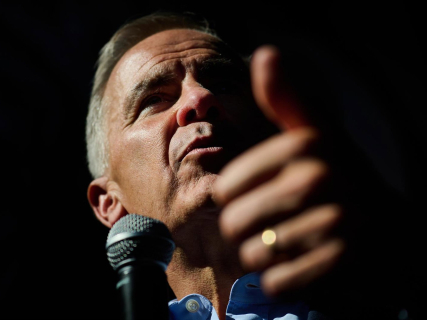

The Prime Minister of Canada, Mark Carney, defended this Saturday that the country has managed to avoid "a bad deal" with the United States after making public its withdrawal from trade talks, a decision motivated by the last-minute changes proposed by Washington and described as "unfair and uneconomical." These proposals, focused on sectors such as steel and the automotive industry, "called into question the reliability of any agreement" and also represented a direct attack on Canada's sovereignty.
Carney recalled that the breakdown of negotiations automatically triggers a 50% tariff by the United States on Canadian exports, worth nearly 24 billion euros. Despite this impact, he emphasized that, although his country "cannot control the storm blowing from Washington," it is in a position to "chart a new course" through the "diversification" of its trade alliances and the adoption of countermeasures "dollar for dollar," in a call for internal unity in the face of this new economic challenge.
In his first appearance before the press after the breakdown, the head of the Canadian government also issued a direct warning to Trump about Canada's strategic weight as an energy supplier to the U.S. market. "Canada drives U.S. growth by supplying 99% of its natural gas imports, 85% of its electricity imports, and 60% of its crude oil imports," he pointed out.
The Prime Minister acknowledged the severity of Ottawa's response, although he considered it inevitable, since with the new conditions imposed by the United States "the gap between partner and competitor" has become "too large." For this reason, last night he ordered his negotiating team to return immediately to Ottawa.
"We cannot accept what they have offered us and we will not give them what they have asked for," Carney stated, accusing Washington of trying to introduce, also at the last minute, "restrictions to prevent Canada from signing trade agreements with other countries."
In light of this scenario, and given that Canadian representatives "were not willing to compromise Canada's sovereignty or undermine its key industries," the government has opted to activate retaliatory measures that will be implemented, Carney indicated, after the Labor Day holiday in Canada, on September 8.
"Canada will respond dollar for dollar to the sanctions from the United States in the areas of steel, dairy, agricultural equipment, or paper," announced the prime minister, who admitted that it is a decision made "grudgingly" due to the effects it will entail. However, he has considered it essential because "it is in the best interest of Canada," reinforces its external image as a "strong" country, and is key to safeguarding national employment and maintaining the competitiveness of the domestic market.
Carney lamented, finally, that the goal of the United States in hindering the dialogue with Ottawa from the beginning has been "to cause harm and divide" Canadian society, something he described as a "miscalculation." In response, he presented Canada's reaction as an exercise in collective pride and social cohesion.
"They want to break us to take us, and they are not going to succeed," he concluded, convinced that "we are the masters of our own destiny."