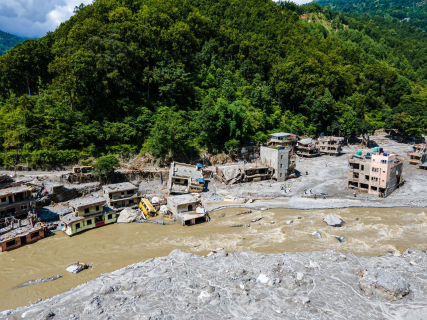

The number of fatalities caused by the severe floods recorded last week in northern Nepal, in an area bordering China, has already exceeded 1,100 deceased, according to the country's authorities, who maintain the figure of people reported missing at more than 3,900.
The National Authority for Disaster Risk Reduction and Management (NDRRMA, for its acronym in English) has indicated in a statement disseminated on social media that so far 1,114 bodies have been recovered, of which 348 correspond to the district of Chitwan, 218 to Nawalparasi East, and 190 to Nawalparasi West.
The agency has added that emergency teams have managed to rescue so far 11,993 people, among them 273 foreigners evacuated by air, and has detailed that 292 people were injured due to the disaster, of which 182 have already been discharged.
Likewise, it has emphasized that more than 21,300 personnel, including 7,900 police officers and 9,200 army members, are deployed to support search and rescue efforts, as well as the distribution of basic aid among the affected.
These figures are in addition to at least 16 deceased and around 550 missing in Chinese territory --among them 261 foreign citizens-- according to the balance provided by the authorities of the Asian giant, in addition to three bodies recovered in India.
On the other hand, the spokesperson for the United Nations General Secretariat, Stéphane Dujarric, has stated in a press conference that the response to the flood "is entering a new phase." "The authorities are intensifying aid efforts and recovery operations," he noted.
"For thousands of affected families, the priority now is to receive humanitarian assistance, recover and identify the remains of their loved ones, locate missing relatives, reunite separated children, and facilitate access to psychosocial support," Dujarric has stated, who has estimated nearly 3,500 people displaced by the tragedy.
In this regard, he specified that these displaced people "live in 27 displacement centers in the most affected districts, those of Nuwakot and Rasuwa, many of them in schools, which has an effect of disrupting education for children," and has urged international partners to continue supporting the efforts of the Nepali authorities.
"Our humanitarian colleagues inform us that the main challenge at this moment is access. More than 40 bridges have been destroyed and sections of the main road remain blocked. The most remote communities continue to depend on Army helicopter flights to receive supplies," he warned, before alerting to the "growing risk" to health arising from "overcrowding in shelters, contaminated water, and damage to health centers," in the midst of the monsoon season.
In this context, the non-governmental organization World Vision has called for "reinforced measures" to assist the minors displaced by the disaster and ensure their reunification with their families, while indicating that it is already mobilizing emergency teams, supplies, and protection services to reach isolated and more vulnerable communities in the districts of Nuwakot and Rasuwa.
"In the overwhelming chaos that follows a disaster of this magnitude, the search for relatives must be rigorous and systematic. Relatives and caregivers arrive at the reception centers eager to reunite with the children, but without immediate verification systems, we run the risk of vulnerable children being left unprotected due to administrative shortcomings," explained the Urban Protection Coordinator of World Vision in Nepal, Anju Bhattarai.
"The delivery of each child must follow formal case management protocols to ensure their safety and well-being," she emphasized, before stressing that "no child should survive a disaster only to disappear afterward."
Thus, she warned that "without proper verification and protection, a child who has survived the floods could be separated again, become a victim of trafficking, exploited, or simply disappear from the system." "All reunification must prioritize the safety of children, so it is urgent to restore and strengthen local child protection systems," she concluded.