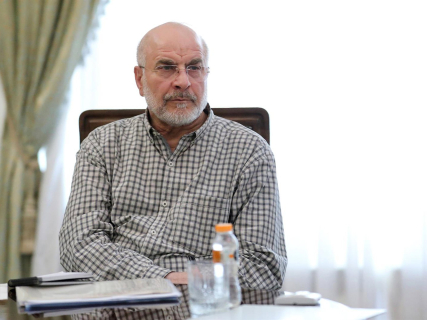

The spokesman of the Iranian Parliament and chief negotiator of Tehran, Mohamed Baqer Qalibaf, has criticized the United States on Tuesday for considering that the Donald Trump Administration "believes that pressing Iran more will allow them to obtain concessions that were never part of the agreement" signed between Washington and the Islamic Republic in mid-June.
"The Americans believe that pressing Iran more will allow them to obtain concessions that were never part of the agreement," Qalibaf reiterated in a message disseminated on his social networks, insisting that the White House's strategy is destined for failure.
In this context, he has pointed directly to the secretaries of the Treasury, Scott Bessent, and of Defense, Pete Hegseth, emphasizing that "they are completely out of their league." "Stop waiting for the clowns to pull a rabbit out of the hat and fix the mess you have created," he exclaimed, raising the tone of his criticisms against the high-ranking U.S. officials.
In recent weeks, Hegseth has hardly spoken publicly about the United States' war against Iran. However, on Monday he defended the military operations of the Trump Administration during a speech in Iowa, where he reiterated the argument, repeated numerous times by the president, that the conflict was essential to curb Tehran's nuclear ambitions.
"Doing very difficult things, going out to defend your country and ensuring that radical Islamist crazies do not get a nuclear weapon, has a cost," Hegseth stated before the audience. "I am not willing to look my children in the eyes and tell them: 'We had the opportunity to do something about it, but we didn't,'" he added, thus justifying the continuation of the military campaign.
At the same time, Bessent suggested last week that Washington is willing to impose "unprecedented" sanctions against Iran, in a new twist to the maximum pressure policy pushed by Trump.
So far, the declared efforts by the United States to force Iran to reopen the Strait of Hormuz and return to formal talks have hardly had tangible results, as the war conflict has now lasted for six months.
In this sense, Trump himself has acknowledged this Tuesday that "there are no conversations or dialogue" scheduled with Iran and has confirmed that the naval blockade over the Strait of Hormuz remains in effect after the expiration, last June, of the agreement previously reached between both parties.