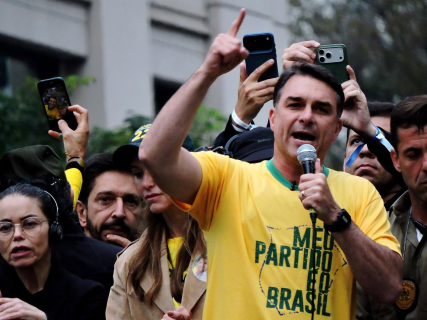
Flávio Bolsonaro leads Lula by four points in the first poll of the second round

The candidate of the Liberal Party finished ahead of Lula in the first round and faces the second on October 25.

1 minute

fotonoticia 20261008174223 1920

fotonoticia 20261008174223 1920

Add DEMÓCRATA to Google

Ask FREN

Published

Last updated

1 minute

Most read

Flávio Bolsonaro obtains 49% of voting intention compared to 45% of Luiz Inácio Lula da Silva in the first Datafolha survey for the second round of the Brazilian presidential elections. The poll, published on October 8, places the senator four points ahead of the current president, although the difference is within the margin of error of two percentage points.

The measurement represents a change from the previous study by the same institute, conducted before the first round: then Lula had 47% support and Flávio Bolsonaro had 46% in the confrontation scenario between the two.

The second round is scheduled for October 25. Neither of the two candidates obtained an absolute majority of valid votes in the first round, so the Presidency will be decided in the final vote.

Excluding blank and null votes and undecided voters from the calculation, Flávio Bolsonaro reaches 52% of valid votes, compared to 48% of Lula. This is the reference used to estimate the distribution of votes that will decide the election, although it does not eliminate the uncertainty reflected by the margin of error.

In the overall responses, 5% of respondents say they would vote blank or annul their ballot, while 1% still do not know who to choose. The mobilization of these groups and the ability of both candidates to attract those who supported other candidacies may be relevant in the final result.

A change from the first round

Flávio Bolsonaro finished the first round ahead of Lula, with 47.03% of valid votes compared to 45.16% of the president. The difference was about 1.9 percentage points, a result that opened a new phase of the campaign with the senator as the most voted candidate in the first round.

The new survey reflects that the scenario of the second round is competitive. Bolsonaro's numerical advantage does not allow us to affirm that he has a consolidated position, given that the four-point difference in voting intention is within the margin of error of the study.

With the vote set for October 25, the two candidates face the final stretch of the campaign with different objectives: Flávio Bolsonaro will seek to maintain the advantage obtained in the first round, while Lula needs to expand his support to attempt re-election.

More key points, information and questions with FREN

AI-GENERATED CONTENT

What is the Brazilian electoral process for the second round and what requirements must candidates meet to win?

In Brazil, presidential elections are governed by a two-round system (ballotage) established in the 1988 Constitution. The goal is to ensure that the president has a clear majority support from the electorate. The second round is only held if no candidate achieves an absolute majority of valid votes in the first round.

When the second round is held

In Brazilian presidential elections:

  • The first round is held on the first Sunday of October.
  • If necessary, the second round takes place on the last Sunday of October, approximately three weeks later.

The second round is called if, in the first, no candidate surpasses 50% of the valid votes (that is, excluding blank and null votes). If someone reaches that absolute majority in the first round, they are automatically elected and there is no ballotage.

Who can compete in the second round

Only the two most voted candidates in the first round advance to the second round. There is no possibility for a third candidate to join, even if the difference between the second and third candidate was minimal.

Between the first and second rounds, there are some relevant political elements:

  • Rearrangement of alliances: parties whose candidates were left out can publicly support one of the finalists.
  • Specific second-round electoral campaign, with rules for propaganda, televised debates, and radio and TV times distributed according to electoral legislation.
  • Possibility for candidates to adjust their discourse to attract the electorate of eliminated contenders.

Requirements to win in the second round

The victory criterion in the second round is simpler than in the first:

  • The winner is the one who obtains more valid votes than their opponent, that is, a simple majority of the valid votes cast.
  • No special threshold (such as 50% plus one) different from the normal majority criterion is required: it is enough to surpass the other candidate.
  • Null and blank votes are excluded from the count to determine the winner; only valid votes count.

Since there are only two candidate options, in practice the winner always has more than 50% of the valid votes, although the margin may be very narrow.

Validity of the election and participation

In Brazil, voting is mandatory for most literate citizens between 18 and 70 years old, and optional for young people aged 16 and 17, those over 70, and illiterate people. However:

  • There is no minimum participation quorum for the second round to be valid.
  • The election is not repeated due to high abstention; voting obligation is enforced through administrative sanctions (fines, restrictions for certain procedures), not by annulling the election.

Proclamation of results and inauguration

After the closing of electronic ballot boxes, the Superior Electoral Court (TSE) centralizes the counting:

  • Results are usually known the same day, given the extensive use of electronic voting machines.
  • The electoral justice officially proclaims the winner once data is consolidated and any appeals or challenges are resolved.

The elected president and vice president take office on January 1 following the election, starting a four-year term, with the possibility of one consecutive re-election.

Summary

In summary: the presidential second round in Brazil is held if no one achieves an absolute majority of valid votes in the first round; only the two most voted participate, and the winner is the one who obtains more valid votes, without special quorums or additional requirements. The system seeks to legitimize the president through a clearly majority mandate, even in scenarios with high fragmentation of candidacies in the first round.

How is the electoral campaign organized between the first and second rounds in Brazil? What role does the Brazilian electoral justice (TSE) play in supervising the second round? How do the rules of the Brazilian presidential second round compare with those of other Latin American countries?

What are the powers and functions of a president in Brazil according to the Brazilian Constitution?

The Constitution of the Federative Republic of Brazil of 1988 configures the president as both head of state and head of government in a presidential system. Their powers are mainly set out in articles 76 to 91, especially article 84. Below is a summary of their main functions and powers.

1. Head of State and Government

The president holds two roles:

  • Head of State: represents Brazil abroad, guarantees the continuity of the State, and symbolizes national unity.
  • Head of Government: directs the political and administrative action of the federal Executive Power.

The Constitution establishes that the executive power is exercised by the president, assisted by the ministers of state. There is no separate figure of prime minister: all political responsibility for government leadership rests with the president.

2. Powers in Government and Administration

Among the internal executive powers are:

  • Appointing and dismissing ministers of state, who head ministerial portfolios and are responsible for specific areas of federal administration.
  • Exercising the superior direction of federal administration, creating, reorganizing, and extinguishing direct administration bodies within limits established by law.
  • Issuing decrees and regulations for faithful execution of laws, without contradicting them or replacing the legislator in creating primary norms.
  • Deciding on the organization and functioning of federal administration when it does not imply creation or extinction of bodies nor increased expenditure, under terms allowed by the Constitution through autonomous decree.

3. Legislative and Normative Functions

Although legislative power belongs to the National Congress, the president has relevant instruments to intervene in normative production:

  • Legislative initiative: can present bills to Congress, and in certain areas (e.g., administration organization, armed forces, multi-year plans, budgets) their initiative is exclusive.
  • Provisional measures: in cases of relevance and urgency, can issue provisional measures with the force of law, which take immediate effect but must be reviewed by Congress within a set period; if not ratified, they lose effect.
  • Sanction, veto, and promulgation:
    • Can sanction laws approved by Congress.
    • Can totally or partially veto bills for unconstitutionality or contradiction to public interest, justifying the veto.
    • The president is responsible for promulgating and ordering publication of laws; in case of omission, promulgation passes to the Senate president or other legislative authorities.

4. Powers in Foreign Policy and Defense

As head of state, the president assumes a central role in international relations and national defense:

  • Directs foreign policy and maintains relations with other states and international organizations, negotiating treaties and agreements, which must be approved by Congress to have internal effect.
  • Accredits heads of diplomatic missions (ambassadors) and receives credentials from foreign representatives.
  • Is commander-in-chief of the Armed Forces, able to appoint commanders of the Navy, Army, and Air Force, according to legislation.
  • Can declare war and make peace, always with authorization or ratification from the National Congress, except in cases of imminent foreign aggression, where they can act more swiftly, also under parliamentary control.
  • Can decree the state of defense and state of siege, constitutional exceptional measures to face serious threats to democratic order or security, with intervention and control by Congress.

5. Financial and Budgetary Powers

The president has key functions in planning and executing federal public finances:

  • Prepares and submits to Congress the Multi-Year Plan, the Budget Guidelines Law, and the Budget Law.
  • Executes the approved budget, able to make certain modifications within limits set by the Constitution and budget legislation.
  • Can propose extraordinary credits in urgent and relevant situations, which must be authorized by the legislature.

6. Powers in Justice and Clemency

In the criminal justice sphere, the Constitution grants the president:

  • The power to grant pardons and initiate commutations of sentences, based on current legislation and generally through collective pardon decrees (e.g., on special dates).
  • The competence to grant individual clemency in certain cases.
  • To appoint, with Senate participation, ministers of the Supreme Federal Court and other higher courts, as well as the Attorney General of the Republic and other high justice system authorities.

7. Responsibility and Control

Although endowed with broad powers, the president is subject to several control mechanisms:

  • Political responsibility before Congress, which can authorize impeachment processes for crimes of responsibility (equivalent to serious infractions in office).
  • Judicial control of their normative and administrative acts by the Supreme Federal Court and other courts.
  • Financial control by the Federal Court of Accounts and Congress itself, especially over budget execution.

Overall, the Brazilian Constitution designs a strong presidency, with broad executive, normative, and political leadership powers, balanced by Congress and judicial intervention to prevent abuses and preserve democratic order.

Could you compare the powers of the president of Brazil with those of the president of the United States? What exactly is a “provisional measure” in Brazil and how is it processed in Congress? How does the impeachment process of the president in Brazil work according to the 1988 Constitution?

What political trajectory and positions has Flávio Bolsonaro held before running as a presidential candidate?

Before becoming a presidential candidate in the 2026 Brazilian elections, Flávio Nantes Bolsonaro developed a political career spanning more than two decades, focused on the legislative branch and closely linked to the state of Rio de Janeiro and bolsonarism as a political current.

Origins and early entry into politics

Flávio Bolsonaro was born on April 30, 1981, in Resende (state of Rio de Janeiro). A lawyer by training, he complemented his studies with courses in public policy and entrepreneurship, and also engaged in business activities. However, his public profile was built almost entirely through elected positions.

His jump to institutional politics was very early. At just 21 years old, in the 2002 elections, he won a seat in the Legislative Assembly of the State of Rio de Janeiro (Alerj). He took office as a state deputy in 2003 and from that moment chained four consecutive terms, remaining in Alerj until early 2019. In those 16 years, he consolidated his own electoral base in Rio and became one of the most visible faces of the local right.

State deputy (2003–2019): bolsonarism base in Rio

During his time as state deputy, Flávio focused much of his activity on public security issues, support for police forces, and toughening the penal system. Various parliamentary analyses highlight that a very high proportion of his interventions were related to security, police, and the penitentiary system, which helped profile him as a spokesperson for the most punitive positions of bolsonarism at the regional level.

In those years, he also built networks with sectors of Rio's security forces and figures later linked to militias, episodes that fueled controversies and several investigations, although without resulting in firm criminal convictions against him. Institutionally, however, his trajectory in Alerj was continuous: four consecutive re-elections and constant presence in state legislative debate.

Municipal career: candidacy for mayor of Rio (2016)

During his time as state deputy, Flávio tried to make a first leap toward executive positions. In 2016, he ran as a candidate for mayor of the city of Rio de Janeiro, under the banner of the Social Christian Party (PSC). Although the campaign increased his and the bolsonarist brand's notoriety, the result was insufficient to win the municipal executive: he finished fourth, with around 14% of valid votes (about 424,000 votes). After that experience, he fully returned to his role in the Legislative Assembly until preparing the leap to national politics.

Federal senator for Rio de Janeiro (since 2019)

The real scale change in Flávio's career came in the 2018 general elections, the same in which his father, Jair Bolsonaro, reached the Presidency of the Republic. Flávio was elected federal senator for the state of Rio de Janeiro, then by the Social Liberal Party (PSL), with about 4.38 million votes. His term began in February 2019 and runs until 2027.

In the Senate, he maintained public security as the main axis of his agenda. He promoted proposals to toughen penalties, lower the age of criminal responsibility, restrict penitentiary benefits, and expand prison capacity. In 2025, he assumed the presidency of the Senate's Public Security Commission, from where he reinforced his profile as a reference for the "hardline" discourse against crime.

Beyond the formal, his political influence was greater than that of an average senator during Jair Bolsonaro's government (2019–2022). He acted as an informal interlocutor between the Planalto and Congress, participated in meetings with ministers, and was one of the channels through which the then president received demands from political and business allies, to the point that some colleagues unofficially described him as a "senator–minister."

Party evolution

Flávio's trajectory also reflects a succession of party changes, largely parallel to his father's. He began his career linked to the former Brazilian Progressive Party (PPB), later integrated into the Progressive Party (PP). He briefly passed through the Liberal Front Party (PFL) and returned to the PP before landing in the PSC, with which he ran for mayor of Rio in 2016.

For the national leap, he joined the PSL, which served as the platform for bolsonarism in 2018 and under whose banner he was elected senator. After internal fractures in the PSL, he was first linked to Republicanos, then briefly to Patriota, and finally affiliated with the Liberal Party (PL) at the end of 2021. It is this last party that projects him as a presidential candidate in 2026.

End point: presidential candidate without executive experience

When the PL proclaims him presidential candidate for the 2026 elections, Flávio arrives with a clearly legislative profile: four terms as state deputy and a current term as senator, plus a failed mayoral attempt. He has not held any executive office at municipal, state, or federal levels until then. His political capital comes from that parliamentary trajectory, the Bolsonaro surname, and his role as the designated heir of bolsonarism.

Could you detail the most relevant legislative initiatives Flávio Bolsonaro promoted as senator before becoming a presidential candidate? What controversies and investigations have marked Flávio Bolsonaro's political career up to 2026 and how have they affected his image? How does Flávio Bolsonaro's prior trajectory compare with that of other recent Brazilian presidential candidates?

Play

Test your knowledge with FREN!

How much do you know about this topic? Answer the following 3 questions.

What percentage of voting intention does Flávio Bolsonaro obtain in the first poll of the second round according to Datafolha?

Question 1 of 3

What is the margin of error of the mentioned Datafolha poll?

Question 2 of 3

Why is a second round held in the Brazilian presidential elections?

Question 3 of 3