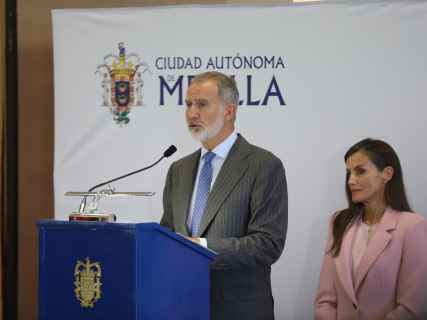
Felipe VI warns from Melilla: "We are prepared to defend our values and our freedoms"

The King claims the belonging of Melilla to Spain and the European Union, asks Morocco for a relationship based on trust and good faith, and calls for institutional unity as a guarantee of stability.

EuropaPress 7845438 reyes felipe vi letizia mantienen encuentro representacion sociedad

EuropaPress 7845438 reyes felipe vi letizia mantienen encuentro representacion sociedad

Add DEMÓCRATA to Google

Ask FREN

Published

Last updated

3 minutes

Most read

The king Felipe VI has claimed this Wednesday from Melilla the Spanish sovereignty over the autonomous city and its condition as a border of the European Union, warning that any threat to its territorial integrity affects the whole of the Twenty-Seven. The monarch has launched this message during his speech before representatives of Melilla society, on the last day of his official visit alongside Queen Letizia to Ceuta and Melilla.

"In Melilla, Spain and the European Union begin," said the head of State, who defended the European commitment to the rule of law and human dignity. "Let no one confuse those convictions with weakness. We are prepared to defend our values and our freedoms", he warned.

The speech comes after the border crisis of last summer, marked by the massive entry of migrants into Ceuta on July 30 and 31, and in the midst of the pre-campaign for the general elections on November 29. The visit of the Kings to both autonomous cities has been accompanied by messages in defense of Spanish territorial integrity and calls for institutional cooperation.

A message to Morocco based on trust and good faith

Felipe VI has also dedicated part of his speech to relations with Morocco, to which he conveyed the need to maintain a neighborhood relationship based on "trust and responsibility, based on good faith".

"We must always ensure to build and preserve a good neighborly relationship, looking towards a future of mutual benefit through peace, security, stability, and cooperation," the monarch pointed out.

The King has placed this commitment in the geographical context of Melilla, where Africa and Europe meet, and has highlighted the importance of preserving coexistence in a city characterized by its cultural diversity.

He has also thanked the hospitality of the Melillans and has recognized the difficulties faced by both autonomous cities. In particular, he highlighted "the resilience that the Ceutíes are demonstrating" and the ability of the inhabitants of Melilla to manage the daily challenges of coexistence.

Felipe VI calls for institutional unity in the midst of the electoral pre-campaign

The head of State has taken advantage of his intervention to reiterate the call for the unity of the institutions, a message that he had already conveyed during his visit to Ceuta and that takes on special relevance in the current political context, after the call for general elections on November 29.

Felipe VI has acknowledged that discrepancies are "logical and even necessary" in a democracy, but he has defended that they must be compatible with collaboration between the administrations.

"Discrepancies, logical and even necessary in an advanced democracy like ours, must always go hand in hand with institutional unity and the search for understanding", he stated.

According to the monarch, that unity constitutes a "guarantee of stability" and allows the institutions to carry out their work effectively.

"All institutions, starting with the Head of State, must always work with that same awareness of the common good," he added.

His words come in a scenario of electoral pre-campaign and after a migration crisis that has once again placed the management of the borders of Ceuta and Melilla in the national political debate.

The Kings conclude their first visit to Ceuta and Melilla

The speech has also served to close the two days of official visit by Felipe VI and Letizia to the autonomous cities, a trip that the monarch himself has acknowledged was "pending for too long".

The Kings arrived on Tuesday in Ceuta, where Felipe VI defended that Spanish sovereignty and territorial integrity are non-negotiable. This Wednesday they have continued their institutional agenda in Melilla, where they have been received by numerous citizens.

In his farewell words, the monarch promised to return to the city and emphasized the importance of maintaining a close relationship between the Crown and the inhabitants of both territories.

"You deserve to feel more often, also through your Kings, the embrace and closeness of all Spaniards. Not despite living here, but precisely because of that", he concluded.

More key points, information and questions with FREN

AI-GENERATED CONTENT

What constitutional powers does the King of Spain have in matters of foreign policy and defense?

What is the parliamentary procedure to modify the status of Ceuta and Melilla as autonomous cities?

Modifying the status of Ceuta and Melilla as autonomous cities is not a simple change of ordinary law: it involves reviewing the constitutional territorial model. This essentially requires two major blocks of action:

  • a constitutional reform, to redefine the position of Ceuta and Melilla; and
  • the approval or reform of their future Statutes of Autonomy, through organic laws.

1. Prior constitutional reform: why it is necessary

The current status of Ceuta and Melilla is directly established by the Constitution, which places them in a unique position compared to the autonomous communities. Altering that position (for example, fully equating them to an autonomous community or giving them another regime) requires modifying the Constitution itself, an ordinary law or an isolated organic law is not enough.

The reform must specify:

  • how Ceuta and Melilla are integrated into the territorial organization of the State, and
  • what minimum rank and content their future Statutes of Autonomy or equivalent norms must have.

Depending on the scope of the change (whether it affects only specific provisions or the basic structure of Title VIII on territorial organization), the reform would be processed through the ordinary constitutional reform procedure (art. 167 CE) or the enhanced procedure (art. 168 CE). The key is whether the change is understood to affect “core” elements of the territorial model—in which case the enhanced procedure would tend to apply—or if it can be reduced to a punctual modification.

2. Steps and majorities of the constitutional reform

Generally, the reform follows this scheme:

  • Initiative: it can come from the Government, the Congress, the Senate, or the Assemblies of the autonomous communities. A drafted text of constitutional reform is submitted.
  • Processing as a reform project or proposal:
    • qualification and admission for processing;
    • debate in the Congress with the possibility of amendments;
    • committee report and vote in the Plenary.
  • Majorities:
    • if the scheme of art. 167 CE applies, a three-fifths majority in the Congress and a three-fifths majority in the Senate is required; if there is no agreement, a mixed commission is foreseen and, ultimately, a reinforced vote in the Congress;
    • if it is understood that the change falls under art. 168 CE (enhanced reform), a two-thirds majority in each Chamber is needed, dissolution of the Cortes, new approval by two-thirds of the new Chambers, and finally, a mandatory referendum.
  • Referendum:
    • in the ordinary procedure (art. 167), it is only necessary if requested by a qualified minority of parliamentarians;
    • in the enhanced procedure (art. 168), the referendum is always mandatory.
  • Sanction, promulgation, and entry into force: once the reform is approved, the King sanctions it and it is published in the Official State Gazette (BOE).

3. Statutes of Autonomy of Ceuta and Melilla

Once the new status is constitutionally defined, it must be “filled with content” through Statutes of Autonomy (or norms of the same rank) specific to Ceuta and Melilla. The Statutes are organic laws, so they require an absolute majority in the Congress in the final vote on the entire text.

The parliamentary procedure for approval or reform of the statutes essentially follows the scheme of any organic law:

  • Presentation of the initiative (government bill or private member's bill).
  • Complete processing in the Congress:
    • admission for processing and publication;
    • deadlines for total and article-by-article amendments;
    • work in the committee and subcommittee with report;
    • debate and vote in the Plenary, where an absolute majority is required in the final vote.
  • Referral to the Senate, which can approve, amend, or veto the text. The Congress has the final say on amendments and vetoes.
  • Sanction, promulgation, and publication in the BOE.

4. Political and technical sequence

In practice, the change would be articulated in two linked major phases:

  • first, a constitutional reform that enables and defines the new position of Ceuta and Melilla; and
  • then, approval of their Statutes through organic laws, developing the level of self-government, own institutions, and distribution of competences that the reformed Constitution allows.

Both processes require reinforced majorities and broad consensus, so the central element is not only legal-procedural but also political: without broad agreement in the Congress and the Senate, modifying the territorial status of Ceuta and Melilla is not feasible.

What specific legal differences would there be between Ceuta and Melilla remaining autonomous cities or becoming autonomous communities? Which political and territorial actors should be involved in a possible reform of the status of Ceuta and Melilla and what role would each have? What precedents of statutory or constitutional reforms on territorial organization could serve as a reference for Ceuta and Melilla?

Which party obtained the majority of seats in Melilla in the last regional elections?

In the last regional elections to the Assembly of Melilla, held on May 28, 2023, the party that obtained the majority of seats was the People's Party (PP). According to the electoral data consulted, the PP won 14 of the 25 seats in the Assembly, which gave it an absolute majority in the Melilla chamber.

The Assembly of Melilla is the legislative body of the autonomous city and is composed of 25 deputies. Achieving 14 seats means surpassing the classic threshold of absolute majority (half plus one), which in this case is 13. Obtaining that fourteenth seat by the PP not only made it the most voted force but also allowed it to have a capacity to govern alone arithmetically, without the need for stable support from other parties for investiture or for the approval of most ordinary initiatives.

The 2023 results thus consolidated the role of the PP as a hegemonic force in Melilla's politics. Available information indicates that, after those elections, the institutional leadership of the city again fell to Juan José Imbroda, from the People's Party, who is listed as president of the Autonomous City of Melilla. This continuity in the presidential figure links to a long trajectory of Imbroda at the head of Melilla's institutions, having already presided over the city during several previous terms.

Although the data consulted focus on the main fact—the PP's majority with 14 seats—they do allow some clear political implications to be drawn. First, the configuration of the Assembly resulting from the May 28, 2023 elections left the PP in a position of clear negotiating advantage over the other parties. Even in scenarios where it might need occasional agreements (for example, for issues requiring reinforced majorities or to provide political stability in tense situations), part of that strength comes precisely from having enough votes to pass a large part of the government agenda alone.

Second, the PP's absolute majority in Melilla fits into a broader context of territorial strength of the PP in several autonomous areas in this political cycle. Although each territory has its own dynamics, Melilla's case is often cited as an example of a consolidated stronghold, with very personalized leadership around Imbroda and an electorate that has repeatedly supported that political option.

The rest of the Assembly seats were distributed among other political formations present in the autonomous city, but none of them reached a number of representatives comparable to the PP nor, of course, an absolute majority. This fragmentation in the non-PP space further reinforces the specific weight of the People's Party within the chamber.

From an institutional point of view, having a single party control the majority of seats in a small chamber like Melilla's has very visible effects on daily functioning:

  • It facilitates the approval of the autonomous city's budgets, as it mainly depends on the internal discipline of the majority group.
  • It allows greater control over the Assembly's Board and the organization of parliamentary work (agenda, pace of processing initiatives, etc.).
  • It grants the majority party a central role in the appointment of institutional positions linked to the Assembly and in the dialogue with the central Government.

In summary, to the question of which party obtained the majority of seats in Melilla in the last regional elections, the answer is clear: the People's Party, with 14 of the 25 seats in the Assembly of Melilla, achieved an absolute majority and positioned itself at the center of the political and institutional power of the autonomous city after the 2023 elections.

How were the remaining seats distributed among the other parties in those 2023 Assembly of Melilla elections? What role has Juan José Imbroda played in Melilla's politics before and after the 2023 regional elections? What powers does the Assembly of Melilla have and how does an absolute majority of the PP influence its exercise?

Play

Test your knowledge with FREN!

How much do you know about this topic? Answer the following 3 questions.

What has Felipe VI emphasized regarding the sovereignty of Melilla during his official visit?

Question 1 of 3

What aspect has Felipe VI highlighted as fundamental for relations between Spain and Morocco?

Question 2 of 3

What has Felipe VI said about disagreements between institutions in a democracy?

Question 3 of 3