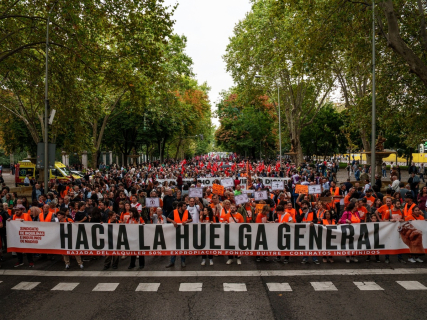
Spain will be the only country in the EU with a general strike and the Parliament dissolved.

Europe does not register an equivalent precedent: Greece, Portugal, and Spain called their major strikes with the Parliaments active and the measures still in process.

9 minutes

huelga general 1200x900

huelga general 1200x900

Add DEMÓCRATA to Google

Ask FREN

Published

9 minutes

Most read

Finally, on November 11, the unions UGT and CCOO have called for a general strike. A strike that occurs in a peculiar context, pointed out this Tuesday by the campaign chief of the acting president and leader of the PSOE, María Jesús Montero, stating that this demonstration will be against the opposition and not against the Government of Pedro Sánchez. 

Nevertheless, Spain faces a situation for which it is difficult to find an equivalent precedent in the European Union.

And it is that the unions CCOO and UGT are preparing a nationwide general strike while the Cortes Generales are already dissolved, the country is immersed in the electoral process for the elections on November 29, and the Government is trying to bring to the Permanent Deputation - it is still unknown what day, although they are already published in the BOE - some housing decrees that were rejected by Congress.

In any case, the comparative analysis of general strikes in Europe shows that the large union mobilizations of recent decades have occurred, as a general rule, in a different institutional scenario: with Parliaments open, Governments making decisions, and the reforms against which the unions protested still in the process of negotiation, debate, or approval.

No other recent case appears, among the European precedents located by DEMÓCRATA, that simultaneously gathers the circumstances that occur now in Spain: a national general strike called after the dissolution of Parliament and with an electoral campaign already underway.

The uniqueness is not, therefore, that a strike may coincide with an electoral period. Nor that the unions have historically used mobilization to influence political decisions. The exceptional thing is the institutional moment in which the protest is raised, without Budgets for almost four years and with a Cortes that have ceased to function as an ordinary legislature,  and where citizens are called to decide the composition of the next Parliament, while the protest unfolds amid that electoral dispute.

The great European strikes were made with Parliament open

The study of the European Parliament Towards an EU-wide right to politically strike: A constitutional perspective, published in 2024, allows situating the phenomenon in perspective. The report analyzes political strikes and distinguishes between those that have a direct relationship with labor conditions and the so-called purely political strikes, aimed essentially against a decision of the Government or the legislator.

The period of greatest intensity occurred during the economic and European debt crisis.

Greece recorded 17 general strikes between 2010 and 2011 and another 12 during 2012. Spain, for its part, had general strikes in 2010, 2012, and 2013. Portugal also experienced several national mobilizations during those years.

The pattern repeats: the trade unions used the strike as a pressure instrument while the Governments and Parliaments were making decisions that affected salaries, employment, pensions, taxes, or public spending.

The Greek case is especially significant. On September 26, 2012, a general strike occurred against the new austerity package that the Government was negotiating in the midst of the debt crisis.

The objective of the mobilization was to exert pressure on measures that were being discussed and that had to go through the legislative institutions. Greece experienced that year an extraordinary succession of general strikes, but all of them took place with the Parliament in operation.

Portugal offers a similar scenario. The general strike on November 24, 2011, was directed against the austerity measures and the budget for 2012. The Portuguese Parliament was then immersed in the processing of public accounts. The mobilization occurred, therefore, as a pressure mechanism on a decision that was still in the hands of the political institutions.

And Spain is part of the same historical pattern. The general strikes of 2010, 2012, and 2013 took place during ordinary legislatures, with the Government and Parliament in operation. In November 2012, moreover, Spain, Portugal, Italy, Cyprus, and Malta participated in a coordinated mobilization of European dimension, with solidarity actions in other countries, including France.

The difference with the current scenario is substantial. Those strikes aimed to alter, stop, or modify decisions that were being adopted by Governments and Parliaments. The one that CCOO and UGT are now preparing is proposed after Congress has rejected the housing decrees and once the Cortes have been dissolved.
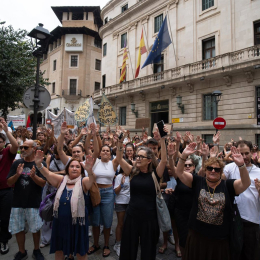
Greece: 25 general strikes in six years

The dimension of the Greek precedent allows us to understand to what extent the general strike has been a common tool of political pressure in Europe. Between 2010 and 2015, Greece accumulated 25 general strikes, according to the comparative literature collected by the European Trade Union Institute. The phenomenon was particularly intense during the years of austerity, when unions responded with successive mobilizations to the reforms demanded of the country.

But even in the most extreme European case, the strikes took place in a context of legislative activity. Parliament was the place where cuts were discussed and where measures were finally approved. The strike sought to condition that process.

It is an important difference compared to Spain: the union pressure was then exerted on a fully operational legislative power, not on a Cortes already dissolved.

Portugal: a strike during the processing of the Budgets

The Portuguese strike of November 2011 perhaps offers an even clearer comparison. The trade unions called the strike against the measures included in the 2012 Budgets and against the Government's austerity policies. The parliamentary calendar and the union calendar were directly connected.

Parliament had to pronounce on the public accounts. The strike aimed precisely to exert pressure on those who had to make that decision.

There was, therefore, no temporary break that occurs in Spain in 2026: first the parliamentary rejection of the decrees; then, the dissolution of the Cortes; and finally, the call for a general strike during the electoral process.

France: the closest precedent, but without a general strike

The French case of 2024 is the one that most closely resembles the current Spanish scenario for a specific reason: there was parliamentary dissolution and an electoral campaign immediately afterwards.

Emmanuel Macron dissolved the National Assembly on June 9, 2024, and called for legislative elections on June 30 and July 7. During the following weeks, large mobilizations occurred against the possibility of a victory for the National Rally. Tens of thousands of people took to the streets, and different social and political organizations called for mobilization during the campaign.

But France does not offer the same union precedent. Those mobilizations were fundamentally political and social protests. There was no national general strike comparable to the one that CCOO and UGT are preparing now in Spain.

The French comparison allows, precisely, to delineate the Spanish uniqueness: there is indeed a recent precedent of a dissolved Parliament, elections underway, and political mobilization in the streets; there is no equivalent precedent of a national general strike called in that scenario.

Slovenia: a strike on election day, but of a sectoral nature

The European comparison even offers a case in which a strike coincided with elections. In Slovenia, in 2004, a union organization of journalists called for a strike that began on the same day as the general elections.

However, it cannot be considered an equivalent to the Spanish case either. It was not a national general strike against a government policy, but a sectoral conflict related to working conditions and collective bargaining.

It is another example of the difference between strike and elections and the assumption posed now in Spain: the former has precedents; the combination of a national general strike, a dissolved Parliament, and political conflict during the campaign is much more exceptional.

Italy and other countries: political strikes with functioning institutions

The same pattern appears in other countries. Italy has witnessed general strikes against fiscal, budgetary, or labor reforms. One of the references collected in the comparative documentation is the general strike of November 30, 2004, against the budget project and the fiscal measures of the Government.

Again, the common element is the same: the mobilization occurred while the institutions were functioning and decisions remained open to political negotiation.

The Parliament was not an absent actor. On the contrary: it was one of the main recipients of union pressure.

The first European strike also arose with the Parliaments open

On November 14, 2012, one of the most relevant episodes of transnational union mobilization during the crisis occurred. Spain, Portugal, Italy, Cyprus, and Malta participated in the first European-scale strike, while there were solidarity mobilizations in France.

That episode is particularly useful for comparison because it occurred at the moment of maximum pressure from austerity policies. European unions used the strike to respond to specific decisions of national governments and to the economic policies that were being debated and applied.

Nor was the scenario that now appears in Spain raised at that time: a country with the Cortes dissolved and a general strike called in the midst of an electoral race.

The academic literature: a strike can have electoral effect

The institutional uniqueness does not mean that a strike during a campaign cannot have precedents in terms of political impact. The academic literature has precisely studied the relationship between general strikes and electoral behavior.

A study on 16 countries in Western Europe between 1980 and 2012 concluded that general strikes can have electoral consequences and that this effect can be particularly relevant when the mobilization occurs close to elections.

Strikes can modify voters' perceptions of government responsibility and increase the electoral cost of certain policies.

That is to say, the strike can not only be an instrument to try to modify a government decision. When elections are near, it can also become an element of electoral competition.

The difference is that, in the usual scenario, the strike occurs while the government is still under the ordinary control of Parliament. In Spain, the mobilization is raised when citizens are already called to decide who will occupy that Parliament after November 29.
EuropaPress 7826823 varias personas observan acampada vivienda puerta sol octubre 2026 madrid
Several people observe the housing camp at Puerta del Sol. Photo: Europa Press. 

The Cortes are dissolved, but not all parliamentary activity has disappeared

There is a constitutional precision that is essential to understand the scenario. The dissolution of the Cortes does not mean that any form of parliamentary activity disappears.

The Constitution maintains the Permanent Deputations of the Congress and the Senate during the period between legislatures. Article 78 assigns them certain functions, among them those related to the situations constitutionally provided for during the periods when the Chambers are not meeting.

Precisely through this mechanism, the Government intends to try to carry out the housing decrees that the Plenary of the Congress has rejected.

For this reason, talking about a Spain "without Parliament" would be imprecise. What exists is something different: the Cortes are dissolved, the ordinary activity of the Chambers has ended, the Permanent Deputations maintain the competencies assigned to them by the Constitution, and the country is already in an electoral process.

It is in this framework, and not in that of an ordinary legislature, where the general strike is proposed.

A scenario that finds no clear equivalent in Europe

The comparison allows for a conclusion: general strikes are a known tool in European democracies and have been used on numerous occasions to pressure Governments and Parliaments. There are also precedents of protests during electoral campaigns and strikes coinciding with elections.

But the pattern changes when all variables are crossed.

Greece had dozens of general strikes during the crisis, but with its Parliament functioning. Portugal called strikes against its budgets while they were being processed. Spain did the same during the reforms of 2010, 2012, and 2013. France experienced in 2024 an electoral campaign after the dissolution of its Assembly and large mobilizations in the streets, but not a comparable national general strike. Slovenia had a strike coinciding with elections, but it was sectoral and linked to a labor conflict.

None of these cases reproduces the scenario that is now opening in Spain.

For this reason, in terms of European comparison, Spain finds itself in a singular situation: a national general strike being prepared with the Cortes already dissolved, the electoral process underway, and after the Congress has rejected the measures that are at the center of the protest.

The exceptionality, therefore -they explain to DEMÓCRATA sources from the EU experts in this matter-, does not reside in the existence of a general strike nor in the fact that the unions intervene in a political conflict. Both things have a long European tradition. What is different is the moment: the union pressure comes when the legislature has ended and the next political decision is already in the hands of the voters.


More key points, information and questions with FREN

AI-GENERATED CONTENT

What parliamentary procedures remain pending in Spain after the dissolution of the Cortes Generales?

After the dissolution of the Cortes Generales due to the call for elections, ordinary parliamentary activity practically stops, but not everything disappears or is closed off. Some procedures are extinguished and must be restarted in the new legislature; others are suspended but can be reactivated; and a very small core of functions passes to the Permanent Deputation, which maintains a “vital minimum” of Parliament until the new Chambers are constituted.

1. Legislative initiatives: what is extinguished and what can be reactivated

The general rule is that the dissolution of the Congress and the Senate causes the initiatives that were in process to lapse:

  • Government bills: they are extinguished. If the new Government wants to continue, it must approve and submit a new bill in the next legislature.
  • Private members’ bills from groups or other legitimized subjects: they also lapse. They can be registered again when the new Cortes are constituted.
  • Initiatives in an advanced phase (working group, committee, report pending Plenary, referral to the Senate, etc.): are also considered concluded without final approval, unless a final vote on the text had already taken place.

The practical effect is that no law remains “pending” in the strict sense: there is no right to resume processing at the point where it was left off, but rather the political possibility of registering the same initiative again, regardless of how far the previous file had advanced.

2. Government oversight and other control initiatives

Ordinary parliamentary control (oral questions, interpellations, motions, investigative committees, etc.) is based on the existence of active Chambers. With the Cortes dissolved:

  • Questions, interpellations, and motions registered and pending debate lapse. If the new deputies want to insist, they must register them again.
  • Investigative committees: they are extinguished with the legislature, even if conclusions have not been approved. They are not “inherited” by default; new committees must be created if necessary.
  • Requests for appearances not held also lapse and must be requested again in the new Chambers.

Therefore, no ordinary control instruments remain pending in the legal sense after dissolution; what exists is a political space to reconsider them later.

3. General State Budgets and budgetary matters

The Budgets remain in force even if the Cortes are dissolved, because they are already a law in force. What is affected are their parliamentary procedures:

  • If the Budget Bill was in process and had not been approved, it lapses. The new majority will decide whether to present a new bill or extend the previous ones.
  • Any budget modification in progress (extraordinary credits, supplements, etc.) requiring a law will follow the same general rule: the initiative lapses and must be restarted.

In parallel, the Government becomes caretaker and, as established by the Government Law, cannot approve a new Budget bill to submit to dissolved Cortes, although it can adopt urgent measures by decree-law when constitutional requirements are met.

4. Role of the Permanent Deputation: what can continue to be processed

The great exception is the Permanent Deputation, provided for in Article 78 of the Constitution. Once the Chambers are dissolved, it assumes certain very limited powers until the new Cortes are constituted:

  • Royal decree-laws (art. 86 CE): if the Government approves decree-laws while the Cortes are dissolved, the Permanent Deputation of the Congress can validate or repeal them within 30 days. This is practically the only “legislative” procedure alive during that period.
  • States of alarm, exception, and siege (art. 116 CE): if declared with the Congress dissolved or with the mandate expired, the Permanent Deputation assumes the Plenary’s powers to authorize extensions and declare or extend states of exception and siege.

Outside these constitutionally specified cases:

  • The Permanent Deputation cannot legislate (does not process bills or private members’ bills).
  • Does not exercise ordinary control (no control sessions, questions, or routine political interpellations).
  • Does not assume other authorizations belonging to the Chambers (international treaties, military authorizations, etc.), unless expressly attributed by the Constitution.

When the new Chamber is constituted, the Permanent Deputation must report on the decisions taken, but these decisions (for example, the validation of a decree-law) will have already produced full effects.

5. In summary: what can be considered “pending”

In legal terms, after dissolution:

  • Ongoing initiatives (legislative or control) are understood as concluded without approval or pronouncement and do not persist as pending files.
  • Only exceptional procedures linked by the Constitution to the Permanent Deputation (decree-laws and states of alarm, exception, and siege) remain active, insofar as they can be activated during the electoral period.
  • What remains “pending” in a political sense is the possibility that the new parliamentary majority reopens the same debates through new initiatives, but with completely new file numbers and procedures.

Thus, dissolution closes almost the entire parliamentary board but leaves a narrow channel for urgent decisions and crisis management, avoiding a complete vacuum of democratic control until the new Cortes are constituted.

What differences are there between the activity of the Permanent Deputation of the Congress and that of the Senate during the dissolution? Can you explain with real examples which decree-laws have been validated in previous electoral periods? How does the dissolution of the Cortes affect investigative committees and their pending conclusions?

What are María Jesús Montero’s competencies and functions as minister and PSOE leader?

María Jesús Montero has been in recent years a central figure in the Government of Spain and the leadership of the PSOE. According to our database, which collects official records and reference press, she ceased to be First Vice President and Minister of Finance at the end of March 2026, when Pedro Sánchez appointed Carlos Cuerpo as new First Vice President and Arcadi España as new Minister of Finance. Since then, she has focused her activity on organic and parliamentary politics, especially in Andalusia and in the Senate.

1. Competencies and functions as Minister of Finance and First Vice President

During her time in the Executive (2018–March 2026), Montero was responsible for the Ministry of Finance and, in the last phase, also First Vice President of the Government. According to Royal Decree 1009/2023 (basic structure of departments) and Royal Decree 206/2024 (basic organic structure of Finance), the main competencies of her department were, in summary:

  • Fiscal and tax policy: design and proposal of state taxes, supervision of their management through the Tax Agency, promotion of measures such as extraordinary levies on banks and energy companies and the temporary tax on large fortunes.
  • General State Budgets: preparation of the budget bill, negotiation with parliamentary groups, and monitoring of its execution. Under her mandate, several expansive budgets aimed at strengthening the welfare state were approved.
  • Budgetary stability and fiscal rules: application of stability frameworks, relationship with the Independent Authority for Fiscal Responsibility, and adaptation of deficit and debt targets after successive crises (pandemic, energy, etc.).
  • Autonomous and local financing: proposal of resource distribution among autonomous communities and local entities, management of the Autonomous Liquidity Fund, and negotiation of partial debt cancellations or restructurings.
  • Management of State assets and centralized contracting: direction of State assets and policy of rationalization and centralization of state public procurement.
  • European funds linked to Finance: coordination of a significant part of the budgetary management of Next Generation EU funds and other European financial instruments.

As First Vice President, besides heading Finance, she acted as the government’s number two: coordinating economic action with the Vice Presidency of Economy, participating in major negotiations with parliamentary partners, and, in the president’s absence, presiding over the Council of Ministers and representing the Executive in Congress. The press and the PSOE itself describe her as a “key pillar” of the Government and one of the decisive figures in budgetary and investiture negotiations.

Between January 2020 and July 2021, she was also Government spokesperson at Moncloa. In that role, she was responsible for:

  • Explaining Council of Ministers agreements in press conferences.
  • Coordinating the government message with different ministries.
  • Acting as the visible face of the Executive in moments of high political or economic tension.
2. Functions as PSOE leader

On the organizational level, official PSOE sources and the press agree that Montero is currently:

  • Federal PSOE Deputy Secretary General (number two of the party).
  • Secretary General of the Andalusian PSOE (PSOE-A) and candidate for the Presidency of the Junta in the 2026 Andalusian elections.

As Deputy Secretary General, her political and strategic functions include:

  • Forming, together with Secretary General Pedro Sánchez, the core leadership of the party at the national level.
  • Designing the political and discourse strategy of the PSOE, especially in economic, social, and territorial matters.
  • Being one of the main negotiators of government and parliamentary agreements with other forces (Podemos, Sumar, and territorial partners), as highlighted by various chronicles and party statements.
  • Acting as a public reference in debates on taxation, welfare state, and confrontation with PP and Vox, providing “ideological ammunition” to the economic debate from social-democratic positions.

As Secretary General of PSOE-A and leader of the Andalusian opposition, her duties are:

  • Leading the Andalusian socialist organization (provincial and local groups) and supervising electoral lists.
  • Setting the line of opposition to Juanma Moreno’s Government, with special emphasis on health, housing, and public services.
  • Coordinating the work of the Socialist Parliamentary Group in the Andalusian Parliament, where she serves as spokesperson, and connecting that action with the federal PSOE position.
  • Driving the campaign and mobilization of the progressive electorate ahead of the Andalusian elections.
3. Recent parliamentary positions

Besides her internal responsibilities in the PSOE, parliamentary records indicate that Montero combines her Andalusian leadership with a relevant presence in the Cortes Generales: she is a senator by autonomous designation of the Socialist Group and is part of the Permanent Deputation of the Senate, as well as serving as deputy spokesperson of the Socialist Group in the Board of Spokespersons. These positions allow her to continue influencing the national agenda and coordinate between the federal PSOE, the Senate, and Andalusian politics.

Can you detail concrete examples of fiscal or budgetary decisions María Jesús Montero took as Minister of Finance? What role does María Jesús Montero play today in the Senate and how does she coordinate that work with her leadership in the Andalusian PSOE? How are strategic functions distributed in the current PSOE leadership among Pedro Sánchez, María Jesús Montero, and other key leaders?

How many general strikes have been called in Spain during the current legislature and how many have coincided with electoral periods?

According to available information, during the current state legislature (from the general elections of July 2023 until the dissolution of the Cortes and call for elections on November 29, 2026) two nationwide general strikes have been called in Spain. Of these, one was explicitly planned in an electoral period context.

1. Number of general strikes called in the legislature

  • General strike on October 15, 2025
    The Order TED/1139/2025, of October 13, and the Order HAC/1128/2025 state that the Government sets minimum services “in view of the various general strikes called nationwide for October 15, 2025.”
    These texts detail:
    • A strike call by UGT and CCOO affecting labor and civil service activities throughout the State, with two-hour stoppages per shift.
    • 24-hour general strike calls by other unions (e.g., General Confederation of Labor, Base Commissions, etc.) extending nationwide.
    Although part of the mobilization is organized as partial stoppages, the BOE itself expressly refers to “general strikes” nationwide that day, so it can be considered a general strike day.
  • General strike for housing, agreed for autumn 2026
    UGT and CCOO have agreed to call a 24-hour general strike in autumn 2026 over wages and housing. This is reported by Demócrata in “UGT and CCOO agree to call a general strike for housing this autumn”, which indicates:
    • It will be a 24-hour general stoppage.
    • The decision must be ratified by the highest governing bodies.
    • The exact day has not yet been set, but it will take place in autumn.
    Therefore, although the date is not fixed, there is an agreed call for a general strike in the final stretch of the legislature.

With these elements, it can be stated that in the current legislature there have been:

  • Two nationwide general strikes called: October 15, 2025, and the general strike for housing agreed for autumn 2026.

2. Coincidence with electoral periods

The key nuance of your question is which general strikes have coincided with “electoral periods.” It is worth distinguishing:

  • October 15, 2025: official documentation (minimum service orders and press coverage, such as this Demócrata piece on the Gaza strike) does not link it to a specific electoral cycle, but to international protest over Palestine and other demands. It is not associated with a campaign or election call on that date, so it is not recorded as coinciding with a state electoral period.
  • General strike for housing in autumn 2026:
    • The Prime Minister has announced an early election and set the general elections for November 29, 2026, as Demócrata recalls in several pieces about the legislature’s close.
    • The Demócrata article on the strike explains that the call will occur “in a political scenario marked by the general elections of November 29,” placing the mobilizations “in the full electoral countdown.”
    • Other information, such as statements from employers disseminated by CEOE and CEPYME, emphasize that it is a strike “in the full electoral call.”
    • At the same time, UGT General Secretary Pepe Álvarez has indicated that the union’s intention is that the date does not coincide with the formal campaign, but takes place before its start, although already in an openly electoral context.
    From a political and media point of view, it is clearly a general strike called within the electoral period, understood as the time between the election call and the vote, even if strict overlap with official campaign days is avoided.

Based on this data, the concise answer would be:

  • General strikes called in the legislature: 2.
  • General strikes coinciding with an electoral period (early call of November 2026 general elections): 1, the general strike for housing agreed for autumn 2026.

The figure can be nuanced depending on the strict definition of “electoral period” adopted (only official campaign or the entire interval from the call), but with the available information, only the general strike for housing clearly fits that electoral context.

Can you better detail the content and the organizers of the general strike on October 15, 2025? What arguments are the unions and employers using regarding the general strike for housing in autumn 2026? How do these general strikes legally fit in relation to pre-campaign and campaign electoral periods?

Play

Test your knowledge with FREN!

How much do you know about this topic? Answer the following 3 questions.

What particularity makes the general strike called in Spain unique compared to other EU countries?

Question 1 of 3

In which European country were 25 general strikes held between 2010 and 2015, always with the Parliament in operation?

Question 2 of 3

What is the main difference noted between previous general strikes in Spain and the one called now?

Question 3 of 3