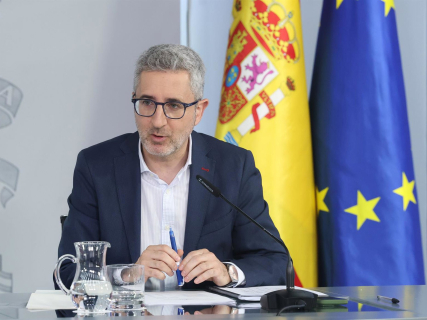

Hacienda does not need the vote of any autonomous community to approve its new financing model. It also has the vote of Catalonia and the Canary Islands. However, Minister Arcadi España may encounter a limit to the processing of the expected reform.
Madrid calls on all PP communities to abstain from the Fiscal and Financial Policy Council (CPFF) convened this Friday and try to block the Government's reform.
Even if it has the votes --the Government wins votes even with all the communities against--, it cannot approve votes if there are not enough participants.
The rules of operation of this body require the attendance of at least half of its members. And the PP governs the majority of autonomous communities in the country. If they support the call from the administration led by Isabel Díaz Ayuso, they could force the suspension of the meeting and prevent the voting on the reform.
The meeting will begin at 10:30 hours in the Cuzco building of the Ministry of Hacienda, located at number 162 on Paseo de la Castellana in Madrid. It will be presided over by the Minister of Hacienda, Arcadi España, who will hold a press conference at the end of the meeting.
Almost 21,000 million more in 2027
The proposal provides that the autonomous communities of the common regime will have in 2027 20,975 million euros more than they would receive if the current system remained in force. In total, the new model would distribute that year approximately 224,507 million.
The Executive presents the reform as a boost aimed at strengthening healthcare, education, and social services, reducing funding differences per inhabitant, and increasing the fiscal autonomy of the communities. However, its detractors believe that the system is conditioned by the political agreements reached with Catalonia and does not guarantee a sufficiently transparent and equitable distribution.
Catalonia and the Canary Islands ensure the vote
Catalonia and the Canary Islands are the two communities that have announced their favorable vote. This support is sufficient for the Government to overcome the vote of the CPFF, even though most of the autonomous governments express opposition.
The central Executive has in this body a weight equivalent to that of all the communities. Therefore, its vote, accompanied by that of at least one autonomy, allows reaching the necessary majority in a second vote.
The Catalan support was anticipated since the presentation of the model, whose negotiation is linked to the agreements reached between the PSOE and ERC. According to the calculations of the Generalitat, Catalonia would receive around 4.7 billion euros additional and would concentrate 22.3% of the new resources incorporated into the system.
The Catalan Government defends that the reform improves financial autonomy, reduces differences between territories, and represents a step forward compared to the model in force since 2009. The president of the Generalitat, Salvador Illa, has urged the rest of the communities to present alternative proposals if they believe that the distribution proposed by the Treasury is not adequate.
Canary Islands will also vote in favor after obtaining specific commitments related to its territorial uniqueness. The agreement includes additional resources outside the model, changes in convergence funds, and the possibility of using surpluses and pending excess financing for investment projects for three years.
Its support caused discomfort among the communities governed by the PP, which had requested more time and documentation to analyze the proposal. The Treasury then agreed to postpone until this Friday the CPFF initially scheduled for the end of July.
Block rejection by the PP communities
Ten of the eleven communities governed by the Popular Party will attend the Council with the intention of voting against, after the Community of Madrid has formally announced that it will be absent from the meeting.
The autonomous government of Isabel Díaz Ayuso has also reportedly asked the rest of the popular communities not to respond to the Executive's call, although, at least for the moment, none have picked up that gauntlet. The explicit objective of the Madrid government is to try to ensure that there is no quorum and, therefore, that the Treasury cannot push the proposal forward. According to sources from the Community of Madrid, the joint absence of the popular autonomies would mean "the paralysis of this break from the equality of all Spaniards and the whitewashing of the economic and political corruption of the managers of the Generalitat of Catalonia in recent decades."
The Internal Regime Regulations of the CPFF establish that, "for the valid constitution of the Council the attendance of at least half of its members will be necessary." The autonomous communities governed by the PP argue that the model responds to the demands of the Government's independentist partners and that the distribution has not been negotiated in a truly multilateral manner.
The popular governments also denounce that the Treasury did not initially provide them with complete and homogeneous simulations, nor a calculation report that would allow verifying the effect of all the criteria on each territory.
The party demands a system based on adjusted population, the effective cost of public services, and the demographic and territorial circumstances of each community. It also demands that no autonomy is harmed and that the new resources are not conditioned by prior bilateral agreements.
The Minister of Finance has asked the PP communities to prioritize the interests of their citizens over the "dictates of Genoa." Arcadi España defends that all autonomies will obtain more resources and emphasizes that some of the regions that would benefit the most, such as the Comunitat Valenciana, Andalucía, or Murcia, are governed by the populars.
Rejection also in socialist governments
The response to the funding proposal is not limited to the PP communities. The socialist governments of Castilla-La Mancha and Asturias have also expressed their reservations, leaving the central Executive practically alone against the autonomies, with the exceptions of Catalonia and the Canary Islands.
Castilla-La Mancha considers that the model does not adequately guarantee the cost of providing public services in extensive, aging territories with a high population dispersion. The Government of Emiliano García-Page rejects that the reform can preserve the ordinality demanded by Catalonia if that limits redistribution among communities.
Asturias also questions the adjusted population criteria and demands that aging, geographical dispersion, and healthcare costs have greater weight.
The opposition of two autonomous governments of the PSOE weakens the Treasury's argument that the rejection responds exclusively to a strategy coordinated by the PP. It also anticipates a complicated negotiation when the reform passes from the CPFF to the Council of Ministers and, subsequently, to the Cortes Generales.
What changes with the new funding model
The proposal raises the percentage of the large state taxes that is ceded to the communities. The autonomous participation in the IRPF would rise to 55%, while that of the VAT would increase to 56.5%. These changes would contribute nearly 16,000 million additional.
The system also modifies the calculation of the adjusted population, the variable used to determine the spending needs of each territory. For this, factors such as population, age, health and educational needs, unemployment, area, dispersion, and insularity are taken into account.
The Treasury also proposes to strengthen leveling mechanisms to reduce funding differences per inhabitant, incorporate new tax figures into the autonomous basket, and create a fund of 1,000 million linked to the effects of climate change.
The Government assures that no community will lose resources compared to the current system. The worst-funded territories, including the Comunitat Valenciana, Murcia, Andalucía, and Castilla-La Mancha, are among those that would experience the largest increases.
The vote does not imply final approval
The result of this Friday will not allow the new model to automatically come into force. The CPFF is a coordination body between the State and the communities, and its pronouncement represents only the first political and institutional endorsement.
After the meeting, the Government must convert the proposal into legislative modifications and approve them in the Council of Ministers. Subsequently, the reform will have to go through Congress, where it needs an absolute majority as it affects the Organic Law on the Financing of Autonomous Communities.
This parliamentary procedure constitutes the main obstacle for the Executive. The support of ERC is not enough and Junts has questioned the model considering that it does not fulfill the agreement to advance towards a singular financing of Catalonia. The Government will therefore have to negotiate with parties that hold different and even incompatible positions on territorial distribution.