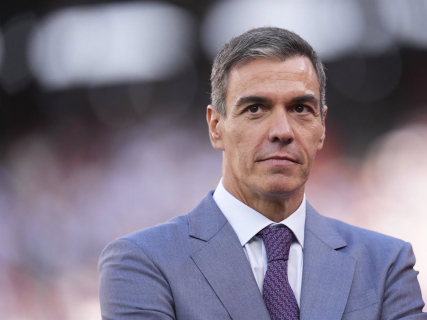

The President of the Government, Pedro Sánchez, appears this Thursday before the Plenary of Congress to provide explanations about the crisis in Ceuta, more than a month after the massive entry of migrants on July 30 and 31. He will do so after weeks of controversy over what the Executive knew before the entry, how it reacted during the first hours, the real figures of the crisis, and the role played by Morocco.
The appearance comes after the mobilizations held on Wednesday in Ceuta and in different parts of Spain to demand solutions to the crisis. Sánchez arrives at the hemicycle after the explanations offered by ministers of his Government and with a new front opened by the report prepared by the National Center for Immigration and Borders (CENIF) that interprets the entry of migrants as an operation with "prior planning" orchestrated with the permissiveness of the Moroccan authorities.
With this scenario, Sánchez faces an appearance in which he will have to reconstruct the Government's actions during the crisis and respond to the uncertainties that loom over a crisis pending resolution.
What did the Government really know before July 30 and when did it know it?
One of the main uncertainties remains what information the Executive had before tens of thousands of people headed towards Ceuta and how far the warnings received went.
Since the beginning of the crisis, there has been discussion about whether the National Intelligence Center (CNI) shared information about the massive arrival in Ceuta with the Ministry of the Interior or not. The versions released by the Government were disparate, from the Minister of Defense, Margarita Robles, to the Minister of the Interior, Fernando Grande-Marlaska, with contradictory accounts of the events. The pending question is to determine whether those signals only allowed anticipating an increase in migratory pressure or warned of an organized mobilization towards the border, and when each piece of information reached the political leaders.
Sánchez will have to explain what the Government knew before July 30 and why, despite the existing alerts, there was no anticipation of an entry of the dimensions that ultimately occurred.
What role does Sánchez now attribute to Morocco after the police report became known?
This issue has acquired a different dimension after the CENIF report was made known. The police document describes an "almost active" tolerance from the Moroccan security forces and notes that the interviewed migrants reported almost unanimously that the forces did not limit themselves to remaining passive. However, the Government has insisted from day one that Rabat is not responsible for the massive arrival of migrants and praises its collaboration in repatriation efforts.
According to the testimonies included in the report, the Moroccan Gendarmerie offered directions to access Ceuta via the water through the area of the El Tarajal Jetty. The CENIF also analyzes images of uniformed agents and individuals in plain clothes and speaks of "prior planning," "superior planning," and "gray zone strategies."
The question is whether these elements modify the assessment that the Government has made so far about Morocco's actions during the crisis.
Why was the Interior unaware of the report sent by the Police to the National Court?
The emergence of the document has opened a second controversy about the circulation of information within the Ministry of the Interior.
Grande-Marlaska has asked for explanations from the director general of the Police after the content of the report sent to the National Court became known.
Sánchez will have the opportunity to clarify when the Government became aware of the document, when its content reached the Interior, and why a report of this relevance had not been previously known by the minister.
How many people entered, how many have left, and how many actually remain in Ceuta?
More than a month after the massive entry, there continue to be differences between the figures handled regarding the number of people who crossed the border, those who returned to Morocco, and those who remain in Spanish territory.
The CENIF report itself admits the difficulties in establishing an objective figure. The Police collects estimates from different institutions and makes its own calculation, but acknowledges that it does not have reliable data that allows for an accurate determination of entries, exits, and stays.
Sánchez will have to provide an updated picture of the situation and also clarify how many minors remain in Ceuta and what their situation is.
Why did the Government take time to activate the extraordinary response?
The chronology of the response constitutes another of the pending issues. The Executive ended up declaring the situation of interest for National Security in Ceuta and designating the Minister of Territorial Policy, Ángel Víctor Torres, as the functional authority to coordinate the response.
The question is what failed during the first hours and days following the massive entry and why extraordinary measures were not adopted earlier.
What solution does the Government have for those who still remain in Ceuta, especially minors?
Beyond reconstructing what happened on July 30 and 31, the immediate problem for Ceuta continues to be the management of the people who remain in the city.
The Government must clarify what will happen to those who are still there, who can be returned, what alternatives exist for those who cannot return to Morocco, and how their reception or transfer to other points in the territory will continue.
Especially sensitive is the situation of minors, both due to protection obligations and the pressure that their care places on the resources of the autonomous city.
What relationship does Spain want to maintain with Morocco after the crisis?
The last unknown transcends the immediate management of Ceuta and affects the bilateral relationship between Spain and Morocco.
The Government has defended the importance of cooperation with Rabat during the crisis. Now Sánchez will have to explain how that position fits with a report from the National Police that describes the behavior of Moroccan forces and uses concepts such as "superior planning," "gray zone," and "geopolitical interference."
The president must clarify whether the Executive will ask Morocco for explanations, whether it contemplates any diplomatic action, and what guarantees Spain has to prevent a similar episode from recurring.