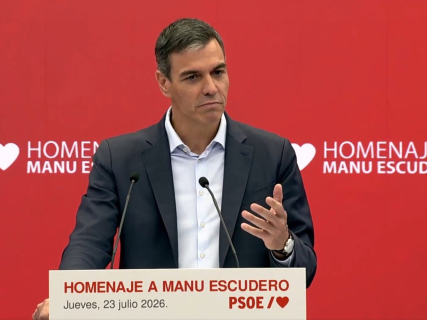

The PSOE has disseminated an informative note about the situation in Ceuta in which it defends the actions of the Government of Pedro Sánchez in response to the massive entry recorded on July 30 and 31 and tries to respond to the criticisms received in recent weeks.
The document starts from the consideration of those events as the “most serious mass entry in the history” of Ceuta, with thousands of people crossing by swimming in a few hours and dozens of fatalities during the attempt. According to the PSOE, that situation caused a simultaneous humanitarian, security, public order, and coexistence crisis.
The figures and assessments are part of a political note prepared by the Socialist Party itself, so the PSOE attributes to the Executive a large part of the positive results it reports and directs direct criticisms against PP and Vox.
The PSOE maintains that more than 90% returned to Morocco in the first 24 hours
According to the socialist document, the Government responded "from the very first moment" by reinforcing border security, healthcare, humanitarian response, migration management, and the diplomatic route.
The PSOE asserts that the deployment allowed more than 90% of the people who had entered by swimming to voluntarily return to Morocco during the first 24 hours. The party defends that the actions of the Executive must combine firmness and security with respect for Spanish, European, and international legislation and human rights.
The note also recalls that Pedro Sánchez traveled to Ceuta on the same July 31 and states that the Executive organized its response in three major fronts: security and border control, triage and immigration procedures, and humanitarian assistance.
More than 500 additional agents, according to the socialists
In terms of security, the PSOE points out that before the crisis there were 1,659 members of the State Security Forces in Ceuta, of which 945 belonged to the National Police and 714 to the Civil Guard.
Since July 30, according to the party, 270 national police officers and another 240 civil guards were added, which means more than 500 additional personnel. A provisional maritime containment system was also installed, consisting of a line of buoys of 730 meters and a floating pneumatic barrier of 500 meters.
The PSOE also maintains that patrols were increased on the streets and a service for attention and reception of complaints was established 24 hours a day. According to their interpretation, crime and incidents affecting the Ceutí population remained "practically unchanged" during the crisis, despite the strong temporary increase in population.
A new CATE to accelerate triage and returns
The socialist note also details the reinforcement of foreign teams with specialists from the General Commissariat of Foreign Affairs and Borders and agents from the Foreign Brigade.
According to the PSOE, cooperation with Morocco was also intensified and extraordinary meetings of the Interministerial Commission for Asylum and Refuge were held to accelerate return procedures.
Among the measures is the creation of a provisional Temporary Attention Center for Foreigners (CATE) in a warehouse in Tarajal, aimed at speeding up identification and triage tasks. The works began on August 10 and the forecast included in the document is that it will be operational between the end of August and the beginning of September.
More than 2,000 humanitarian places and health reinforcement
In the assistance area, the PSOE assures that the CETI was expanded with 400 additional places to reach 1,183 and that temporary spaces provided by Defense and the Autonomous City were enabled until more than 2,000 new humanitarian attention places were available.
The Príncipe Felipe and Reina Sofía schools were designated for the reception of minors and, according to the note, the Red Cross distributed thousands of humanitarian aid kits among the people concentrated on the Trampolín beach.
The document also states that a specific health circuit was created to attend to migrants without interfering in the ordinary care of Ceutí residents. The PSOE claims that no scheduled intervention or consultation was suspended or delayed and that more than 60 additional health professionals were incorporated.
A single command and more than 100 million additional for Ceuta
The PSOE highlights as one of the main novelties of this last week the creation of a single command, a measure that, according to the document, was requested by the Ceutí authorities themselves to improve institutional coordination.
The party also announces an Extraordinary Expansion of the Comprehensive Socioeconomic Development Plan for Ceuta, with an additional allocation of over 100 million euros.
According to the PSOE, the money will have three main objectives: to reinforce urban and border security, to manage returns and the situation of migrants who continue in Ceuta, and to strengthen public services and the economy of the autonomous city.
The note adds that agreements have been reached with the autonomous communities to send vaccines and mobilize 25 million euros allocated for accommodation, food, transfers, clothing, and legal assistance, in addition to locating new reception spaces after neighborhood protests.
The PSOE claims the Government's investment in Ceuta
Beyond the immediate response, the socialists defend that their commitment to Ceuta goes back years. According to the note, Pedro Sánchez has visited the city four times, more than any other president of the Government during democracy.
The PSOE estimates 428 million euros in transfers made to Ceuta during Sánchez's governments, an amount that it presents as almost 50% higher than that recorded during the governments of Mariano Rajoy. It also points out that the advances reached 56 million in 2026.
In infrastructure, the document compares the 31 million invested between 2012 and 2017 with the 69 million it attributes to the years of socialist government and highlights the 56 million planned by Transport for the Port of Ceuta until 2029.
The PSOE accuses the PP and Vox of "partisan use" of the crisis
The most political part of the document directs strong criticism against PP and Vox. The PSOE accuses both parties of having contributed to a climate of "tension, confrontation, and chaos" through speeches that, according to the socialists, have favored social tension.
The note attributes to the right and the far-right the dissemination of "falsehoods and messages of hate" and maintains that certain statements and mobilizations have fueled the confrontation. These accusations are part of the PSOE's political assessment of the events.
The socialists also reproach several communities governed by the PP for their stance on the distribution and care of migrant minors and contrast that position with the disposition shown, according to the document, by Navarra or Asturias.
Condemnation of assaults against military personnel and migrants
The note incorporates, however, an explicit condemnation of all forms of violence.
The PSOE assures that it rejects both the aggressions against military personnel and civil guards as well as any crime committed by migrants. Likewise, it condemns the attacks against migrant people, the destruction of camps, and the obstacles to the humanitarian work of the Red Cross.
The party also expresses its support for the State Security Forces and Corps and the Armed Forces, with a special reference to the agents and military personnel injured during the last days, and extends that recognition to the Red Cross personnel deployed in Ceuta.
The PSOE defends its migration policy despite the crisis
Finally, the socialists attempt to frame what happened in Ceuta as an extraordinary episode within a general downward trend of irregular immigration.
According to the data collected by the PSOE, irregular arrivals in Spain decreased by 43% in 2025 compared to 2024 and continued to drop by almost 15% during the first half of 2026. Before the Ceuta crisis, irregular entries by sea had fallen by 30.8% and in the Canary Islands, the decrease reached 59.6%.
The document also cites figures from Frontex to support that Spain recorded fewer irregular crossings in 2025 than Italy or Greece and presents the government's migration policy as "a model that has been working for years".
With this note, the PSOE thus tries to establish its own narrative about the crisis: it defends that the Government reacted with resources and reinforcements from the very first moment, claims new investments to restore normality in Ceuta, and accuses the opposition of politically using a situation that it still considers exceptional.