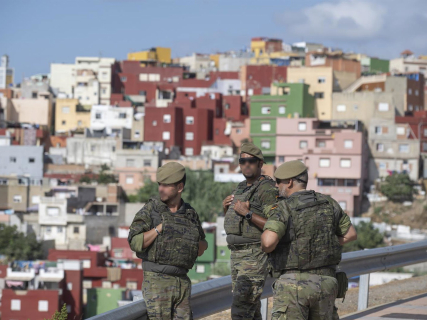
The "single command" that the PP requests for Ceuta: what it is, who would appoint it, and what powers it would have

The popular ones demand that Sánchez declare a situation of interest for National Security and concentrate the coordination of the crisis in one authority. The figure would allow mobilizing and ordering resources from various administrations, but would not grant exceptional powers nor suspend rights.

8 minutes

fotonoticia 20260820205603 1920

fotonoticia 20260820205603 1920

Add DEMÓCRATA to Google

Ask FREN

Published

Last updated

8 minutes

Most read

The "single command" that the PP claims for Ceuta does not appear by that name in the National Security Law. The norm does allow the president of the Government to declare a "situation of interest for National Security" and, within that mechanism, appoint a functional authority in charge of directing and coordinating the actions of the different administrations involved. This would mean centralizing the political and operational response to the crisis, but not granting that person extraordinary powers or placing all Ceuta institutions under their orders.

The PP has brought this request to Congress after the massive entry of migrants recorded at the end of July. Cuca Gamarra demands that the Government consider what happened a national security crisis, sovereignty, and territorial integrity, increase police and military forces, strengthen Immigration, and accelerate returns. The measures are part of two non-legislative propositions of equivalent content presented for debate in the Joint Commission of National Security and in the Interior Commission.

The expression "single command" simplifies, therefore, a mechanism that is much more concrete. For it to exist, a step must first be taken that only Pedro Sánchez can adopt: formally declaring a situation of interest for National Security through a royal decree.

What exactly is the "single command"

Law 36/2015 on National Security does not use that expression. Its article 24 establishes that, when the president declares a situation of interest for National Security, the royal decree may include the appointment of a "functional authority" and must specify exactly what powers it will have to direct and coordinate the necessary actions.

That is what the PP is politically calling "single command."

Its function would be to prevent each involved agency from responding to the crisis separately. In a scenario like that of Ceuta, it would be necessary to coordinate actions affecting Interior, Defense, Immigration, child protection, the Government Delegation, authorities of the Autonomous City, and, eventually, other public services.

It does not mean merging all those agencies under a new structure. It means placing their action in response to that crisis under a coordinated and previously defined direction.

The National Security Law itself defines these situations as crises that, due to their severity, urgency, dimension, and transversal nature, require "reinforced coordination" from the authorities that already have competencies.

Who could be that command

The law does not determine in advance who has to occupy the so-called functional authority.

The decision would correspond to the president of the Government, who should include the appointment in the royal decree or determine it within the mechanism provided to manage the crisis. The National Security Council would advise Sánchez on the choice.

That is why it cannot be stated now that the command would have to correspond to the Minister of the Interior, the Government delegate in Ceuta, a military official, or any other specific position.

The identity would depend on the decision of the Executive and, above all, on the functions that it wished to concentrate in that authority.

What it would mean in practice for Ceuta

The main difference would be in the chain of coordination.

Currently, the different actors act according to their competencies: the National Police and Civil Guard depend on the Ministry of the Interior; the Armed Forces have their own structure; the Government Delegation develops the state competencies in Ceuta; the Autonomous City maintains its own, including those related to certain public services and child protection.

The declaration would allow to organize those resources within a common response directed from the National Security System.

The royal decree would have to establish five essential issues: what crisis is being faced, what territory it encompasses, how long the mechanism will remain activated, what competencies the functional authority will have —if designated— and what human and material resources will be necessary.

The competent administrations would be obliged to provide the necessary means that are under their dependency within the limits established by law.

Applied to the demands of the PP, it could serve to integrate within the same operational direction the police reinforcements, the management of Immigration, border surveillance, and other state resources specifically aimed at responding to the crisis.

But the royal decree would have to determine what resources are mobilized. The declaration does not automatically generate more police, civil guards, military personnel, or immigration officials.

What a single command could not do

This is one of the fundamental differences compared to a state of exception.

Declaring a situation of interest for National Security does not suspend fundamental rights, does not allow the use of extraordinary powers, and does not imply intervening in Ceuta. The law itself requires managing the crisis through the ordinary powers that the different administrations already have.

The competencies of the Autonomous City and those of the different ministries do not disappear either.

The Constitutional Court made this issue clear in 2016 when examining the National Security Law: the mechanism establishes a reinforced coordination, but does not alter the distribution of competencies among administrations. Resources can be temporarily put at the service of the common response without changing their organic dependence permanently.

That is why "single command" can lead to a broader idea than what the legislation actually contemplates. The functional authority directs and coordinates certain actions; it does not receive a general power over all the institutions present in the territory.

It is also not a state of alarm, exception, or siege

The National Security Law expressly establishes this separation.

A situation of interest for National Security is designed for crises serious enough to require a coordinated action from different administrations, but that can be managed using the ordinary powers of the State.

If the situation required resorting to exceptional powers, one would have to refer to the specific constitutional regulations corresponding.

The mechanism proposed by the PP for Ceuta would therefore not imply the automatic declaration of any of those exceptional states.

The final word belongs to Sánchez

The PP can request the activation of the mechanism from Congress, but cannot declare it from Parliament.

Article 15 of the National Security Law expressly assigns to the President of the Government the competence to declare a situation of interest for National Security. He must do so by royal decree.

This also limits the effect of the initiatives registered by the popular party.

Non-legislative propositions are instruments through which Congress or its committees set a political position and urge the Government to act. They are not laws and their agreements have a political scope, not binding legal effects on the Executive. This is explained by Congress itself when describing its parliamentary control instruments.

Therefore, even if the PP managed to push its proposal forward in the Joint Commission of National Security, where it proposes to debate it alongside another identical initiative in Interior, the vote would not activate the single command.

The Government would then have to assume the request and Sánchez would have to formally declare the situation.

What would have to happen to activate it?

The law requires that the crisis has certain characteristics.

It must be a situation whose seriousness, dimension, urgency, and transversality make a reinforced coordination of the competent authorities necessary. The regulation does not contain a closed list of events that must automatically be considered situations of interest for National Security.

The PP believes that the crisis in Ceuta meets those conditions and wants the Executive to recognize it as a matter of national security, sovereignty, and territorial integrity.

It is up to the Government to accept or reject that interpretation.

The PP demands much more than a single command

The coordination mechanism is only part of the measures presented by the popular party.

The initiative proposes a National Normalization Plan, more effective National Police and Civil Guard, presence of specialists from the Central Unit of Immigration Networks and Document Fraud, and a reinforcement of at least 50 Foreign Affairs officials, according to the proposal announced by Gamarra.

The party also demands more participation from the Armed Forces and calls for strengthening the material and technological means at the border.

An eventual declaration of a situation of interest for National Security could provide the coordination framework for some of those resources, but would not approve all these measures by itself. Some depend directly on decisions from the Government and the corresponding ministries, and others would require regulatory changes.

The return of minors would not be automatic either

One of the politically most sensitive points of the proposal is the PP's request to return those who entered Ceuta irregularly, including minors.

In this latter case, the existence of a single command would not allow for a collective or automatic return to be ordered.

The Immigration Law and its regulations establish a specific procedure for unaccompanied foreign minors. Before agreeing to a repatriation, their family circumstances must be analyzed, among other issues, and it must be determined that the return responds to the best interest of the child. The alternative may be reunification with their family or their handover to the protection services of the country of origin when adequate conditions exist.

The procedure corresponds to the State Administration and also requires the intervention of protection services and the Public Prosecutor's Office, as well as guarantees for the minor to be heard.

The initiative itself of the PP included in the starting piece conditions the return on respecting those legal guarantees and the best interest of the child.

What would really change if the Government accepted the proposal

The main difference would be political and organizational.

The management of the crisis would stop relying solely on ordinary coordination between ministries and administrations and would move to the formal framework of crisis management of National Security, directed by the president of the Government and assisted by the National Security Council.

An authority could be appointed with express capacity to coordinate the assigned actions, determine what resources the administrations must provide, and establish a specific duration for the device.

The Government would also have to inform Congress immediately about the measures adopted and about the evolution of the situation.

What would not change is the constitutional framework: neither the single command could assume unlimited powers, nor would the declaration allow for the suspension of rights, nor would it automatically make legal measures that need to comply with immigration law, child protection, or defense.

That is the real scope of the request that the PP has brought to Congress: not to create an authority with exceptional powers in Ceuta, but to ask Sánchez to formally elevate the crisis to the National Security System and concentrate under a functional direction the response of the different state bodies.

More key points, information and questions with FREN

AI-GENERATED CONTENT

What are the necessary parliamentary steps for a non-legislative motion from the PP on the unified command in Ceuta to have practical effects?

A non-legislative motion (PNL) from the PP regarding the establishment of a unified command in Ceuta, by itself, does not create or modify legal norms: it expresses a political position of the Congress and "pushes" the Government or other authorities to act. For it to have practical effects, there are actually two chains of steps: the parliamentary processing of the PNL and, afterwards, the possible decision of the Government and competent authorities to execute what is requested.

1. Parliamentary processing of the PNL in the Congress

The Congress Rules regulate PNLs in articles 193 to 195:

  • Presentation and registration: the Popular Group submits the PNL in writing to the Congress Board. In the text, it formulates a resolution proposal on the unified command in Ceuta (for example, urging the Government to adopt certain coordination or command measures).
  • Qualification and admission for processing: the Board, as the governing body, "qualifies" the document (checks that it complies with the Rules), decides its admissibility, and determines whether it will be processed in Plenary or in the competent committee (in this case, likely Interior or Defense), taking into account the will of the proposing group and the importance of the matter.
  • Publication and amendments: once admitted, the PNL is published and a brief period is opened for other parliamentary groups to submit amendments to the text (art. 194.2), usually up to six hours before the session in which it will be debated.
  • Inclusion in the agenda: for it to be discussed, the Presidency (in the case of the Plenary) or the Committee Board sets the matter on the agenda, in accordance with the Spokespersons' Board. Without this decision, the PNL may remain "in the drawer" for a long time.
  • Debate: in the corresponding session, the first turn corresponds to the Popular Group as proposer; then the groups that have submitted amendments intervene, and finally the other groups (art. 195.1). It is a political debate where positions on the unified command in Ceuta are established.
  • Voting: the PNL is put to a vote with the amendments accepted by the proposer. The general voting rules of the Rules apply (ordinary voting, electronic procedure, etc.). If it obtains a simple majority, the PNL is approved.

2. Legal nature: why it is not binding

PNLs are, in the words of the Rules, resolution proposals to the Chamber. They are not laws nor royal decrees, nor direct executive decisions. Their function is:

  • To state an official political position of the Congress on a matter.
  • Urge the Government, or exceptionally other institutions, to act in a certain way.

Therefore, even if a PNL on the unified command in Ceuta is approved by a large majority, the Government is not legally obliged to implement it. There is a strong political commitment and reputational cost if it is ignored, but the obligation is political, not legal.

3. From political mandate to practical effects

For that PNL to have real effects on the organization of security in Ceuta, steps must be taken outside Parliament:

  • Political decision of the Government: the Council of Ministers must decide whether to assume the orientation of the PNL. This can be done explicitly (public announcements, parliamentary appearances) or implicitly (initiating regulatory or organizational changes).
  • Regulatory or governmental instruments:
    • Council of Ministers agreements that define a unified command or reinforced coordination scheme in Ceuta.
    • Royal decrees that modify the structure of the General State Administration or the competences of bodies dependent on Interior or Defense.
    • Ministerial orders that adjust the internal organization of the State Security Forces and Corps.
    • Bill projects or legislative modifications, if the unified command model requires changes in organic laws (for example, Organic Law of Security Forces and Corps, regime of autonomous cities, etc.).
  • Specific administrative action: beyond the norm, effectiveness will come from operational instructions, coordination protocols, appointment of the authority exercising the unified command, definition of command chains and resources, etc.

4. Particularities of a “unified command” in Ceuta

Ceuta is an autonomous city with a singular regime, but in matters of borders, immigration, customs control, and defense the competences are essentially state-level. Therefore:

  • The protagonism falls on the Ministry of the Interior (Civil Guard, National Police, security coordination) and, if applicable, the Ministry of Defense if the Armed Forces are involved.
  • The Government Delegation in Ceuta is the key body of the General State Administration in the territory: any operational “unified command” is usually articulated around that Delegation or a person responsible designated by Interior or Defense.
  • The authorities of the Autonomous City can participate in coordination (local police, civil protection), but the “unified command” in the strict sense over the border and external security corresponds to the State.

Consequently, a PNL from the PP in the Congress can serve to set a political line and pressure the Government to reorganize the security command in Ceuta, but the production of practical effects will depend on the Executive assuming that political mandate and translating it into regulatory and organizational decisions within its competence.

What functions and competences does the president of the Government have in the activation of the National Security Law?

The president of the Government has a central role in the design, activation, and management of the National Security system provided for in Law 36/2015, but his actions are limited by two major boundaries: he must operate with the ordinary powers of public administrations and cannot suspend fundamental rights nor empty autonomous competences. From there, the law recognizes specific functions in declaring the situation of interest for national security, directing the National Security System, and mobilizing and coordinating resources.

1. Who proposes and who declares the situation of interest

Law 36/2015 configures the president of the Government as the key authority:

  • At the strategic level, the National Security Strategy "is prepared at the initiative of the President of the Government, who submits it for approval to the Council of Ministers" (art. 4.3).
  • Regarding competent bodies, the text itself includes the President of the Government as a body with its own competences in National Security (art. 15).
  • Specifically, it is established that it corresponds to the president to "declare the Situation of Interest for National Security" (art. 15.c).

The declaration is formalized by royal decree of the president of the Government, which must contain at least the definition of the crisis, the affected geographic area, duration and possible extensions, the possible designation of a functional authority, and the determination of necessary human and material resources (art. 24.1). That is, the formal activation of the situation of interest for national security is a direct competence of the president.

2. Direction of the Administration's action

National Security policy is defined by law as a public policy exercised "under the direction of the President of the Government and the responsibility of the Government" (art. 3.1). More concretely, article 15 attributes to the president:

  • Direct the National Security policy and the National Security System.
  • Exercise other competences attributed to him by law within that framework.

In a situation of interest, crisis management is carried out "under the direction of the Government, within the framework of the National Security System" (art. 23.2), and the president, as director of that System, leads the political and strategic management of the response. Additionally, he presides over the National Security Council, which is the Government's delegated commission that assists him in directing the system and managing crises.

3. Coordination with autonomous communities and other administrations

Law 36/2015 emphasizes that National Security is a shared objective of the State, autonomous communities, and local entities. Within this framework:

  • The National Security System integrates all administrations, according to their competences, and the National Security Council can convene autonomous and local authorities when matters affect their competence.
  • The declaration of a situation of interest implies the obligation of competent authorities to provide the necessary human and material means under their dependency (art. 24.2), an obligation that the Constitutional Court has interpreted in accordance with the Constitution to avoid a wholesale assumption of autonomous competences.

In practice, the president directs a scheme of reinforced coordination with other administrations, without replacing their ordinary competence structure, but being able to centralize political-strategic direction and, if applicable, designate a single functional authority for management.

4. Mobilization of resources and direction of the National Security System

The presidency of the Government is also the apex of the System regarding resources:

  • The National Security Council, chaired by the president, organizes the contribution of resources to National Security and proposes the catalog of human and material resources of strategic sectors and the Declaration of Resources of Interest for National Security, which the Government approves (title IV).
  • In a situation of interest, the president can designate a functional authority to promote and manage coordinated actions, after advice from the National Security Council (art. 25).

The disposition and assignment of resources – including private ones – is always carried out through Government norms (royal decrees and Council of Ministers agreements) and in coordination with autonomous communities, but under the political direction of the president.

5. Limits and parliamentary control

The law establishes very clear material limits:

  • The situation of interest "in no case may imply the suspension of fundamental rights and public freedoms" (art. 23.3).
  • It is addressed "with the ordinary powers and means" of the administrations, without creating an exceptional regime parallel to states of alarm, exception, or siege.

And it provides for a specific parliamentary control: the Government must inform "immediately" the Congress of Deputies of the measures adopted and the evolution of the situation of interest (art. 24.3), and appears annually before the Joint Congress–Senate National Security Committee to report on the evolution of National Security and the application of the Strategy. Thus, the broad protagonism of the president is balanced with controls by the General Courts and with the prohibition of altering the constitutional regime of rights or competences through this figure.

How is the Parliament of Ceuta currently composed and what results did the parties obtain in the last elections?

No official table with the distribution of seats and votes by party in the last elections to the Assembly of Ceuta has been found in the sources consulted in this same search iteration, nor an updated breakdown of the internal composition of the Chamber beyond very general references. Therefore, I cannot provide you with concrete figures of seats, votes, or percentages by candidacy without going beyond the available evidence.

However, there are some institutional elements that allow framing how political power is organized in the autonomous city and where to go to obtain the exact data you seek.

Fundamental bodies of the City of Ceuta

According to an institutional note from the Senate about the autonomous city of Ceuta, the two main political bodies are:

  • The Assembly of Ceuta, which acts as the local parliament and exercises normative, budgetary, and political control functions over the city's Executive.
  • The Government Council, which is the executive and political and administrative management body of the autonomous city.

The same Senate note indicates that, in the XI Legislature, both institutions are presided over by Juan Jesús Vivas Lara, which allows affirming that the institutional political leadership of the city rests on his figure both in the executive aspect and in the representative aspect of the Assembly.

Political composition: what can and cannot be stated

To answer your question, specifically the following would be needed:

  • The number of representatives each political party holds in the Assembly in the current legislature.
  • The official result of the last local elections in the city of Ceuta, broken down by candidacies, with:
    • votes obtained;
    • percentage of vote;
    • number of seats assigned.

However, neither the internal parliamentary database nor additional searches in press and electoral documentation have returned, in this iteration, a document that specifically collects those results for the Assembly of Ceuta (or for the local elections of Ceuta treated as such), with the level of detail you request.

The documentation from the Central Electoral Board consulted in the Official State Gazette refers, in the texts located, to:

  • Results of European Parliament elections, where Ceuta appears only as a constituency within the state as a whole (for example, in the agreement of June 27, 2024).
  • Specific corrections of results in 2023 local elections in various provinces and municipalities, but the relevant fragments do not include a general table of Ceuta with distribution of votes and seats among candidacies to the city's Assembly.
Where to find the exact data

Although they do not appear explicitly in the documents returned by this search, the data you request exist and are public. To obtain them precisely, I recommend going to:

  • The election results section of the Ministry of the Interior website, where official counts of local elections are published and where the city of Ceuta appears as its own entity.
  • The institutional portal of the Autonomous City of Ceuta (and, if applicable, of the Assembly itself), which usually includes:
    • nominal list of deputies and groups;
    • parliamentary groups and their size;
    • seat distribution resulting from the last electoral event.
  • The proclamations of elected candidates and summaries of local results published by the Central Electoral Board in the Official State Gazette based on the minutes of the corresponding local electoral boards in Ceuta.
Summary

In summary, with the information available here I can confirm the institutional framework (Assembly and Government Council, presided in the current legislature by Juan Jesús Vivas Lara) and guide you on the sources where detailed electoral results are found. But I cannot offer you, without exceeding what the consulted sources show, the exact table of:

  • seats by party in the Assembly of Ceuta;
  • votes and percentages of each candidacy in the last elections.

For rigorous work on current composition and results, the necessary step is to download the data from Interior, the Official State Gazette, and/or the Assembly of Ceuta itself, and from there prepare the summary with seats, votes, and percentages by party.

Play

Test your knowledge with FREN!

How much do you know about this topic? Answer the following 3 questions.

What condition is essential to activate the 'single command' mechanism according to the National Security Law?

Question 1 of 3

What power is NOT granted by the 'single command' mechanism provided in the National Security Law?

Question 2 of 3

What legal effect does the approval of a non-legislative motion have to activate the single command?

Question 3 of 3

Hola, soy Fren. ¿Cómo te ayudo?