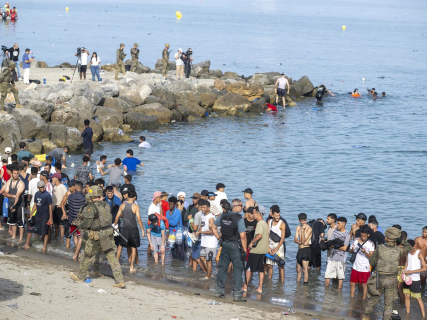
Vox will support the Sumar proposal to exclude Morocco from the 2030 World Cup.

The initiative will presumably be debated in September and proposes to review the joint candidacy of Spain, Portugal, and Morocco after the migratory crisis in Ceuta.

3 minutes

fotonoticia 20260810214805 1920

fotonoticia 20260810214805 1920

Add DEMÓCRATA to Google

Ask FREN

Published

Last updated

3 minutes

Most read

Vox will vote in favor of the non-legislative proposal registered by Sumar in Congress to ask that Morocco stop being part of the organization of the 2030 World Cup along with Spain and Portugal, according to sources from the party confirmed to El País.

The initiative still does not have a set date, although everything points to it being voted on in September, with the start of the new political course. The decision places Vox and Sumar on the same side of this issue for the first time, despite being in opposing ideological positions.

The proposal from Sumar arises after the massive entry of migrants recorded in Ceuta on July 30 and 31, an episode that has led several parties to question the relationship with Morocco and, specifically, its participation in the shared candidacy for the World Cup.

Vox supports Sumar's initiative

The 32 deputies of Vox lean towards supporting Sumar's initiative. The party of Santiago Abascal had previously registered its own non-legislative proposal with a similar objective.

In that text, Vox argues that "the very serious events recorded in Ceuta on July 30 and 31 have completely broken the foundations of trust and cooperation on which a shared candidacy necessarily rests."

The party adds that Morocco "is not a loyal partner, neither for organizing an event of this magnitude nor for any neighborhood issue" and considers that what happened raises "serious doubts" about its ability to provide the necessary guarantees to organize a competition like the World Cup.

Sumar focuses on human rights

The proposal from Sumar reaches a similar conclusion, although from a different argumentation.

"As long as such serious doubts persist about the political use of human lives, Morocco cannot obtain the prestige, economic benefits, and international legitimacy of a World Cup", states the text.

The initiative suggests that the Government review the joint organization of the tournament with FIFA, the Spanish Football Federation, and Portugal, the third country involved in the candidacy.

Sumar also demands specific guarantees regarding human rights throughout the preparation process for the championship.

Sumar could vote against Vox's proposal

The coincidence between both parties does not imply, however, a mutual support of their respective initiatives.

Although Vox does plan to vote in favor of the PNL from Sumar, everything points to Sumar rejecting the proposal presented by Vox, despite the fact that both aim to question Morocco's participation in the tournament.

The difference lies in the approach and in the content of the texts, although the political outcome they pursue partially coincides.

Podemos also wants to exclude Morocco

Podemos has also joined the voices calling for Spain not to share the organization of the World Cup with Morocco.

Its Secretary General, Pablo Fernández, defended that "Spain should not organize the World Cup with a dictatorship like Morocco, which does not respect human rights" and linked this position directly to the crisis in Ceuta.

If Vox, Sumar, and Podemos ultimately support the same initiative, they would add up to 62 deputies: 32 from Vox, 26 from Sumar, and four from Podemos.

The rest of the parliamentary groups have not yet publicly set their position.

The Government maintains its bet on the joint World Cup

The Executive maintains, for now, a different position.

The Minister of Sports, Milagros Tolón, assured last week that the Government continues to support the joint organization of the 2030 World Cup.

"We respect, we are in a coalition government, sometimes we have differences and, as a government, we bet on this World Cup," she stated in an interview on Cadena SER.

The proposal from Sumar thus opens a new disagreement within the coalition government, although for the moment the PSOE has not announced any change in position.

More key points, information and questions with FREN

AI-GENERATED CONTENT

What is the parliamentary status of Sumar's non-legislative motion regarding Morocco's exclusion from the 2030 World Cup, and what are the next expected procedures?

Sumar's non-legislative motion regarding the 2030 World Cup and Morocco appears in the news as registered in Congress, but the available information does not yet include its official record or any subsequent procedures (qualification by the Board, assigned committee, debate or voting date). As of today, it can only be stated that Sumar has promoted an NLM for Congress to consider reconsidering co-organization with Morocco, with no further procedural milestones recorded yet. In this context, the foreseeable “next steps” are those set by the Rules for any NLM: qualification by the Board, assignment to a committee, inclusion in the agenda, debate, and voting.

What exactly has Sumar presented

According to the newspaper Demócrata, Sumar has registered a non-legislative motion “for the Chamber to express whether Spain should reconsider its participation in organizing the 2030 Football World Cup alongside Morocco,” proposing that the Government study this option with FIFA, the RFEF, and Portugal, co-organizer of the tournament (Demócrata information). Another piece from Demócrata summarizes that:

  • Sumar was the first to bring the matter to Parliament.
  • Its NLM asks Congress to express an opinion on the advisability of continuing to organize the World Cup with Morocco.
  • It does not literally demand the immediate “exclusion” of Morocco, but rather a review of the co-organization.

In parallel, Vox has presented a different initiative, explicitly aimed at “demanding the exclusion of Morocco as organizer of the 2030 World Cup,” which will be debated in the Education, Vocational Training, and Sports Committee (Demócrata news). It is important to distinguish both: Sumar's NLM (review of the candidacy) and Vox's NLM (direct exclusion).

The available documentation does not yet show the file number of Sumar's NLM (of the type 161/xxxx) nor its official record in Congress. Therefore, it cannot be specified whether the Board has already qualified it or to which committee it has been referred.

Current parliamentary status

With accessible information, the following can be stated:

  • Sumar's NLM is politically registered in Congress (noted by several Demócrata news), but there is no public trace yet of:
    • Its admission for processing by the Board.
    • The specific committee to which it is sent (most logically Culture/Sports or Foreign Affairs, but it does not appear in any source).
    • A debate date or inclusion in a committee or Plenary agenda.
  • There is no indication that it has already been debated and voted on; if so, normally there would be a Congress note like the one reporting, for example, the NLM on Western Sahara and Morocco-Spain RAN (Congress note), and there is nothing equivalent about the 2030 World Cup.

Consequently, the most prudent status to attribute today is: NLM registered and pending ordinary parliamentary processing (qualification, publication, and scheduling for debate).

Procedures pending according to the Rules

The Congress Rules regulate NLMs in articles 193 to 195:

  • Presentation and qualification (art. 193 and 194.1): groups submit the NLM in writing; the Board decides on its admissibility, orders its publication, and agrees whether it is processed in Plenary or in the competent committee “based on the will expressed by the proposing Group and the importance of the topic.”
  • Amendments (art. 194.2): once published, other groups may submit amendments up to six hours before the session in which it is debated.
  • Inclusion in the agenda (art. 194.3): the Presidency and the Board of Spokespersons set when it is debated, applying the rules for interpellations.
  • Debate and voting (art. 195): the author group intervenes first, then groups with amendments and the rest. After the debate, the NLM is voted on with accepted amendments.

Applied to Sumar's case, the next foreseeable procedures are:

  • Qualification by the Board and official publication of the NLM.
  • Assignment to a committee (likely Culture/Sports) and opening of the amendment period.
  • Inclusion in that committee's agenda for debate and voting.
  • Final result: “approved” or “rejected” in committee or, if taken up, in Plenary. In any case, the NLM has no binding legal effects but establishes a political position of Congress directed at the Government.

No further information is available in the consulted sources about the specific processing of this Sumar NLM; to refine the real status, one would have to wait for Congress to publish the file record with its milestones.

In which specific committee will Sumar's NLM on the 2030 World Cup ultimately be debated when its processing record is made public? What exact contents does the text registered by Sumar in its non-legislative motion on reviewing the World Cup with Morocco include? What parliamentary support could Sumar and other groups gather for a critical NLM on the co-organization of the 2030 World Cup with Morocco to succeed?

What are the competencies and functions of the Minister of Sports, Milagros Tolón, regarding the organization of international sporting events?

Milagros Tolón is not a “Minister of Sports” in a separate department, but rather Minister of Education, Vocational Training, and Sports. Her competencies over sports, and therefore over major international sporting events, derive from her ministry being responsible for “proposing and executing the Government's policy on sports,” according to Royal Decree 829/2023, of November 20, on ministerial restructuring, modified by Royal Decree 1230/2023 (RD 829/2023, RD 1230/2023). The operational organization of international competitions mainly falls to the Higher Sports Council (CSD) and sports federations, but under the political guidance and supervision of her ministry.

Legal framework and institutional position

Royal Decree 829/2023 establishes that:

  • The Ministry of Education, Vocational Training, and Sports is responsible for proposing and executing Government policy on education and vocational training.
  • It is also responsible for proposing and executing Government policy on sports.

Additionally, the same royal decree stipulates that the Higher Sports Council is attached to the Ministry of Education, Vocational Training, and Sports (additional provision modified by Royal Decree 1230/2023). The subsequent development of the ministry's structure is done through Royal Decree 274/2024, cited in various CSD agreements such as the one related to the Ryder Cup 2031 (Ryder Cup agreement), where it is specified that the CSD is an autonomous body attached to the ministry and refers to the CSD Statute, approved by Royal Decree 460/2015.

The Sports Law 39/2022 reinforces this framework by considering high-level sport of interest to the General State Administration and explicitly linking it to international competitions, as recalled by the CSD's “Team España Centros” resolution (Team España Centros program).

Functions regarding major events and international competitions

1. Direction of international sports policy

As the highest official of the department competent in sports, Milagros Tolón:

  • Defines the Government's political position regarding participation and organization of major international sporting events, in coordination with the Presidency of the Government and Foreign Affairs.
  • Participates in coordination bodies for major events. For the 2030 Football World Cup, for example, Tolón participates in the Interministerial Commission chaired by Pedro Sánchez to prepare the tournament, conceived as “one of the country's major strategic priorities,” involving 15 ministries (Sánchez heats up the 2030 World Cup).
2. Supervision of the Higher Sports Council

Through the CSD, attached to her ministry, she exercises key competencies directly linked to international events:

  • Authorization and supervision of international competitions in Spain: the statutes of various federations (rowing, table tennis, aeronautics, etc.) state that to “organize, request, or commit to” international competitions on Spanish territory requires authorization from the CSD, an entity acting under the minister's political direction (Rowing statutes, Table Tennis, Aeronautics Federation).
  • Management of specific agreements and programs: the CSD Statute (RD 460/2015) assigns it the management of programs and agreements with federations and organizers. A paradigmatic example is the agreement for the Ryder Cup 2031 in Spain, where it is explicit that the CSD coordinates, with the RFEG and Ryder Cup Europe LLP, the “preparation and celebration” of this major competition (Ryder Cup 2031).
  • High-level centers and programs: the CSD classifies centers and programs within the “Team España Centros” plan to support athletes with notable presence in international competitions (Worlds, Europeans, etc.) (Team España Centros).
3. Financing and support for international representation

In the Council of Ministers, at the proposal of Education, Vocational Training, and Sports, the minister promotes key economic decisions:

  • Assistance to athletes in international competitions: the Government has authorized the CSD a call for 29.4 million euros for social protection of high-level athletes and support for those competing internationally representing Spain (Council of Ministers 06/16/2026).
  • Subsidies to federations, COE, and CPE: the Council of Ministers has also approved direct subsidies to the federation ecosystem and the Olympic and Paralympic committees to strengthen structural projects and Olympic and Paralympic preparation (agreements 12/09/2025, agreements 07/28/2026).
4. Political and diplomatic relations of sport

Sources show Milagros Tolón exercising a representative and diplomatic role associated with this general competence over sport:

  • Relations with federations and sports agents at the ministry headquarters (meetings with the Spanish Sports Association, federations such as Athletics or sports for people with disabilities; official agenda on 06/10/2026, 07/01/2026, 06/23/2026).
  • External projection of Spanish sport: she accompanies and supports the national team at the 2026 World Cup, from where she highlights the exemplary value of the team (promise of Nico Williams), and participates in bilateral meetings with other sports ministers, such as the Italian Andrea Abodi (agenda 04/23/2026).

Limits: who really organizes the events

From the federation statutes published in the BOE, it is clear that the Spanish sports federations organize or supervise official international competitions held in Spain, and that the CSD exercises authorization, coordination, and administrative supervision. The minister sets the strategy, proposes rules and resources, and exercises political leadership, but does not assume the “technical organization” of each specific event, which falls to federations, professional leagues, and organizing committees, always within the framework set by her department.

What exactly does Sports Law 39/2022 say about the State's role in international sports competitions? How does Minister Milagros Tolón coordinate with other ministries and autonomous communities to organize the 2030 Football World Cup? What specific competencies does the Higher Sports Council have regarding authorization of international competitions held in Spain?

What were the results of the last general elections for Sumar, Vox, and Podemos, and how many deputies does each party currently have in Congress?

In the last general elections on July 23, 2023, Sumar obtained 12.3% of the votes and 31 seats in Congress; Vox achieved 12.4% and 33 seats; and Podemos did not run with its own list but was integrated into Sumar's candidacy. As of August 10, 2026, these initial results have been nuanced by group changes and resignations: the Plurinational Sumar Group has about 27 deputies, Vox has 32 (after Javier Ortega Smith's departure to the Mixed Group), and Podemos maintains 4 deputies in the Mixed Group. There is no official single and closed data on composition at that date, but the basic evolution by parties is available.

Results of July 23, 2023 for Sumar, Vox, and Podemos

Sumar

The best direct data comes from the alternative left analysis published by El País: Sumar, led by Yolanda Díaz and including Podemos within the coalition, obtained in the 2023 general elections “more than 3 million votes, 12.3%, and 31 seats” in Congress, being decisive for Pedro Sánchez's investiture and the coalition government renewal (El País analysis).

From those 31 seats, the Plurinational Sumar Group was formed in the XV Legislature. Several subsequent polls, compiled by the newspaper Demócrata, use precisely that reference: Sumar “obtained 12.3% and 31 seats” in the last general elections to compare its collapse in vote estimates (40dB average; GESOP barometer; Sigma Dos panel), confirming that figure as a stable reference.

Vox

In Vox's case, several polls cited by Demócrata take as official starting point the July 23 result: “in the 2023 general elections, PP and Vox totaled 170 seats: 137 for PP and 33 for Vox” (Sigma Dos). Other polls repeat that Vox “achieved 12.4% and 33 deputies” in those elections (Ipsos; Hamalgama Métrica; Sigma Dos, May 2026).

With those data, the July 23 balance for Vox was:

  • Vote: 12.4% nationwide.
  • Seats: 33 deputies in Congress.
Podemos

Podemos did not present its own list in the 2023 general elections but integrated into Sumar's candidacy. Numerous Demócrata pieces explicitly recall this: “In the 2023 general elections, Podemos ran integrated in Sumar's candidacy” (Hamalgama Métrica; GESOP).

This implies that:

  • There is no official separate result of votes or seats for Podemos in July 23.
  • Its representation was absorbed in Sumar's 31 seats and 12.3%.

Current situation in Congress (August 2026)

Sumar

After the political break between Sumar and Podemos at the end of 2023, some deputies elected on the joint list left the Plurinational Sumar Group and joined the Mixed Group. A detailed Demócrata analysis on the group's internal restructuring explains that, although the candidacy obtained 31 seats, “the four from Podemos left their ranks and joined the Mixed Group,” and that “currently, the Sumar Group is made up of 27 deputies” (keys about Sumar in Congress).

In the absence of significant new defections in later sources, the reasonable snapshot as of August 2026 is:

  • Plurinational Sumar Group: approximately 27 deputies.
Vox

Vox started the legislature with 33 deputies, the same as obtained at the polls. No massive splits are recorded, but there is a relevant change: Javier Ortega Smith leaves Vox and joins the Mixed Group, keeping his deputy seat. Demócrata summarizes it as: Ortega Smith “leaves Vox and joins the Mixed Group,” which now includes, among others, representatives from Compromís, BNG, Ábalos, and four Podemos deputies (explanation about the Mixed Group).

With that move, Vox's situation in Congress is approximately:

  • Vox deputies in their parliamentary group: 32 (one less than the 33 elected).
Podemos

After the break with Sumar, Podemos broke discipline in the Plurinational Group and its deputies moved to the Mixed Group. A political analysis on 15 years of 15M summarizes the change: “Podemos, which once had 71 deputies, now has a residual representation in the Lower House. Five deputies integrated in the Mixed Group, after running in the elections with Sumar but deciding not to be part of the same parliamentary group” (report on 15M).

However, the later piece about Ortega Smith's entry into the Mixed Group nominally lists the Mixed Group members and cites only four Podemos deputies: Javier Sánchez, Noemí Santana, Martina Velarde, and Ione Belarra (Mixed Group details). That list, already in July 2026, suggests that one of the initially mentioned five had left the seat.

With the available information, the best estimate as of August 10, 2026 is:

  • Podemos deputies: 4, integrated in the Mixed Group.

No further information is available in the consulted sources to refine with absolute precision the exact number of seats of each group at that date, but the above data capture the essential evolution of Sumar, Vox, and Podemos from July 23 until now.

Can you break down in which provinces Sumar obtained its 31 seats in the 2023 general elections? How has Ortega Smith's departure affected Vox's internal balance and parliamentary strategy? Which key Congress votes have evidenced the rupture between Sumar and Podemos deputies since 2023?

Play

Test your knowledge with FREN!

How much do you know about this topic? Answer the following 3 questions.

What specific measure does the non-legislative proposal registered by Sumar in Congress propose?

Question 1 of 3

What recent event has motivated the presentation of initiatives to exclude Morocco from the 2030 World Cup?

Question 2 of 3

What is the current position of the Government regarding the organization of the 2030 World Cup?

Question 3 of 3

Hola, soy Fren. ¿Cómo te ayudo?