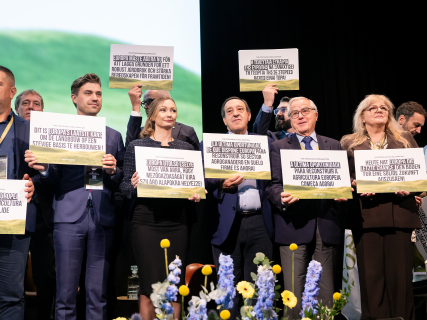
Farmers warn in the Stockholm Declaration that "European agriculture is approaching a critical point."

Representatives of the main agricultural professional organizations and agri-food cooperatives of the European Union have met in Sweden at the biennial Congress of Copa-Cogeca.

Agricultores europeos en el XII Congreso en Estocolmo

Agricultores europeos en el XII Congreso en Estocolmo

Add DEMÓCRATA to Google

Ask FREN

Published

Last updated

1 minute

Most read

"Europe's last opportunity to rebuild its agriculture on solid foundations is now." That is the message from European farmers and agri-food cooperatives gathered in Stockholm from October 14 to 16 (almost the same days that the heads of state of the 27 debate the future of the Multiannual Financial Framework, which is posed as a turning point in the Common Agricultural Policy).

About 400 delegates and 54 speakers have participated in the XII Congress of European Farmers organized by COPA-Cogeca in Sweden. On this occasion, the meeting has taken place in a context of great tension, as the trade tensions and the growing geopolitical instability that increases economic pressure on agricultural operations have been compounded by a devastating summer due to high temperatures that has highlighted the vulnerability of European agricultural production.

Stockholm Declaration

At the same time, European farmers believe that the political directions being taken in the European Commission are uncertain and not reassuring for the primary sector, as the proposal for the MFF and the shift it proposes for the CAP jeopardize the common nature and predictability of European policies, precisely at a time when stability and long-term measures are needed. 

Therefore, European agricultural leaders have adopted the Stockholm Declaration as a historic collective call urging politicians to recognize the seriousness of the situation and take decisive action. 

The document is based on six points:

  • Make agriculture a pillar of European security and defense.
  • Ensure an adequate budget for a CAP adapted to future changes.
  • Maintain a CAP with truly common character.
  • Make agriculture a fundamental pillar of European competitiveness and develop the potential of markets to function properly.  
  • Respect the diversity of European agriculture and livestock and simplify the CAP.
  • Provide farmers and agricultural cooperatives with the necessary security for investment, production, and succession.

For European farmers, defending the CAP is defending Europe, and they assert that they will remain vigilant to continue mobilizing more than ever in the coming months as political negotiations enter more decisive phases.  

More key points, information and questions with FREN

AI-GENERATED CONTENT

What is the current status of the processing of the next EU Multiannual Financial Framework and what are the next steps for its approval?

The next Multiannual Financial Framework (MFF) 2028-2034 is under negotiation and has not yet been approved. As of October 16, 2026, the Commission's legislative proposal, the European Parliament's negotiating position, and partial Council agreements on several programs already exist. The agreement on the figures and financing, obtaining parliamentary consent, and adopting the final texts still need to be completed.

Current status of the negotiation

The Commission presented the initial package on July 16, 2025 and completed it with sectoral proposals on September 3, 2025. Its approach amounts to nearly 2 trillion euros at current prices, equivalent to 1.26% of the average European gross national income for the period. It is a proposal, not an approved allocation.

During 2026, the Council has advanced on program rules without closing their budgets. In June, it agreed on partial mandates regarding national and regional plans, the Competitiveness Fund, Global Europe, and Horizon Europe. These mandates allow negotiations with the European Parliament, but their allocations depend on the overall financial agreement.

The Parliament set its position on April 28, 2026: it calls for more spending, new own resources, and differentiated protection for agriculture, cohesion, and fisheries. It also questions that the new architecture reduces the role of regions or democratic control, according to Demócrata.

The latest relevant move is the Irish Presidency's compromise proposal: to reduce approximately 141 billion compared to the initial approach, around 8%, from about 1.76 to 1.62 trillion at constant 2025 prices. This is not an approved cut, but a negotiating basis for the summit on October 15 and 16. The consulted sources do not yet report its final outcome (Demócrata).

What remains to be approved

  1. Political agreement among the States. The total volume, distribution among policies, and financing must be agreed upon. The European Council guides and unlocks these decisions but does not legally adopt the MFF Regulation.
  2. Consent of the European Parliament. The Parliament must approve the text by majority of its members. It cannot formally amend it through the ordinary procedure but can reject it, which gives it negotiating power.
  3. Unanimous adoption by the Council. The Regulation is adopted through a special legislative procedure: unanimity of the 27, following parliamentary approval, according to Article 312 TFEU.
  4. Closure of associated files. The own resources proposal follows a separate path: Council unanimity, Parliament consultation, and approval by all States according to their constitutional procedures. In parallel, sectoral regulations and the interinstitutional budget agreement must be concluded.

Schedule and critical points

The political goal is to reach an agreement before the end of 2026, leaving 2027 to complete legislation and prepare programs. An extraordinary European Council meeting is announced for November 26 and 27 to try to close pending issues.

The planned implementation begins on January 1, 2028. This schedule is not guaranteed: the main obstacles remain unanimity on figures, parliamentary consent, and national approvals of new own resources. Also, agreeing on the MFF does not mean having all operational programs: their rules must be approved separately.

What are the legal competences of the European Commission in the reform of the Common Agricultural Policy?

The reform of the Common Agricultural Policy (CAP) is a process involving several European Union institutions, but the European Commission has a particularly strong role because it holds the monopoly on legislative initiative in this area and significant executive powers. Its competences derive mainly from Articles 38 to 44 of the Treaty on the Functioning of the EU (TFEU), along with general rules on the functioning of institutions.

1. Exclusive legislative initiative in CAP reform

Regarding the CAP, as in most EU policies, the European Commission is the only institution that can formally propose a legislative reform. This means that:

  • The Commission prepares the legislative reform packages (basic CAP regulations, transitional regulations, etc.).
  • It defines the general architecture of the reform (pillar I: direct payments and markets; pillar II: rural development; new instruments such as eco-schemes, reinforced conditionality, etc.).
  • It carries out ex-ante impact assessments, including economic, social, and environmental analyses, which accompany the proposals.
  • It launches and coordinates public consultations and stakeholder engagement (Member States, agricultural organizations, environmental NGOs, food industry, etc.) before finalizing the legislative draft.

Neither the Council nor the European Parliament can initiate a comprehensive CAP reform on their own: they can request the Commission to act, but the starting legal text is always a Commission proposal.

2. Role in the ordinary legislative procedure

The basic CAP rules (regulations setting its design and instruments) are currently adopted through the ordinary legislative procedure, in which the European Parliament and the Council decide jointly. Within this framework, the Commission has key competences:

  • It presents the initial reform proposal (for example, a package of regulations for a new programming period).
  • During negotiations between Parliament and Council, the Commission can:
    • Modify or amend its proposal to facilitate agreements (e.g., incorporating compromises arising in negotiations).
    • Act as a technical and political mediator, offering alternative wording, legal clarifications, and impact estimates of amendments.
  • If Parliament or Council diverge significantly from the initial approach, the Commission can withdraw the proposal, although this is used exceptionally.

Although the final decision is made by Parliament and Council, the Commission strongly influences the debate framework because it controls the content, timing, and scope of the initial proposal and its possible modifications.

3. Execution and development powers of the CAP

Once the legislative reform is approved, the Commission retains broad competences in the execution and technical development of the CAP:

  • Delegated acts: the legislator (Parliament and Council) usually empowers the Commission to complete or modify non-essential elements of the basic regulations (e.g., details of conditionality, technical criteria of eco-schemes, operational definitions of “active farmer,” etc.). These acts are subject to political control by Parliament and Council, which can object.
  • Implementing acts: the Commission adopts more detailed rules on practical application (application formats, control rules, performance indicators, information systems, etc.), usually with the participation of committees where Member State representatives sit (comitology procedure).
  • Approval and monitoring of national strategic plans or rural development programs, in CAP models that use this approach:
    • Member States submit their plans to the Commission.
    • The Commission assesses their coherence with CAP objectives and requirements and can demand changes before approval.
    • It monitors their execution and can require corrections or reprogramming.
  • Financial management: through the EAGF and EAFRD, the Commission:
    • Reimburses Member States for eligible expenses.
    • Conducts audits and financial corrections when detecting irregularities or deficiencies in national management and control systems.
4. Monitoring and review function

Besides proposing and executing, the Commission has a continuous monitoring and evaluation role of the CAP:

  • It prepares periodic reports to Parliament and Council on CAP implementation, results, and impacts.
  • It promotes external evaluations (e.g., on environment, climate change, farm income, territorial cohesion, innovation).
  • Based on these results, it can propose “mid-term reviews” or adjustments of the current legislation (sometimes called “health check,” “mid-term review,” or other terms), again through legislative proposals that start a new co-decision cycle.
5. Limits of the Commission's competences

Despite its power, the Commission does not decide alone the final content of the CAP. Its main limits are:

  • Substantial reform always requires the joint approval of the European Parliament and the Council.
  • Delegated and implementing acts must respect the limits set by the basic regulations and are subject to control by co-legislators and Member States.
  • On-the-ground implementation largely corresponds to national and regional administrations, which manage payments, controls, and specific measures within the framework set by the Commission and the European legislator.

In summary, the European Commission is the legal and technical engine of CAP reform: it designs the proposal, pilots negotiations from a technical perspective, develops detailed rules, and controls execution, but always within an institutional balance where Parliament and Council have the final say on major political decisions.

Could you explain in more detail how the ordinary legislative procedure works in CAP reforms? What are the differences between the competences of the Commission and those of the Member States in the daily application of the CAP? Can you analyze how the Commission's competences in the CAP have changed over recent reforms?

What requirements must be met to modify the CAP within the framework of the European Union?

The Common Agricultural Policy (CAP) is one of the most integrated policies of the European Union, so its modification requires respecting both the Treaties and the EU's ordinary legislative procedure. Broadly speaking, to change the CAP, legal basis, institutional, procedural, and material requirements must be met.

1. Legal basis and distribution of competences

The first requirement is that any reform has support in the EU Treaties, especially the Treaty on the Functioning of the European Union (TFEU):

  • EU competence in agriculture: agriculture is a shared competence between the EU and Member States, but the CAP, as a common policy, is adopted at the European level (Articles 38 to 44 TFEU).
  • Appropriate legal basis: the rules regulating direct payments, common market organization, or rural development are normally adopted based on Article 43 TFEU. Any reform must fit within these articles; if a change intended to go beyond, it would require amending the Treaties themselves, which is a different and much more complex process.

2. Initiative of the European Commission

The second requirement is that the European Commission submits a formal proposal. Only the Commission has the ordinary legislative initiative in this area, so:

  • It must prepare a legislative package (regulations, sometimes directives) specifying how the CAP is modified (payments, eco-schemes, controls, conditionality, etc.).
  • Before proposing, the Commission usually conducts impact assessments, studies, and public consultations with farmers, professional organizations, NGOs, national and regional administrations, etc. These are not merely political: they are part of the EU's good regulation standards.
  • Sometimes prior consultation of other bodies is required (e.g., the European Economic and Social Committee or the Committee of the Regions), whose opinions are not binding but are mandatory to complete the file.

3. Ordinary legislative procedure (co-decision)

Most major CAP changes are approved through the ordinary legislative procedure, which requires joint intervention of the European Parliament and the Council:

  • European Parliament: examines the proposal in the competent committee (usually Agriculture and Rural Development, AGRI), presents amendments, and approves a position by simple majority. The Parliament's Plenary must vote on the result.
  • Council of the EU: Agriculture Ministers of Member States debate the proposal and their own amendments in the Council and its working groups. Decisions are normally made by qualified majority, not unanimity (except in very exceptional cases).
  • If Parliament and Council agree on the same text, the act is adopted. If not, a second reading and, if necessary, a conciliation committee are opened to seek a compromise text. This ensures that no profound CAP change is approved without agreement between States and MEPs.

4. Participation of Member States and comitology

Beyond major reform, the CAP is modified relatively frequently through delegated and implementing acts:

  • The basic rule can delegate to the Commission the power to adopt delegated acts to complete or modify non-essential elements (e.g., technical details on requirements, lists of practices, etc.).
  • Implementing acts are also used to apply and adapt the CAP, adopted by the Commission with the control of committees where Member States are represented (comitology mechanism). Without sufficient favorable votes from these committees, the Commission cannot proceed.
  • Therefore, for many practical adjustments, the key requirement is a clear empowerment in the basic regulation and obtaining the support of Member States in the relevant committee.

5. Respect for horizontal principles and budget

Any CAP modification must be consistent with broader EU principles and frameworks:

  • Multiannual Financial Framework (MFF): the CAP is funded by the EU budget. Spending cannot be increased beyond the ceilings set in the MFF without formally revising it, which also requires Council and Parliament agreement.
  • Coherence with other policies: reforms must align with EU objectives on climate, environment, trade, competition, and state aid. A change contradicting these frameworks could be challenged.
  • General principles of EU law: proportionality, legal certainty, equal treatment among farmers, protection of legitimate expectations, etc., must be respected in designing any modification.

6. Transposition and practical application

Finally, although CAP regulations are directly applicable, their modification usually requires:

  • Updating the national or regional strategic CAP plans, which each Member State must approve and modify according to new requirements.
  • Adjusting national legislation and procedures (rules on payments, controls, sanctions, paying agencies).
  • Notifying the Commission and demonstrating that the internal design respects European objectives and rules.

In summary, modifying the CAP is not enough with an isolated political decision: a formal Commission proposal supported by the Treaties, joint approval by Parliament and Council (except well-empowered delegated adjustments), respect for the EU budget and transversal policies, and subsequent adaptation in each Member State are required.

Could you explain in detail how the EU ordinary legislative procedure works applied to a specific CAP reform? What role do the national CAP strategic plans have and how are they modified when European legislation changes? How is a CAP reform coordinated with the climate and environmental objectives of the European Union?

Play

Test your knowledge with FREN!

How much do you know about this topic? Answer the following 3 questions.

Where did the XII Congress of European Farmers organized by COPA-Cogeca take place?

Question 1 of 3

What additional problems, besides trade tensions and geopolitical instability, have recently affected European agriculture according to the news?

Question 2 of 3

What do European farmers consider essential for the future of the CAP according to the Stockholm Declaration?

Question 3 of 3