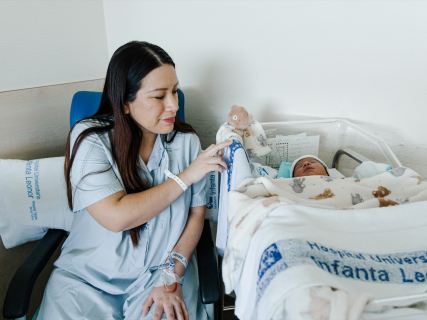

More than 231,000 mothers and fathers enjoyed the birth benefit during the first half of 2026, according to the latest data published by the Ministry of Inclusion and Social Security. The extension of the leave has modified both its duration and the possibility of distributing part of the rest during the first years of the child's life.
The birth leave currently includes 19 weeks paid for each parent. In single-parent families, when there is only one parent, it reaches 32 weeks.
However, not all the leave must be taken immediately after childbirth. The regulations distinguish between mandatory weeks, flexible periods during the first year, and additional weeks that can be reserved until the child turns eight years old.
How many weeks correspond for birth in 2026
The Royal Decree-Law 9/2025, in effect since July 31, 2025, extended the birth and childcare leave from 16 to 19 weeks for each parent.
The rest is distributed as follows:
- Six mandatory weeks: must be taken immediately after birth, uninterrupted and full-time.
- Eleven additional weeks: can be used in weekly periods, continuously or interrupted, until the child turns 12 months old.
- Two more weeks of parental care: can be taken, also by weeks, until the child turns eight years old.
In total, 17 weeks during the first year and another two until the age of eight are granted.
Each parent has their own leave: the weeks are individual and non-transferable. Therefore, one person cannot transfer them to their partner, except in the exceptional cases legally provided.
The biological mother can also anticipate part of the flexible leave up to four weeks before the expected date of delivery.
How long does the leave last in single-parent families
When there is only one parent, the leave amounts to 32 weeks, distributed as follows:
- Six mandatory weeks immediately after birth.
- Twenty-two flexible weeks until the child turns 12 months old.
- Four additional weeks that can be used until the child turns eight years old.
This means that single-parent families have 28 weeks during the first year and four additional weeks, not 32 weeks plus another four.
The extension responds to the changes introduced to reinforce the family reconciliation and to prevent minors with a single parent from having less care time.
How much will I receive during the birth leave
The benefit amounts to 100% of the regulatory base, as established by article 179 of the General Law on Social Security.
In general terms, the contribution base for common contingencies of the month immediately prior to the month before the birth or the start of the leave is taken, divided by the corresponding days.
For example, if the applicable base is 1,800 euros per month and corresponds to 30 days, the regulatory base will be 60 euros per day. A period of 30 days would generate a benefit of 1,800 euros, before considering the applicable individual particularities.
Receiving 100% of the regulatory base does not necessarily mean receiving exactly the same amount as in the last paycheck, because certain supplements or salary concepts may not match the contribution base.
The payment corresponds directly to the National Institute of Social Security, not to the company. In the case of maritime workers, the management is the responsibility of the Social Institute of the Navy.
Additionally, the benefit is generally exempt from IRPF, although the Social Security warns of the particularities of the Navarrese foral regime.
How many days must be contributed
To receive the benefit, it is necessary to be registered or in a situation assimilated to registration. Additionally, the minimum contribution depends on age:
- Under 21 years old: no minimum contribution period is required.
- Between 21 and 25 years old: 90 days of contributions are required during the previous seven years or 180 days throughout the entire working life.
- From 26 years old: 180 days of contributions are necessary in the previous seven years or 360 days during the entire working life.
The registration status must be maintained or accredited at the beginning of each leave period, especially when the weeks are enjoyed intermittently.
When the required contribution is not met, there may be a specific non-contributory benefit, subject to different requirements and conditions.
How to apply for the leave and what documents to present
The application can be made through the Your Social Security portal, with a digital certificate or Cl@ve. It can also be processed through the platform enabled for people without electronic identification or in person with a prior appointment.
The usual documentation includes:
- DNI, NIE or passport of the applicant.
- Certificate of birth registration in the Civil Registry or equivalent documentation.
- Company certificate, unless the company has already sent it electronically.
- Maternity report when necessary.
- Judicial or administrative resolution in cases of adoption, custody, or foster care.
To enjoy the flexible weeks, the worker must communicate it to their company with a minimum notice of 15 days. The Social Security has, in general, 30 days to resolve the request.
Twins, hospitalization, and eight weeks of parental leave
The leave can be extended in case of multiple birth or disability of the child: an additional week corresponds to each parent for each child from the second in the case of a multiple birth.
If the newborn needs to remain hospitalized for more than seven days due to certain clinical circumstances, the rest can be extended for the duration of hospitalization, with a maximum of 13 additional weeks.
Finally, it is important to distinguish between the two paid weeks included in the birth leave and the eight weeks of parental leave. The latter constitutes a different right and, in general, is not paid. The two additional weeks are indeed paid, but they are already part of the total 19 weeks.