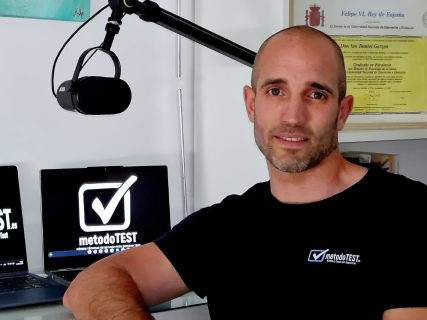

Former programmer, graduated in Psychology and firefighter, proposes to bring the way of studying the syllabus closer to the way the tribunal constructs the questions. His approach addresses a common problem among students: they know the content, but do not always know how to answer in the exam.
The student has prepared the topic. He would know how to explain it perfectly. But when the exam is placed in front of him, the cold sweats begin: he recognizes the words, the options look similar, and he no longer knows which one to choose.
After more than three years working hand in hand with more than 300 candidates, Ian Garzón, creator of MétodoTEST, places this problem in the difference between how the tribunal and the student process the information and with what objective they do so.
"The student reads a text thinking about learning it. The tribunal reads it thinking about how to turn it into questions."
His proposal seeks to bring both processes closer so that the student not only learns the syllabus but also prepares to answer the possible questions.
Where there seems to be a paragraph, there are several questions
A text can explain who grants an authorization, its requirements, and its duration. Ian proposes to recognize those pieces as "questionable units": parts of the content that allow formulating a meaningful question and retaining a complete answer.
Breaking them down does not mean isolating data: a deadline must remain linked to its procedure; an exception, to its rule.
Here the analogy with programming appears: just as there are variables that contain numbers, text, or lists, Ian distinguishes different types of questionable units. His own classification includes definitions, data, lists, actors, conditions, consequences, and sequences, among others.
They are not labels to memorize, but clues for studying. A list requires retaining its elements; a procedure, moreover, its order. Connections also matter: requiring two conditions does not equate to allowing one or the other.
"Not all questions require the same mental task"
Ian distinguishes direct, indirect questions, and practical cases. In direct questions, the statement delineates what is being sought. In indirect questions, one must verify statements, identify their units, and detect changes in data or relationships. Practical cases require interpreting facts and applying rules.
Their presence varies between competitions and calls; analyzing official exams allows adjusting the preparation.
"One of the keys to success in the opposition lies in a first quality round of the syllabus."
For Ian, that turn serves to understand and sift: to distinguish relevant information and identify its units and relationships. The subsequent ones allow synthesizing, organizing, and connecting through tables, schemes, or associations. A mnemonic can help when a piece of data resists.
Memorizing as a result of processing information well
Memorizing is posed as a result of that work, reinforced with retrieval, review, and correction of deviations in study to optimize the result.
"It is about analyzing the errors in the tests to identify where the memorization process of that data has failed: in comprehension, synthesis, association, or retrieval, etc. This way we can correct that point, instead of studying the same thing in the same way again."
The model is based on reverse engineering: starting from the questions to understand how they were constructed and returning to the syllabus with concrete decisions. The exam stops serving only to count correct answers and begins to guide the study.
The board does not ask how many times a page has been read. It poses a task. The key is having learned to perform it beforehand.