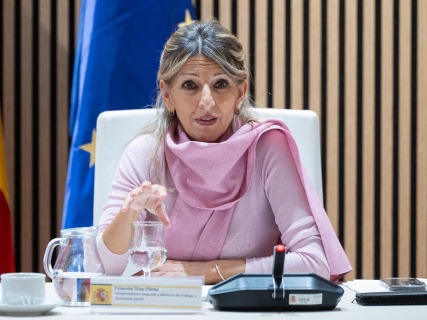

The second vice president and minister of Labor and Social Economy, Yolanda Díaz, has asked this Thursday the commission of experts that advises the Government on the interprofessional minimum wage (SMI) to submit its proposal for an increase for 2027 before the end of this month or, at the latest, at the beginning of November.
After meeting with the members of this advisory committee, Díaz explained that these experts had already been summoned prior to the announcement by the president of the Government, Pedro Sánchez, about the dissolution of the Cortes and the call for general elections on November 29.
The Minister of Labor has not clarified whether there will be room to approve the increase of the SMI for 2027 before the election date. She has only emphasized that she has set a schedule for the experts to deliver their report and that, once received, the social dialogue table will meet to discuss the proposal, following the usual procedure. She has also stressed that her goal is for companies to know by January 1 what the minimum wage increase will be in 2027.
"The life of workers and companies does not stop for an electoral process," Díaz has emphasized, who has also expressed her desire that, when the document reaches the negotiation table with unions and employers, the conversations advance swiftly and conclude with an agreement among all parties.
Regarding the content of the report, the minister has requested the commission to keep in mind the significant increase in prices, with an inflation rate of 4.9%, as well as the "historic" business margins, the good state of the economy, and the improvement in productivity.
"It's time to tighten the belt a little from the top, not from the bottom," Díaz has reiterated, emphasizing that company profits are growing above 20% and that their margin on sales exceeds 8%.
As in previous years, the Minister of Labor has instructed the experts that their approach respects two principles: that the SMI reaches at least 60% of the average salary, as stated in the European Social Charter, and that it does not lose purchasing power against the evolution of inflation.
This year, in addition, the commission has been asked to specifically analyze how the SMI impacts households with lower incomes, which are the ones that most frequently receive this minimum income.
The rapporteur of the Commission of Experts and professor of Applied Economics at the University of Oviedo, Begoña Cueto, has emphasized that the proposal they will raise regarding the SMI will take into account the evolution of salaries, inflation, and other relevant macroeconomic variables.
In the previous exercise, for the update of 2026, this committee prepared, at Díaz's request, two possible trajectories for increasing the minimum wage: one that included taxation in the IRPF and another that did not include it.
The first scenario, ultimately chosen by the Government and agreed upon with CCOO and UGT after the non-taxation of the SMI was agreed, contemplated an increase of 3.1%, up to 1,221 euros per month in fourteen payments. The second scenario proposed an increase of 4.4%, up to 1,240 euros per month.
The Government's advisory committee for the SMI, which includes representatives from the Executive, trade union organizations, and the academic field, was established in January 2021 with the task of defining the pace of increase of the minimum wage so that it would reach 60% of the average salary, in line with the European Social Charter.
The latest revisions of the SMI, only with union support
The Government approved last February, with retroactive effects from January 1 of this year, an increase of the SMI of 3.1% for this exercise, up to 1,221 euros per month in fourteen payments, which represents 37 euros more than the amount set for 2025.
This increase was the result of the agreement between the Ministry of Labor and CCOO and UGT, without the support of business organizations. Thus, the update for 2026 was closed only with the unions for the sixth consecutive year.
The last time that CEOE and Cepyme supported an increase in the minimum wage was in 2020, when the SMI rose from 900 to 950 euros per month.
Once the Ministry of Labor formally receives the proposal from the commission of experts, it will call the social agents to specify the increase of this minimum income. Although Labor does not have the legal obligation to negotiate the increase of the SMI, but only to consult, it usually tries to reach an understanding with unions and employers.