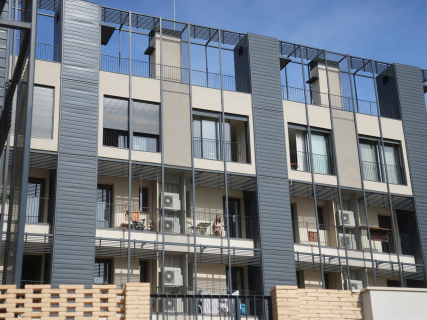

Spain has one of the smallest public housing parks in Europe. Only 1.5% of the total housing in the country is public, compared to 34% in the Netherlands, 23.6% in Austria, and 21.5% in Denmark.
The distance reflects one of the main structural weaknesses of the Spanish residential system: the limited capacity to offer affordable alternatives to the free market.
The difference is not only in the number of houses built: the two European countries have a wide sector of social and affordable rental, also managed by non-profit entities and cooperatives
Spain starts from a very different situation than that of the Netherlands and Austria in public housing. The report from the administrative managers places the Spanish stock at around 1.5% of the total housing, compared to percentages between 20% and 30% in countries like Austria and the Netherlands. The OECD comparison, which uses the category of social rental housing and data from 2022 or the last available year, estimates that proportion at approximately 1.2% in Spain, 34% in the Netherlands, and 23% in Austria.
The figures vary depending on what is considered public or social housing and the reference year, but they reflect a difference in scale: in the two Central European countries, there is a much broader affordable rental stock that does not depend exclusively on the Administration.
A national housing strategy
This is noted in the report from the General Council of Administrative Managers of Spain, made known to DEMÓCRATA, in which a national and state strategy for housing with a horizon of twenty years, but which can begin to be developed in the first 100 days of a new legislature.
The document, which takes as a reference the Annual Report 2025 of the Bank of Spain, places the reduced weight of public housing among the factors that condition residential access and calls for a sustained expansion of the protected stock.
The proposal is not limited to building more homes. The administrative managers propose that those built with public support maintain their affordable character permanently, so that this investment does not lose its social purpose over time.
The goal is to consolidate a stable stock that can respond to residential needs beyond political and budgetary cycles.
other housing models
Netherlands: housing associations
-
Who manages: housing associations that build, maintain, and rent properties under public regulation.
-
What weight do they have: they own around 75% of the rental housing in the country.
-
How it works: they offer social rental and are subject to public allocation rules.
-
Key of the model: social housing constitutes a consolidated sector, although problems of scarcity and access persist.
Austria: municipal housing and limited-profit entities
-
Who manages: municipalities and non-profit or limited-profit entities, which reinvest resources in housing.
-
Vienna as an example: combines municipal apartments with housing managed by cooperatives and social entities.
-
What weight does it have: the report places municipal and social housing in Vienna at around 60%, with a broad definition; Austria reaches approximately 23% of social housing at the national level, according to the OECD.
-
Key of the model: a wide offer of affordable rental sustained for decades, with public participation and specialized entities.
More alternatives to the free market
Within this document, prepared by economist Javier Santacruz, with whom DEMÓCRATA has been able to converse, there is a commitment to diversify the formulas for access to housing. Alongside ownership and conventional rental, it proposes to promote affordable rental, cooperatives, use transfer, and rent-to-own. The intention is to expand the available options for households with different needs and economic capacities.
Among those alternatives, Santacruz's work proposes to develop a specific and stable regulatory framework for cooperatives in use transfer, with preferential access to public land and long-term legal security for their members.
This system allows access to the use of a home without necessarily reproducing the traditional scheme of individual purchase or market rental.
The administrative managers also propose to measure progress through the number of homes in use transfer and affordable rental that are incorporated annually into the market. Protected housing would thus stop depending exclusively on specific promotions to be part of a continued policy of production and conservation of affordable supply.
A twenty-year strategy
The report also proposes that the increase of the public and affordable housing stock be part of a long-term strategy, with intermediate objectives and evaluation mechanisms. In ten years, it proposes to appreciably increase that stock and bring the annual production of housing closer to the creation of new homes.
In twenty years, it aims to have a permanently protected public and affordable system comparable to that of the reference European countries.
The document avoids setting fixed figures for these goals and considers that it is up to the competent ministry, in coordination with the autonomous communities, to quantify them based on an initial evaluation of the residential system. It also argues that the strategy should be maintained regardless of the political color of the governments.
The expansion of public housing constitutes, therefore, one of the social legs of the roadmap, alongside the increase in construction, the mobilization of land, and the streamlining of urban procedures. The approach of the administrative managers is that the response to access difficulties should not rest on a single measure, but on the sustained creation of housing and a broader range of affordable options.
The European comparison serves as a reference to gauge the distance that the report considers necessary to reduce. It does not imply, warns the document itself, that all countries follow an identical model: their systems differ in taxation, demographic structure, property culture, and territorial organization.
The proposal for Spain involves increasing the public and protected housing stock and ensuring that homes financed with public resources maintain their affordable function in the long term.
Spain finished 76% fewer protected homes in 2024 than in the year of the real estate boom
According to this report shared with our newspaper, the country went from building 60,878 protected properties in 2006 to 14,371 in 2024.
Since then, until now, protected housing has not recovered the construction volumes it recorded before the real estate crisis. Spain finished 60,878 protected homes in 2006, at the height of the sector, compared to 14,371 in 2024.
The difference amounts to a drop of 76.4% in 18 years, according to the figures from the Housing and Land Observatory of the Ministry of Housing and Urban Agenda collected in the report of the General Council of Administrative Managers.
The setback is framed within the general contraction of residential activity. In 2006, 658,510 homes were completed in Spain, while in 2024 the figure was 100,980.
Total production thus decreased by 84.7%, in an evolution marked by the burst of the real estate bubble, the subsequent adjustment of the sector, and the difficulty in recovering the construction pace of previous decades.
The comparison of both years introduces, however, a relevant nuance: although the absolute number of protected homes fell sharply, their weight on the total number of completed homes increased, from around 9.2% in 2006 to 14.2% in 2024.
The problem is not, therefore, that protected housing represents a smaller proportion in those two reference years, but that the volume of new protected homes is still far from the levels recorded before the crisis.
Administrative managers propose a horizon of twenty years to consolidate a permanently protected public and affordable housing stock, with a stable supply and access formulas that go beyond conventional purchase and rental. For the first ten years, they propose to appreciably increase that stock and bring the annual production of homes closer to the creation of new households. The report leaves the specification of quantitative objectives in the hands of the competent ministry, in coordination with the autonomous communities, after an initial evaluation of the residential system.