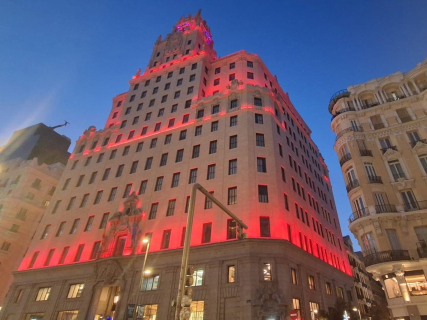
Telefónica sells its historic headquarters on Gran Vía to Tomás Olivo for 200 million.

The operation puts an end to almost a century of the company's connection with one of the most recognizable buildings in Madrid and is framed within the divestments driven under the presidency of Marc Murtra.

2 minutes

fotonoticia 20260720164233 1920

fotonoticia 20260720164233 1920

Add DEMÓCRATA to Google

Ask FREN

Published

Last updated

2 minutes

Most read

Telefónica has closed the sale of its historic headquarters at 28 Gran Vía in Madrid to real estate entrepreneur Tomás Olivo for 200 million euros, culminating an operation agreed upon months ago.

The sale was notarized on September 1, according to sources familiar with the transaction cited by Cinco Días. Olivo controls General de Galerías Comerciales (GGC), one of the main Spanish groups of shopping centers.

The operation represents the exit from Telefónica's assets of a property closely linked to the company's history for nearly a century.

Telefónica initially aspired to around 300 million

Telefónica had put the building on the market at the end of 2025 and hired Rothschild as an advisor to lead the process.

The company initially sought to approach 300 million euros, but the urban characteristics of the property conditioned the offers.

The building has a high degree of heritage protection and currently maintains a private and cultural infrastructure use. The lack of expectations that the Madrid City Council would allow it to be transformed for other tertiary uses reduced the asset's appeal for some investors.

During the process, various funds and entrepreneurs showed interest, while Tomás Olivo simultaneously maintained his negotiations with Telefónica until reaching an agreement.

Finally, the price has been set at 200 million euros, with a formula that also contemplates the distribution between the parties as the future project of the property progresses, although not all economic details have been disclosed.

One of the first skyscrapers in Spain

The Telefónica headquarters on Gran Vía was built between 1926 and 1929 under the direction of architect Ignacio Cárdenas.

The property became one of the first large modern skyscrapers in Spain and for years was the tallest building in the country.

From there, a large part of the first telephone infrastructure in Madrid was developed, and the property eventually became one of Telefónica's main corporate symbols.

The company moved its main activity in 2006 to the Distrito Telefónica complex in Las Tablas. Gran Vía 28 continued to host cultural spaces, exhibitions, and offices of the Fundación Telefónica.

Telefónica's divestment strategy

The sale comes within the process of asset and business review developed since the arrival of Marc Murtra to the presidency of Telefónica.

The operator has sought in recent months to reduce costs and debt and concentrate its activity in its markets considered strategic: Spain, Germany, the United Kingdom, and Brazil.

Within that process, Telefónica has reduced its presence in Latin America, has undertaken a new staff adjustment, and has also divested from other financial investments.

For Tomás Olivo, the purchase incorporates one of the most unique properties in the center of Madrid into a real estate portfolio headed by General de Galerías Comerciales and its large shopping complexes.

More key points, information and questions with FREN

AI-GENERATED CONTENT

What urban planning procedures would be necessary to change the use of the building at Gran Vía 28?

In Madrid city, a change of use of a building like Gran Vía 28 requires combining municipal urban planning requirements, regional regulations, and license control by the City Council. The specific details will depend on the current use (offices, commercial, lodging, residential…), the intended use, and the level of protection of the property, but the procedure scheme is quite stable and can be described generally.

1. Preliminary verification of planning and property protection

The first technical step is to verify if the General Urban Development Plan of Madrid (PGOUM) and the rest of the planning allow the new use on the plot and in the building:

  • The City Council checks the urban zoning of the land (residential, tertiary offices, tertiary lodging, institutional, etc.) and the conditions of use and buildability. Example: in the Centro district, buildings like those on Gran Vía are usually in highly regulated areas and often included in the General Catalog of Protected Buildings, with high levels of protection, as described for Gran Vía 20 in the municipal note “Three projects in Gran Vía, Princesa and San Bernardo…” (City Council link).
  • It is analyzed whether the new use is directly compatible with the current planning or if it requires a specific instrument (special plan, punctual modification, etc.).
2. Is it necessary to modify the planning (Special Plan, rezoning…)?

When the planning does not directly allow the intended use or it is an emblematic/protected building, a Special Plan is usually required:

  • The Madrid City Council has used this figure to validate significant use changes in buildings in the Centro area (for example, to implement hotel tertiary use in Gran Vía 20 or tourist apartments in Princesa 22 and 24), processing Special Plans for Environmental Urban Use Control (PECUAU) that are approved in Plenary after public information and reports from heritage, planning, etc. (municipal note).
  • In other cases, the change of use can be supported by regional regulations without modifying the planning. The Law on urban measures for the promotion of protected housing of the Community of Madrid allows, for example, transforming tertiary office land into protected rental housing “through a license, without the need for a planning instrument”, provided the City Council has chosen to apply the regime and defines its areas (Demócrata analysis; Community note).
3. Technical project and application for urban planning license for works and use

Even when the planning allows the use, the change cannot be executed without the corresponding urban planning license (or, in minor actions, a responsible declaration, a figure also managed by the City Council according to the Building Services Charter: link).

  • The promoter must commission a technical project of architecture/engineering that describes the necessary works and justifies compliance with the PGOUM, urban regulations, and, if applicable, the determinations of the special plan or the applicable regional law (for example, protected housing conditions, parking standards, etc.).
  • With that project, the license for works and change of use is requested from the City Council. The license is the administrative act that authorizes the action, as recalled by the doctrine collected in resolutions of the Directorate General of Legal Security and Public Faith when analyzing use changes in Madrid and their registry reflection (BOE-A-2025-16282).
  • For protected buildings or those located in BIC areas, municipal and regional heritage reports are usually mandatory, such as those cited for the Gran Vía 20 building (Local Heritage Commission, Directorate General of Cultural Heritage, etc.).
4. Execution of works, municipal control, and first occupancy

Once the license is granted:

  • The adaptation works to the new use are carried out according to the authorized project.
  • The City Council, through its building services, can carry out inspections and controls, both during the works and afterwards, within the framework of urban discipline (powers included in the Building Services Charter).
  • For uses such as housing, hotel, or other tertiary uses, a first occupancy or operation license is usually required, which certifies that the works have been correctly executed and that the property can be used for the new purpose.
5. Registry effects and coordination with the Property Registry

If the change of use affects the registry description (for example, from commercial premises to housing), it must be accredited before the Property Registry. The Directorate General of Legal Security and Public Faith has emphasized, in resolutions on use changes in Madrid, the importance of:

  • Having the enabling urban documentation (license or, if applicable, proof of consolidated situation).
  • Proving that the new use is compatible with the current planning and does not contradict the municipality's urban regulations (BOE-A-2025-16282 resolution).

In summary, for a property as unique as Gran Vía 28, the determining factors will be: (1) what the PGOUM and regional regulations currently allow for that specific plot; (2) whether the change requires a special plan or not; and (3) obtaining the corresponding urban planning licenses, with the consequent legality control by the City Council and, if applicable, heritage bodies.

What are the competencies of the president of Telefónica according to Spanish corporate law?

In Spanish corporate law, there is no closed and uniform catalog of “competencies of the president of Telefónica” as such, but rather a general framework for presidents of listed public limited companies (such as Telefónica, S.A.) on which the bylaws and the board of directors' regulations of each company then act. Based on the Capital Companies Act (LSC) and good governance recommendations, the typical functions of the board president can be grouped into several blocks.

1. Organ to which they belong and type of president

The LSC establishes the board of directors as the body responsible for the management and representation of the company when it adopts that structure. The president is a director who assumes an internal management function of the board itself. In listed companies, the law and the Good Governance Code distinguish between:

  • Non-executive president, whose role focuses on organizing and coordinating the board and the relationship with shareholders.
  • Executive president, who also assumes ordinary management functions of the company (usually together with the CEO or instead of them), under a contract approved by the board.

In Spain, it is encouraged, as a good governance recommendation, to separate the roles of board president and chief executive officer (CEO), or to strengthen checks and balances if the president is executive (for example, by appointing a coordinating director among the independents).

2. Internal functions within the board of directors

The core competencies of the president regarding the board usually are:

  • Calling and presiding over board meetings, setting the date, time, and place of the meeting in accordance with the bylaws and board regulations.
  • Setting the agenda of the sessions, in coordination with the secretary and, if applicable, with the CEO and the chairpersons of the board committees (audit, remuneration, sustainability, etc.).
  • Leading deliberations, moderating debates, and ensuring that all directors can participate, requesting clarifications and having sufficient and timely information to make decisions with judgment.
  • Ensuring the proper functioning of the board and its committees, promoting the annual meeting schedule, periodic evaluation of the board itself, and training of its members on relevant matters.
  • In many bylaws, the president is granted a casting vote in case of a tie, although this depends on what the company's bylaws specifically provide.
3. Relationship with the general meeting and shareholders

The board president is usually also, unless otherwise provided, the chair of the general shareholders' meeting. In that context, their typical functions are:

  • Presiding over the general meeting, validly declaring the meeting constituted and directing its development, with support from the meeting's board.
  • Ordering shareholders' interventions, granting the floor and resolving order or procedural issues raised during the session.
  • Proclaiming the voting results on the agenda items, according to the data provided by the secretary and technical support services.
  • Acting as the highest institutional representative of the company before the meeting and towards the market, explaining the strategy, results, and proposals of the board.
4. Representation and external relations

According to the LSC, the representation of the company corresponds to the governing body in the manner determined by the bylaws. It is common to attribute representation power to the president, the CEO, and, if applicable, other directors jointly. Among their usual functions:

  • Representing the company before authorities, regulators, markets, and institutional investors, especially on strategic matters.
  • Promoting the corporate governance policy, sustainability, and relations with shareholders and other stakeholders, although formal approval of policies corresponds to the board.
5. When the president is executive

If the bylaws and the board attribute executive status to the president, they also assume direct business management functions (general management, strategy execution, supervision of senior management, etc.), with a senior management contract previously approved by the board with enhanced transparency and control requirements.

In summary, Spanish corporate law defines a general framework: presidency of the board, organization of its work, direction of the meeting, and representation of the company, which is then specified in the bylaws and the board regulations of each company. In the specific case of Telefónica, the exact competencies of the president are determined by those internal texts, always within the limits and principles of the Capital Companies Act and the good governance rules for listed companies.

What real estate assets does General de Galerías Comerciales currently manage in Spain?

With the information available from the consulted sources, it is not possible to fully and exhaustively reconstruct all the real estate assets currently managed by General de Galerías Comerciales (GGC) in Spain. However, it is possible to outline the type of assets the group focuses on, mention some of its flagship centers and assets, and explain why detailed information (closed list, exact areas, rents, etc.) is only obtained in the company's corporate documentation or specialized commercial registries.

1. General profile of General de Galerías Comerciales

General de Galerías Comerciales is the vehicle through which entrepreneur Tomás Olivo has built a large group focused on the retail real estate business in Spain. According to the newspaper Demócrata in a recent profile on Olivo, GGC has consolidated as “one of the giants of national retail real estate,” with a broad portfolio of retail parks and shopping centers and other high-value real estate assets.

The group's model is based on:

  • Ownership and operation of large regional shopping centers and retail parks.
  • Acquisition of unique “prime” assets in very consolidated locations.
  • Direct management of the complexes (leasing premises, operating parking lots, marketing spaces, etc.).
2. Flagship shopping centers of the group

The Demócrata article about the purchase of the Telefónica building on Gran Vía summarizes the core of GGC's assets as follows:

“Among its best-known assets are Nevada Shopping, in Granada, and La Cañada, in Marbella, as well as other complexes spread across different parts of Spain. Its group, General de Galerías Comerciales, currently controls a broad portfolio of retail parks and shopping centers…”.

Based on this reference and sector literature, it can be cautiously stated that the bulk of GGC's assets consist of:

  • Nevada Shopping (Granada) – a large regional shopping center south of the Granada capital, with a combination of fashion retail, dining, leisure, and anchor operators. It is one of the complexes with the highest footfall levels in Andalusia.
  • Centro Comercial La Cañada (Marbella, Málaga) – a reference asset on the Costa del Sol, aimed at both local and tourist audiences, with a commercial mix of mid to high range and presence of international brands.
  • Other regional retail parks and shopping centers in different autonomous communities (mainly Andalusia and the Mediterranean coast), which are not listed individually in the consulted news but are described in the article as part of “a broad portfolio of retail parks and shopping centers.”

Quantitatively, journalistic sources mention that the group manages “some of the largest shopping centers in the country,” but do not provide a detailed table with gross leasable area (GLA) per asset nor a closed list.

3. Unique real estate assets outside the shopping center format

Besides large commercial complexes, GGC — through Tomás Olivo — has begun incorporating iconic assets not necessarily configured as traditional shopping centers. The most recent case reported by Demócrata is:

  • Telefónica Building, Gran Vía 28 (Madrid) – Olivo “has become the new owner of the historic Telefónica building on Madrid's Gran Vía,” in a transaction valued at over 200 million euros. The property, with the highest level of urban protection, houses corporate and cultural uses (Espacio Fundación Telefónica). The purchase strengthens the group's presence in the office and iconic building market in prime locations.

This move illustrates that GGC's assets are no longer strictly limited to the classic shopping center format but include iconic office and mixed-use buildings in major capitals.

4. Limits of the available information

With the located news and public notes, it is not possible to:

  • List one by one all the shopping centers and retail parks in the portfolio.
  • Confirm with certainty the current status (active/inactive) of each specific asset as of today.
  • Provide financial data broken down by asset (market value, rents, occupancy).

Such information usually appears in:

  • The corporate website of General de Galerías Comerciales and its annual reports.
  • Documents filed in the Commercial Registry (accounts, management reports).
  • Sector reports from consultancies (retail real estate) that are not always publicly accessible.
5. How to interpret, then, their assets

In light of journalistic sources, it can be summarized that General de Galerías Comerciales:

  • Manages in Spain a broad portfolio of shopping centers and retail parks, including several of the largest and most profitable complexes in the country.
  • Has expanded into iconic assets in prime locations (such as the Telefónica building on Gran Vía), diversifying beyond the closed shopping center format.
  • Maintains a strategy very focused on ownership and direct management of assets, not only on providing services to third parties.

For a truly precise inventory — complete list of centers, exact locations, areas, opening dates, and main economic figures — it would be necessary to cross-reference the company's information with professional real estate databases or recent sector reports.

Play

Test your knowledge with FREN!

How much do you know about this topic? Answer the following 3 questions.

For how much did Telefónica sell its historic headquarters at Gran Vía 28?

Question 1 of 3

Who bought the Gran Vía 28 building from Telefónica?

Question 2 of 3

What was one of the factors that influenced the sale price of the building?

Question 3 of 3

Hola, soy Fren. ¿Cómo te ayudo?