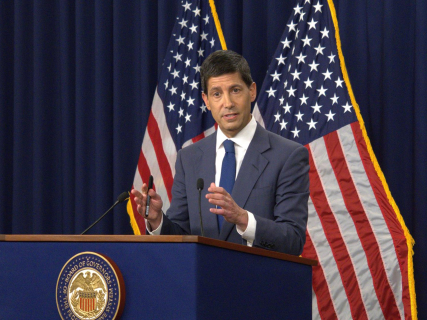

The president of the Federal Reserve of the United States (Fed), Kevin Warsh, has avoided offering clear signals about the next steps of monetary policy, in line with his goal of lowering the tone of the central bank's communications and moving towards a more "discreet" Fed. At the same time, he has made it clear that controlling inflation will remain the main task of the U.S. issuing institute.
"None of the statistics (on prices) is perfect, but all point to a similar situation: inflation exceeds our 2% target. Therefore, the Federal Reserve should focus primarily on prices at this moment," Warsh has stated in his debut at Jackson Hole, the annual meeting of the U.S. central bank.
The top official of the Fed has directly addressed the problem of inflation, admitting that the situation is "worrisome." Although he has acknowledged that price data during the summer was better than anticipated, he has clarified that "it does not indicate to me that underlying trends have improved significantly."
A relevant part of his speech has focused on the need to accurately measure core inflation and have reliable statistics that allow for evaluating not only its variation but also the speed at which it moves.
At the same time, the so-called 'guardian of the dollar' has pointed out that medium- and long-term inflation expectations remain "well anchored," although he has warned that they must be examined "carefully." "What happens with market measures of inflation expectations in economic history is that they tend to seem solid and durable until they are no longer so," he has asserted.
Warsh has emphasized that the central bank still has "work to do" while inflation remains high, in a context marked by the persistence of the conflict in the Middle East and still high oil prices.
"This is my criterion: we must have the certainty that core inflation is heading towards our target, clearly and at a sufficient speed. Otherwise, we have work to do. That is our job, our mandate, and our responsibility," he has confirmed.
Despite this, it has avoided aligning itself with a concrete strategy, reaffirming its commitment to not provide more details than necessary to investors about the future trajectory of interest rates. "Today I present myself here committed to a discipline, not to a decision," it has maintained.
A more "discreet" Fed
Kevin Warsh's view on prospective communications, known as 'forward guidance', has remained intact during the Jackson Hole symposium. In fact, he began his speech with a statement loaded with irony: "Here I present to you a brief summary of what I will address in my speech this morning. You can call it a scheme, you can call it a roadmap, but do not call it forward guidance," he started.
In this line, he has defended cutting the volume of messages that may anticipate the decisions of the Federal Open Market Committee (FOMC). At the same time, he has expressed his purpose of establishing a "correct" relationship between the Federal Reserve and the financial markets.
"To formulate appropriate policies, we also need the relationship between the financial markets and the central bank to be correct. The Federal Reserve needs clear market signals, as direct as possible," he has emphasized.
For this reason, he has advocated for consolidating a more "discreet" central bank with a firmer communication strategy, in order to improve effectiveness in achieving its goals.
"Transparency in communications about future policy decisions is not a virtue in itself. Communications must serve the primary responsibility of the Federal Reserve: to get monetary policy right," he has