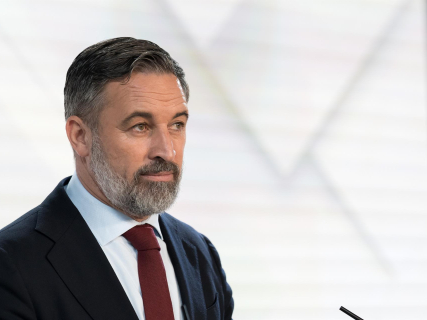
Vox is considering not presenting itself to the Senate in some provinces to favor the PP ahead of the 29N.

Abascal contemplates withdrawing candidacies in constituencies where his party has few options to obtain representation and asking for the vote for the Popular Party. The decision, still pending, would respond to the agreement of joint lists between PSOE and Frente Amplio.

fotonoticia 20261017112152 1920

fotonoticia 20261017112152 1920

Add DEMÓCRATA to Google

Ask FREN

Published

Last updated

4 minutes

Most read

España vota · Congreso y Senado

Elecciones generales 29 de noviembre de 2026

Se eligen 350 diputados y los senadores de elección directa. Encuestas, calendario, candidaturas, programas y todo lo que necesitas saber para votar.

Faltan 42 días y 14 horas para que abran los colegios electorales.Hasta que abran los colegios, el domingo 29 a las 09:00 (hora peninsular).
Entra en el especial

Próximas fechas

  1. Presentación de candidaturas al Congreso y al Senado21–26 oct · Fecha prevista
  2. Voto desde el extranjero (CERA): envío de la documentación24–30 oct · Fecha prevista
  3. Publicación de las candidaturas presentadasFecha prevista
  4. Proclamación de candidaturasFecha prevista
Calendario completo

Vox is considering not presenting candidates for the Senate in certain provinces to concentrate the right-wing vote in the Popular Party ahead of the general elections on November 29. The formation led by Santiago Abascal is contemplating renouncing to compete in those constituencies where its candidates have little chance of gaining representation and asking its voters to support the popular candidates, according to what El País reported this Saturday.

The decision would represent a change in Vox's electoral strategy, which until now had rejected the PP's calls to avoid competition between the two formations in the Upper House. The move comes after the PSOE and Frente Amplio have reached an agreement to present joint candidates for the Senate, under the name "Senado de Progreso," with the aim of concentrating their support.

Abascal has reacted to this pact with a "message of calm" directed at his voters. The president of Vox has assured that his formation will act "with a broad perspective" and will do "what is necessary" to prevent a potential government of PP and Vox from depending on the socialists in the Senate.

"Sánchez is capable of anything to destroy Spain. But we are also capable of anything to save it," the leader stated on his X account.

In the same vein, the general secretary of Vox, Ignacio Garriga, warned this Saturday, during an event in El Escorial (Madrid), that his party will have to make "difficult decisions."

A selective withdrawal without the need for a coalition

The formula that Vox is studying would allow coordinating the vote with the PP without the need to register an electoral coalition. The legal deadline to establish these alliances ended at midnight on Friday, October 16, so both formations can no longer formalize a pact equivalent to that reached by PSOE and Frente Amplio.

However, the electoral calendar still allows for modifying the strategy for presenting candidates. The parties must register their lists between October 21 and 26, and according to the published information, there is also the possibility of withdrawing candidates presented within the legally established deadlines.

Vox mainly manages two alternatives. The first would consist of incorporating some of its candidates into the lists of the Popular Party, a possibility that is considered unlikely. The second, which is gaining more relevance, would involve not presenting its own candidates in certain provinces and expressly asking for votes for the populars.

For now, the leadership of Vox has not communicated in which constituencies this strategy could be applied nor how many candidacies it would be willing to withdraw. A formal agreement with the PP to carry it out has also not been announced.

The precedent of 2023: more than 2.7 million votes without representation

The decision that Vox is studying has as a precedent the results of the general elections of July 23, 2023. In that call, the party did not achieve any senator by direct election, despite its most voted candidates gathering more than 2.7 million votes across the constituencies, according to data collected by El País.

The absence of representation for Vox did not prevent the Popular Party from achieving an absolute majority in the Upper House. However, the agreement between PSOE and Frente Amplio introduces a new element in the electoral competition, allowing both formations to concentrate their support on shared candidacies.

The explanation lies in the election system of the Senate. In the peninsular provinces, four representatives are elected, but each voter can vote for a maximum of three candidates. The seats are awarded to the four people who receive the most votes, which usually translates into a distribution of three senators for the most voted candidacy and one for the next.

In this context, the dispersion of support among different candidacies can influence the result, especially in those provinces where the differences between the candidates are small. However, a withdrawal from Vox would not guarantee that all its voters would automatically transfer their votes to the candidates of the PP.

A decision with consequences for the relationship between Feijóo and Abascal

The eventual renunciation to present candidacies would also have political implications for the relationships between PP and Vox. Until now, Abascal had rejected the electoral coordination proposals from the populars, considering that they could favor the concentration of votes in Alberto Núñez Feijóo's party to the detriment of his own.

A change of position would therefore imply accepting an electoral collaboration formula that Vox had ruled out in previous calls. The possibility arises at a time when both formations have avoided intensifying their public confrontations during the early stages of the pre-campaign and keep the option of governing jointly after the 29N open.

The strategy, however, presents territorial difficulties. In certain constituencies, there are discrepancies between both organizations that could complicate an explicit request for votes in favor of the popular party. This is the case in Ceuta, where Vox has differences with the president of the autonomous city, Juan Jesús Vivas, from the PP.

Moreover, renouncing to run for the Senate could have consequences for Vox's campaign for Congress, where both formations will continue to compete separately. The party leadership will have to assess how to convey to its voters a different voting recommendation for each Chamber.

The National Executive Committee will have the final word

The final decision corresponds to the National Executive Committee of Vox, the body responsible for approving electoral candidacies. Its pronouncement will reveal whether the formation maintains its initial intention to run for the Senate in all constituencies or introduces territorial exceptions.

The calendar leaves a limited margin to resolve the issue. The deadline for submitting candidacies will end on October 26, a date that will allow checking how far the coordination between PP and Vox goes and in which provinces it translates into an effective withdrawal of candidates.

For the moment, Abascal has left the door open to adopting measures to respond to the left's agreement, but has not announced any specific renunciation. The decision that Vox makes will determine whether the competition for the Senate reproduces the confrontation between candidates from both parties or incorporates a formula of electoral cooperation without a formal coalition.

More key points, information and questions with FREN

AI-GENERATED CONTENT

What parliamentary procedures are necessary for an electoral coalition to be officially recognized in Spain?

No parliamentary procedure is needed for an electoral coalition to be recognized as such. The question mixes two different procedures: running jointly in elections and then forming a parliamentary group. The first belongs to the electoral sphere; the second takes place within the chamber, once the elections have been held and the Parliament constituted.

1. Electoral coalition and parliamentary group are not the same

An electoral coalition is an alliance to run jointly in elections. A parliamentary group, on the other hand, is a grouping of deputies or senators that organizes its activity within a chamber: it presents initiatives, participates in debates and committees, and appoints spokespeople and representatives.

Therefore, the formation of a parliamentary group is not the act that recognizes an electoral coalition. Nor should the electoral recognition of a candidacy be confused with the authorization to have its own group. These are different decisions, made at different times and subject to different requirements.

2. What corresponds to the electoral procedure

If the goal is to present candidacies under a coalition, the relevant procedures are those of its formation and communication to the electoral administration, as well as those necessary to present those candidacies. It is not about approving a law, submitting the agreement to a vote in the Congress, or obtaining authorization from the parliamentary Board.

It is advisable to separate both issues when preparing the procedure: one thing is to formalize the alliance to compete in the elections and another to organize the representation obtained. The sources consulted do not provide sufficient regulatory detail here to specify the electoral deadline, the required documentation, and the competent board in each case. This information should not be replaced by the deadlines for the formation of parliamentary groups.

3. If the aim is to form a separate group in the Congress

In that case, there is indeed a parliamentary procedure. According to articles 23 and 24 of the Congress Rules collected in the sources consulted, the main requirements are:

  • Number of deputies: at least fifteen deputies can form a parliamentary group.
  • Alternative route: formations with at least five deputies can also do so if they gather 15% of the votes in the constituencies where they have run or 5% of the votes nationwide.
  • Application: must be submitted within five days following the constitutive session of the Congress.
  • Identification: the group must adopt a name that clearly identifies it.
  • Unique membership: no deputy can be part of more than one parliamentary group.
  • Decision: it is up to the Congress Board to admit or reject the formation of the group according to the Rules.

Deputies who do not join a separate group become part of the Mixed Group. Therefore, obtaining electoral representation does not guarantee having a separate parliamentary group.

4. What this implies for a coalition

The same parliamentary group can bring together representatives from several parties. This allows those who ran jointly to also organize their activity jointly in the chamber, as long as they comply with its rules. But this subsequent parliamentary organization does not replace the prior electoral formalization.

In summary: to recognize an electoral coalition, no initiative needs to be processed nor a parliamentary vote obtained. If the intention is to get a separate group after the elections, then the requirements of the corresponding chamber's rules must be met. The numerical requirements and deadlines explained here are those of the Congress and should not be automatically applied to the Senate or an autonomous parliament.

What are the competencies of the president of Vox's National Executive Committee and who currently presides over it?

The president of the National Executive Committee (CEN) of Vox is Santiago Abascal Conde, who also holds the presidency of the party. His competencies cover the highest political and organizational leadership, the presidency of internal bodies, and the execution of their agreements. To understand its scope, it is useful to distinguish the personal powers of the president from the decisions that correspond to the CEN as a collegiate body.

Who currently presides over it?

As of October 17, 2026, the presidency corresponds to Santiago Abascal, leader of Vox since 2014 and re-elected at the Extraordinary General Assembly on January 27, 2024. Recent information about the national leadership meeting on October 14 still identifies him as president and responsible for gathering the party's leadership. (Leadership meeting).

This presidency should not be confused with the General Secretariat, held by Ignacio Garriga. Both positions are part of the national leadership, but the presidency of the CEN corresponds to Abascal. The party itself presents this body and its composition on its CEN page.

Competencies of the president

According to the statutes published by Vox, his main powers can be organized in the following areas:

  • Presidency of internal bodies. He presides over the National Executive Committee and other party bodies of which he is a member. His role is not limited to publicly representing Vox: it also includes leading these internal leadership spaces.
  • Superior direction and coordination. He exercises the superior direction and coordination of the political and organizational action of the party. This power connects the party's political orientation with its functioning as an organization.
  • Execution of agreements. He takes the necessary measures to execute the agreements of the CEN, the Political Action Committee, and the Management Committee. The difference is important: executing an agreement does not mean personally assuming all the powers of the body that approves it.
  • Operating instructions. He can issue internal orders and instructions about the party's functioning. These are internal organizational powers, not powers to approve rules binding on the public.
  • International relations. He represents Vox in its international relations, unless he delegates this function. This is a representation of the party, distinct from the external representation of the State.
  • Relationship with the Disenso Foundation. He is responsible for directing Vox's relationship with this foundation, a responsibility expressly differentiated within his powers.
  • Electoral representation. He appoints the general electoral representative for the presentation of candidacies. This power should be distinguished from the collegiate decisions about the candidacies themselves.

What corresponds to the president and what to the CEN

The CEN is the highest governing body between general assemblies. Therefore, it is not necessary to describe the president as the individual holder of all its decisions. For example, the ratification of Carlos Pollán as candidate for the Presidency of Castilla y León was attributed to the National Executive Committee, although Abascal later presented the candidacy. (Candidacy ratification).

In summary, Abascal holds the presidency of the party and the CEN: he directs and coordinates, presides over bodies, promotes the execution of agreements, and exercises the indicated representations. But these powers must be read alongside the competencies of the collegiate bodies, without turning his political leadership into a personal attribution of all internal decisions.

What was the result of the last general elections in terms of the number of senators obtained by each party?

The last general elections held in Spain were on July 23, 2023. In the Senate election, the People's Party obtained 120 senators and the PSOE, 72, out of the 208 directly elected. The rest was distributed among the candidacies detailed below.

Distribution of senators elected at the polls
  • People's Party (PP): 120 senators. It was the candidacy that obtained the most representatives and alone exceeded half of the seats subject to direct election.
  • Spanish Socialist Workers' Party (PSOE): 72 senators. It was the second candidacy by number of elected representatives, with 48 fewer than the PP.
  • Lefts for Independence — ERC-EH Bildu: 7 senators. The figure corresponds to the joint candidacy, not seven seats for each of the two formations.
  • Basque Nationalist Party (EAJ-PNV): 4 senators. It is the fourth candidacy in the distribution by number of representatives obtained.
  • PSOE-Sumar-EUIB-ARA Eivissa: 1 senator. This representative appears under the name of that joint candidacy, separate from the 72 attributed to the PSOE candidacy.
  • Socialist Grouping of La Gomera (ASG): 1 senator.
  • Independent Herreña Grouping (AHI): 1 senator.
  • Junts per Catalunya: 1 senator.
  • Navarrese People's Union (UPN): 1 senator.

The distribution sums exactly 208 seats: 120 + 72 + 7 + 4 + 1 + 1 + 1 + 1 + 1. You can consult the official historical series of the Central Electoral Board, as well as the results published by Europa Press and El País.

Why some figures are presented by candidacy

Although the question refers to parties, the electoral result includes alliances of several formations. Therefore, it is advisable to maintain their denominations: the seven representatives of ERC-EH Bildu appear as a joint result, and the seat of PSOE-Sumar-EUIB-ARA Eivissa is also presented separately.

It would not be correct to automatically add that last seat to the 72 of the PSOE and present 73 as if it were the result of a single candidacy. Nor should that representative be interpreted as a seat obtained by Sumar alone. The above list reproduces the distribution by candidacies, without individually attributing the representatives of the alliances to each partner.

What this result includes — and what it does not

These figures describe the result of the polls, not the complete composition of the Senate. To the 208 senators directly elected, 58 appointed by the autonomous communities were added, completing 266 seats. Therefore, representatives obtained in the general elections must be distinguished from those incorporated by autonomous appointment.

The PP achieved an absolute majority among the senators directly elected: the threshold to exceed half of 208 was 105, and it obtained 120. This conclusion specifically refers to the seats subject to voting. The coverage of the result can be expanded in this El País report and in the reports of El Mundo of July 24.

As complementary documentation, the Ministry of the Interior dossier, the Europa Press coverage, and two other El Mundo reports on the day are available: electoral tracking and 23J results. To avoid confusing calls, the information from Demócrata about joint lists refers to the next electoral date and does not modify this 2023 result.

Play

Test your knowledge with FREN!

How much do you know about this topic? Answer the following 3 questions.

What is Vox's objective in proposing not to run for the Senate in certain provinces?

Question 1 of 3

What agreement have the PSOE and Frente Amplio reached for the Senate elections?

Question 2 of 3

What is the deadline for submitting lists for Senate candidacies according to the news?

Question 3 of 3