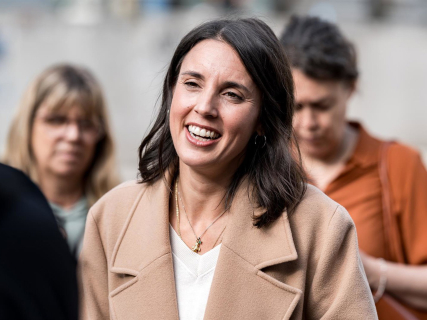
We can start its primaries with Irene Montero while Colau offers to take a step back to unite the left.

The purple formation opens a vote to choose its candidates for the 29N without having reached an agreement with Frente Amplio. The former mayor of Barcelona shows willingness to step down from leading the candidacy if it facilitates a joint list. The deadline to register coalitions ends this Friday.

fotonoticia 20261014102702 1920

fotonoticia 20261014102702 1920

Add DEMÓCRATA to Google

Ask FREN

Published

Last updated

3 minutes

Most read

The left faces 48 decisive hours to define its candidacies for the general elections on November 29. Podemos has opened its primaries this Wednesday with Irene Montero as a candidate for the Presidency of the Government, while Ada Colau has offered to renounce leading the Frente Amplio candidacy if that gesture allows reaching a unity agreement.

The movements occur when negotiations between Podemos and Frente Amplio remain unresolved and there are only two days left until the deadline for registering electoral coalitions expires. Although both parties publicly maintain their willingness to explore a joint candidacy, they disagree on the procedure for choosing their representatives.

The leadership of Podemos defends open primaries for the entire left space as a way to determine the weight of each formation in a possible coalition. Frente Amplio, for its part, believes that the election system must be negotiated and agreed upon beforehand among the involved parties, rather than accepting a vote called unilaterally.

Irene Montero presents herself for primaries that conclude this Thursday

The process driven by Podemos began this Wednesday, October 14, at 8:00 AM and will remain open until midnight on Thursday the 15th. The results will be known on Friday the 16th at 12:00 PM, coinciding with the deadline for registering the coalitions that will participate in the 29N.

The Secretary General of Podemos, Irene Montero, is among the candidates to lead the candidacy. According to the rules established by the organization, the person who receives the most votes for the Presidency of the Government will occupy the first position on the list for Madrid.

The voting system employs the Dowdall proportional method to order the candidacies, with possible subsequent adjustments to ensure compliance with legal parity requirements.

Colau opens the door to renouncing the candidacy

In parallel to the start of Podemos' primaries, Ada Colau has conveyed this Wednesday her willingness to reconsider her candidacy for the Presidency of the Government for Frente Amplio if it contributes to reaching a broader agreement.

In an interview on TVE, reported by Europa Press, the former mayor of Barcelona has stated that her designation is not unmovable and that she is willing to accept another candidacy if it gathers greater consensus among the organizations.
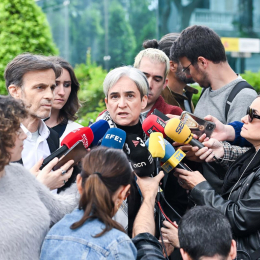
"If later more formations join the Frente Amplio and the consensus of all those formations is that there is another person who generates more consensus than my candidacy, well, go ahead," he has stated.

Colau has defended a "very choral" candidacy, without "crossed vetoes or red lines", and has also opened the possibility of reviewing the name and the electoral brand with which the coalition presents itself.

Her proposal expressly includes Podemos and Irene Montero, whom she wants to incorporate into a unitary candidacy. Likewise, she has mentioned the leader of Más Madrid, Emilio Delgado, as a possible head of the list for Madrid if the organizations consider that his profile facilitates the agreement.

The pact between Podemos and ERC complicates the territorial fit

The negotiations are also conditioned by Podemos' decision to reach an electoral agreement with ERC in Catalonia. By virtue of that pact, the purple formation will not run with its own candidacies in the Catalan constituencies, while the republicans will incorporate representatives of Podemos as independents in their lists for Barcelona and Tarragona.

The open primaries this Wednesday include candidates for those positions, which introduces a particularity in the process: Podemos is choosing candidates for both its own lists and for positions integrated into the candidacies of another formation.

The agreement with ERC adds complexity to a potential state coalition with Frente Amplio, which also aims to present candidacies in Catalonia. Any understanding between both spaces would therefore have to resolve not only the names and the distribution of positions but also how to fit the territorial agreements that Podemos has already reached.

Friday, deadline to register coalitions

The electoral calendar forces the conversations to accelerate. This Friday, October 16, is the deadline to communicate electoral coalitions, so the parties have a very limited margin to close a pact before the 29N.

The coincidence between the closing of Podemos' primaries, the publication of their results, and the deadline to register coalitions leaves two questions open: whether Frente Amplio will accept to negotiate based on the voting driven by the purple ones and whether Colau's offer will facilitate a rapprochement between the organizations.

For now, the gestures of both parties are advancing along different paths. Podemos seeks to resolve the representation through an open vote, while Frente Amplio demands a prior political agreement on the candidacies. Colau's willingness to step aside introduces a possible negotiation avenue, but there is still no pact that allows for a joint list to be presented.

More key points, information and questions with FREN

AI-GENERATED CONTENT

What parliamentary procedures are necessary to formalize an electoral coalition in Spain and what are the usual deadlines?

In Spain, the “formalization” of an electoral coalition is not strictly a parliamentary procedure, but rather an electoral and administrative process, basically regulated by the Organic Law of the General Electoral Regime (LOREG). The effects are later manifested in the chambers, through the formation of parliamentary groups and the internal organization of seats and spokespersons.

1. Internal decision of the parties

Before any action before the Electoral Boards, the parties must:

  • Internally approve the agreement to run in coalition (federal committee, executive, national council… according to each party’s statutes).
  • Appoint representatives and electoral proxies, who will be the ones to sign the communication to the Electoral Board and, if applicable, the candidacies.
  • Agree, although the law does not detail it, on political and material issues: name of the coalition, use of acronyms and symbols, distribution of positions on the lists by constituency, distribution of electoral funding and, if applicable, internal rules on parliamentary group and future spokespersons.
2. Formal communication of the coalition to the Electoral Board

The key step that legally converts several parties into an electoral coalition is the communication provided for in article 44 of the LOREG:

  • A joint written statement must be submitted, signed by the legal representatives of all the parties that make up the coalition.
  • This statement indicates:
    • Which parties make up the coalition.
    • Name, acronym, and, if applicable, symbol of the coalition, which will be used on the ballots.
    • The territorial scope (for example, the entire State or only certain constituencies/provinces).
    • Identification and data of the representatives and, when appropriate, of the electoral administrators.
  • This communication is addressed to the competent Electoral Board:
    • General elections to the Congress and Senate: normally, the Central Electoral Board.
    • Local elections: Provincial Electoral Boards (and, if applicable, of the zone).
    • Autonomous elections: the Electoral Board of the community or the body provided by the autonomous electoral law, which usually refers to the LOREG for the essentials.
3. Legal deadlines to communicate the coalition

The LOREG establishes a fairly clear timeframe:

  • Parties wishing to run as a coalition must communicate it within ten days following the publication of the call decree of the elections in the corresponding official bulletin.
  • This ten-day period is the general reference for general, European, and local elections. Autonomous laws, when they exist, usually reproduce it or refer to it, so in practice it is also the standard deadline in autonomous elections, except for specific particularities.
  • The submission of candidacies comes afterwards (usually around days 15 to 20 from the call), so the coalition must already be communicated and accepted before registering the lists.

In practice, parties negotiate the coalition before the call, but the legally relevant milestone is that communication within the ten days following the decree.

4. Submission of the coalition’s candidacies

Once the coalition is communicated:

  • The coalition submits joint lists in the constituencies where it has decided to run, using the notified name and acronyms.
  • Signatures of voters or endorsements from elected officials are provided when the law requires it (for example, formations without prior representation), as well as the usual documentation of any candidacy (party registration certificates, acceptance of candidates, etc.).
5. Subsequent parliamentary effects

The effects of the coalition are later transferred inside the chambers:

  • The seats obtained are assigned to the coalition’s candidacy; internally, the parties distribute “their” deputies or councilors according to the agreement.
  • In the Congress of Deputies, to form a own parliamentary group it is necessary:
    • Generally, 15 deputies, or
    • At least 5 deputies and having reached 15 % of the votes in the constituencies where the coalition ran, or 5 % at the state level.
    If these thresholds are not met, the deputies join the Mixed Group.
  • The coalition’s parliamentary group appoints its spokesperson and deputy spokespersons according to its internal rules, and communicates these appointments to the Chamber’s Board. The same occurs in the Senate, autonomous parliaments, and local corporations.
  • Belonging to a coalition does not prevent, if the regulations allow and requirements are met, different formations integrated in the same candidacy from coordinating or negotiating group formulas (single group, several groups, group and subgroups, etc.), always under the control of the Board to avoid purely “artificial” structures.

In summary, the legal core lies in the mandatory communication to the Electoral Board within ten days following the call and, once the elections are held, in the coalition’s ability to convert the seats into its own parliamentary group and internally organize its spokespersons and resources.

What are the competencies of the Presidency of the Government in the Spanish political system?

In the Spanish political system, the Presidency of the Government (the president of the Government) is the central piece of the executive power. Its position is mainly configured in articles 97 and 98 of the Constitution and in the Government Law, which specify its formal competencies and its political role within the parliamentary monarchy.

First, the Presidency of the Government is the head of the executive power. According to the Constitution, the Government directs domestic and foreign policy, the civil and military Administration, and the defense of the State, and exercises the executive function and regulatory power. Within this collegiate body, the president is the one who sets the general political direction and coordinates the action of all ministries, acting as the true “head of Government” in the parliamentary sense.

A key competency is to guide governmental action. The president defines the major priorities (economic, social, territorial, European, etc.), approves the strategic agenda, and arbitrates conflicts between ministries. This directing function is reflected, for example, in the ability to set general political objectives, approve plans and strategies, and decide the position the Government adopts on matters of special relevance, such as relations with the European Union or responses to economic and security crises.

Organizationally, the president holds the power to propose the structure and composition of the Government. He decides how many ministries exist, how competencies are distributed among them, and who occupies each portfolio. He can freely appoint and dismiss vice presidents and ministers (formally, the King appoints and dismisses them at the president’s proposal). This capacity to reshape the cabinet is a central political tool to adjust majorities, resolve internal conflicts, or reorient public policies.

Another fundamental competency is the representation of the Government, both internally and externally. Internally, the president appears before the Cortes Generales, especially the Congress of Deputies, to present his program, respond to control sessions, and defend legislative projects or relevant political decisions. Internationally, he is the main representative of the Executive at summits, bilateral meetings, and multilateral forums, especially in the European Union, without prejudice to the King’s competencies as Head of State.

From the perspective of relations with the Cortes, the Presidency of the Government has several high-impact institutional competencies. Among them, the ability to raise the question of confidence before the Congress to reinforce political legitimacy; and, under certain conditions, to urge the King to dissolve the Chambers and call general elections. It also drives the Government’s legislative program, deciding which bills are submitted to the Cortes, when, and with what priority, as well as the Executive’s position regarding opposition or allied groups’ legislative proposals.

In defense and security matters, the Presidency of the Government plays a role of highest political direction. The president exercises supreme command of the Armed Forces through the Government, chairs the coordination bodies of security and defense policy, and leads the political response to crisis situations (disasters, terrorist threats, cybersecurity, etc.), proposing, if applicable, the declaration of states of alarm, exception, or siege, which must be authorized or controlled by the Cortes.

The Presidency of the Government also directs communication policy and inter-institutional coordination. This includes relations with autonomous and local governments, preparation and presidency of key sectoral conferences, as well as articulating the Executive’s position in debates on the territorial model, autonomous financing, or major institutional reforms. The president usually leads the highest-level political negotiations with other parties for investiture, budget approval, or State agreements.

Finally, the Presidency of the Government exercises a function of internal promotion and control over the General State Administration: it coordinates normative planning, supervises compliance with government objectives, evaluates public policy execution, and can issue general directives to ministries. All this is channeled through the organization directly dependent on the Presidency (cabinet, state secretariats, and general directorates of the Presidency of the Government itself).

Overall, the competencies of the Presidency of the Government combine important formal powers (appointing and dismissing ministers, defining the Government’s structure, proposing dissolutions and confidence questions) with political power derived from its role of leadership and coordination over the rest of the Executive and its privileged relationship with the Cortes. This centrality makes the Presidency, in practice, the main center of political decision-making in the Spanish system.

What results did Podemos and Frente Amplio obtain in the last general elections?

In the last general elections held in their respective countries, Podemos and Frente Amplio obtained very different results, both in the way they ran and in their subsequent institutional weight.

Results of Podemos in the last general elections in Spain (23J 2023)

In the Spanish general elections of July 23, 2023, Podemos did not run with a distinct own brand, but integrated into the joint candidacy Sumar, led by Yolanda Díaz. This has an important consequence from a statistical point of view: the electoral administration only publishes official results for the Sumar coalition, not broken down by internal party, so there is no “official” percentage or number of seats attributable solely to Podemos.

The official data for the joint candidacy are:

  • Votes: 3,014,006 ballots.
  • Vote percentage: 12.31 % nationwide.
  • Representation: 31 seats in the Congress of Deputies.

These results can be consulted in the official summaries of the 23J elections, available on portals such as those of the Electoral Board and media reproducing the count, for example RTVE or the special of El País about Sumar.

Since they ran in coalition, the ballots bore the “Sumar” brand (with the member organizations, including Podemos, mentioned in the coalition agreements, not in the official count), so:

  • There is no separate vote percentage for Podemos in 2023; any figure circulating about “what Podemos contributed” are polling estimates or internal calculations, not official count data.
  • The 31 seats obtained are distributed internally according to the coalition agreements (positions on lists, constituencies, etc.), but legally they are seats of the Sumar candidacy.

As a historical reference, in the November 2019 general elections the Unidas Podemos candidacy (Podemos, IU, and confluences) obtained around 12.8 % of the votes and 35 seats, but that call is not the “last” general election, but the one prior to 23J.

Results of Frente Amplio in the last general elections in Uruguay (2024)

In Uruguay, the Frente Amplio does run as a clearly identified political force in the national elections. In the general elections of October 27, 2024, the consolidated data reported by Uruguayan press and specialized bodies are as follows:

  • Percentage of total votes cast: around 43.9 % of the ballots.
  • Percentage of valid votes to parties (basis used for parliamentary distribution): approximately 46.1 %.
  • Chamber of Representatives (Deputies): 48 seats out of 99.
  • Chamber of Senators: 16 seats out of 30 elective.

This information can be cross-checked in analyses about the 2024 Uruguayan elections published by media such as El País (Uruguay), as well as reports from bodies like IDEA International or the Uruguayan Electoral Court itself, which break down the count by political forces and chambers.

The dual percentage reference (43.9 % versus 46.1 %) is explained by the calculation basis used:

  • The figure around 43.9 % takes as denominator all votes cast (including null and blank).
  • The 46.1 % works only on valid votes directed to parties, which is the basis used to distribute parliamentary seats.

In any case, both figures place Frente Amplio as the most voted force, with parliamentary representation very close to half of each chamber and a central position in the country’s governability.

Synthetic comparison

  • Podemos (Spain, 23J 2023): runs within Sumar; the official result of the candidacy is 12.31 % and 31 seats in the Congress. There is no official disaggregated data for Podemos.
  • Frente Amplio (Uruguay, 2024): competes as its own force and obtains around 43.9 %–46.1 % of the vote depending on the basis used, with 48/99 deputies and 16/30 senators.

In summary, while Podemos’ result can only be described through the performance of the Sumar coalition in Spain, the Uruguayan Frente Amplio has a direct and robust figure of electoral support and parliamentary presence, reflecting a much greater weight in its national political system.

Can you break down how the 31 seats of Sumar (including Podemos) were internally distributed among parties in the 23J 2023 general elections? What historical results has Podemos had in all general elections since 2015 and how have their vote percentages and seats evolved? How do the 2024 results of Frente Amplio compare with those obtained in previous Uruguayan elections, both in votes and seats?

Play

Test your knowledge with FREN!

How much do you know about this topic? Answer the following 3 questions.

Who is the main candidate for the Presidency of the Government in Podemos primaries?

Question 1 of 3

What condition has Ada Colau set to give up leading the Frente Amplio candidacy?

Question 2 of 3

With which party has Podemos reached an electoral agreement in Catalonia?

Question 3 of 3