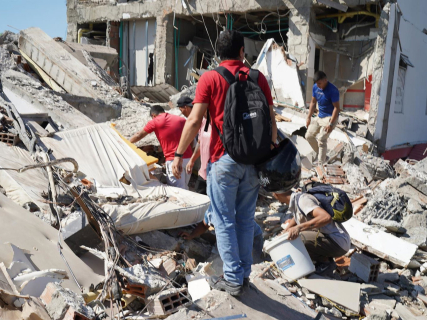
Where are the shelters for those affected by the earthquake in Cali: enabled points and addresses

The Mayor's Office has prepared two scenarios of the Jaime Aparicio Sports Unit to accommodate those who cannot return to their homes. The city also has two collection centers to receive water, food, mattresses, and emergency material.

4 minutes

fotonoticia 20260811043416 1920

fotonoticia 20260811043416 1920

Add DEMÓCRATA to Google

Ask FREN

Published

Last updated

4 minutes

Most read

The Mayor's Office of Santiago de Cali has two temporary shelters open for people who cannot return to their homes after the earthquake of magnitude 7.4 registered on Monday, August 10. The shelters are located at the Miguel Calero Hockey Field and the Baseball Diamond, two venues situated within the Jaime Aparicio Sports Unit.

The district administration has also set up collection centers to channel humanitarian aid. Donations can be delivered at the Jairo Varela Plaza and at the National School of Sports, while rescue operations, building assessments, and assistance to affected families continue.

The information is updated as of this Tuesday, August 11, 2026. As it is an emergency device, authorities may incorporate new spaces or modify the operation of existing ones.

What are the shelters available in Cali

The Mayor's Office of Santiago de Cali has confirmed these two temporary shelters:

  • Miguel Calero Hockey Field or Coliseum: Calle 9, between carreras 37A and 39.
  • Baseball Diamond: Carrera 39 with Calle 9.

Both venues are part of the Jaime Aparicio Sports Unit, also known as the Pan American Sports Unit. They are therefore very close to each other and within one of the most well-known sports areas of Cali.

The Miguel Calero Hockey Field was the first space to which some of the people whose homes had been destroyed or had damages that prevented them from returning were moved. The Baseball Diamond also serves as a shelter, humanitarian assistance point, and provisional health space.

Who can go to these shelters

The shelters are mainly aimed at individuals and families who have lost their homes, have been evacuated, or cannot safely return to their residences due to the damage caused by the earthquake.

The information released by the district administration does not currently establish a reservation system nor details the necessary documentation to access. Municipal teams are conducting identification, census, and assessment of the needs of those affected in the spaces themselves.

Those who are facing an immediate emergency, need to be rescued, or cannot move by their own means must use the single emergency line 123. Authorities have requested that these channels not be used for general inquiries, in order to avoid their saturation.

What attention is provided in the shelters

At the Miguel Calero Hockey Field, a team formed by personnel from different municipal departments has been deployed. According to the Social Welfare Secretariat, the device includes:

  • Psychosocial attention.
  • Health accompaniment.
  • Mats and spaces to rest.
  • Water and food.
  • Blankets and hygiene products.
  • Attention to children and vulnerable populations.
  • Support for victims and migrant people.

The Mayor's Office has also planned the installation of portable toilets to improve the accommodation conditions as the number of people attended increases.

At the Baseball Diamond, the District Public Health Secretariat has set up a tent with doctors, nurses, and nursing assistants. There, a first census and triage are conducted to determine which people can receive basic care on-site and which need to be transferred to a hospital center.

Health care at this point is open to anyone who needs it, regardless of their affiliation with the health system, as explained by the Health Secretariat itself.

Where the collection points are to deliver donations

Although the sports venues also receive materials to care for the housed people, the latest update released by the authorities identifies two main points to channel donations:

  • Jairo Varela Square: Avenida 2 Norte number 10 Norte-1.
  • National School of Sports: Calle 9 number 34-01.

Jairo Varela Square was the first reception center enabled after the earthquake. Subsequently, the National School of Sports was incorporated to expand the capacity for collecting and classifying contributions.

People who want to collaborate must go to the official points to facilitate that the supplies are registered, organized, and distributed according to the needs detected by the emergency teams.

Phones to request help or report an emergency

The emergency information published by the Mayor's Office of Cali includes the following channels:

  • 123: general line for emergencies.
  • 119: Fire Department.
  • 132: Red Cross.
  • 310 229 97 08: WhatsApp enabled for urban reports.
  • 106: attention and support in mental health.

These phones should be used to report situations that require intervention, such as injured or trapped people, fires, buildings at risk of collapse, or citizens who need urgent assistance. The existence of significant cracks or visible damage can also be reported through the urban reporting channel.

Shelters can be expanded during the emergency

For the moment, the official relationship clearly distinguishes between two temporary shelters and two main collection centers. The Jairo Varela Square and the National School of Sports receive donations, but have not been announced as accommodation places.

The Mayor's Office can open new shelters if the number of declared uninhabitable homes increases or if the current spaces reach their capacity. Those affected should consult the channels of the Mayor's Office of Santiago de Cali and the Secretariat for Emergency and Disaster Risk Management before moving, especially because mobility and access to some areas of the city are still conditioned by rescue operations.

More key points, information and questions with FREN

AI-GENERATED CONTENT

What legal requirements must the Cali City Hall meet to enable temporary shelters after a natural disaster?

The issue you raise concerns the specific legal requirements that the Cali City Hall (Colombia) must meet to enable temporary shelters after a natural disaster. My area of expertise is politics, regulations, and institutional activity in Spain (Congress, Government, autonomous communities, etc.), so I do not have a sufficient normative or procedural basis regarding the Colombian legal system —and even less about the specific municipal regulation of Cali— to provide you with a reliable and detailed legal answer. It would be risky to mechanically extrapolate Spanish criteria to a Colombian context that may have different legal frameworks, competencies, and civil protection protocols.

That said, I can guide you very generally, making it clear that this is not a guide to Colombian law nor a substitute for consulting local regulations or experts in Colombia. In most countries, the enabling of temporary shelters after a natural disaster is usually framed within three major regulatory blocks: civil protection and disaster risk management legislation; health, habitability, and safety regulations; and the distribution of competencies among national, regional, and municipal administrations. In the case of Cali, all these aspects would be governed by the Colombian Constitution, state legislation (national laws), the norms of the Valle del Cauca department, and the agreements of the Cali Municipal Council, as well as local risk management plans.

Typical legal areas involved (generic view, not specific to Colombia)

In comparable contexts, the requirements to open temporary shelters after an emergency are usually grouped into several levels:

  • Competence and emergency declaration: usually, a competent authority must declare the emergency or calamity situation (at the national, regional, or municipal level). This declaration enables the adoption of extraordinary measures, including the temporary occupation of spaces for shelters and the simplification of certain procedures.
  • Civil protection framework: civil protection or disaster risk management laws usually include:
    • The obligation to have an emergency plan or municipal risk management plan.
    • The provision of a network of shelters or, at least, the criteria to enable them (capacity, location, care priorities).
    • Coordination with other administrations (police, social services, health, education, etc.).
  • Minimum safety and health conditions: although it is an urgent response, shelters are usually required to meet basic standards, for example:
    • Safe structural conditions (risk of collapse, fires, evacuation access).
    • Minimum sanitary services (drinking water, bathrooms, hygiene, waste management).
    • Ventilation, overcrowding control, and separation of vulnerable groups (children, elderly, people with disabilities).
  • Protection of fundamental rights: temporary accommodation must generally respect dignity, physical integrity, non-discrimination, and, as far as possible, protection of privacy and family unity. Many countries incorporate these criteria in victim, disaster, or human rights laws.
  • Administrative procedure and contracting: enabling shelters may involve:
    • Use of existing public assets (schools, sports centers, community centers).
    • Contracting services for food, cleaning, security, transportation.
    • Possible use of private properties through temporary expropriation, lease, or agreements, which usually requires a specific legal basis.

Limitations of specialization and type of advice I can offer

As an assistant specialized in politics and regulations in the Spanish context, I can rigorously delve into issues such as:

  • How civil protection plans and temporary shelters are regulated in Spain at the state, regional, and local levels.
  • The role of Spanish municipalities in disasters (competencies, financing, coordination with autonomous communities and the State).
  • What parliamentary debates, legislative initiatives, or recent reforms have taken place in Spain regarding disaster management, emergencies, and temporary relocations.

However, I am not an appropriate source to respond with technical precision about:

  • Specific Colombian laws (e.g., law numbers, applicable articles, or specific regulations for Cali).
  • Administrative procedures specific to the Cali City Hall or the Colombian legal system.
  • Infrastructure requirements, licenses, or authorizations established by Colombian regulations.

For a legally solid answer to your question about Cali, it would be necessary to consult local sources: Colombian disaster risk management regulations, Cali Municipal Council agreements, official municipal emergency plans, and preferably the advice of legal or risk management professionals in Colombia.

What obligations do municipalities in Spain have to enable temporary shelters after a disaster? How do the central government, autonomous communities, and municipalities in Spain coordinate on civil protection matters? What recent legislative changes have occurred in Spain regarding risk and natural disaster management?

What competencies does the Secretariat of Social Welfare have in emergency care in Colombia?

The information I have is focused on the institutional and regulatory context of Spain, so I do not have specific, updated, and verifiable data on the concrete competencies of the Secretariat of Social Welfare in emergency care in Colombia. Additionally, in Colombia there are usually several entities with similar names (district, departmental, or municipal secretariats of social welfare, social inclusion, social development, etc.), whose functions vary depending on the city or department and the norm that creates them. Therefore, it is not possible to precisely specify their competencies in emergencies without identifying the specific entity and its own legal framework.

Scope of my specialization and limitations

I am primarily designed to analyze and explain issues related to politics, parliamentary activity, the Executive, and public policies in the Spanish context, relying on sources such as the Official State Gazette, the Spanish General Courts, and Spanish political press, notably the newspaper Demócrata.

In the case of Colombia, I currently do not have access to specific internal regulations (decrees, municipal or departmental agreements, function manuals, institutional organigrams) that precisely define the competencies of a particular Secretariat of Social Welfare in emergency care, nor to the details of their protocols for action in natural disasters, humanitarian crises, or social emergencies.

Variable nature of “Secretariats of Social Welfare” in Colombia

Another element that makes it difficult to provide a closed answer is that in Colombia the denomination “Secretariat of Social Welfare” (or very similar names, such as welfare and social inclusion, social development, etc.) usually corresponds to dependencies of:

  • Municipal governments (mayor's offices).
  • District governments (in the case of special districts).
  • Departmental governments.

Each territorial entity can approve its own administrative structure agreement or decree, in which it defines missions, functions, and competencies of each secretariat. This means that the exact responsibilities in emergency care can differ significantly between, for example, a secretariat of a large urban district and that of a small municipality or a departmental government.

Competencies in emergencies: why I cannot detail them

To answer your question precisely, it would be essential to:

  • Identify the specific entity (for example, “Secretariat of Social Welfare of Municipality X” or “Secretariat of Social Welfare of Department Y”).
  • Consult the administrative act of creation or structure (decree, agreement, or ordinance) where its functions are explicitly listed.
  • Review, if applicable, the disaster risk management plans and local response protocols in which functions are distributed among the social welfare secretariat, the risk management office, health, security, etc.

Since I do not have those specific regulations nor an updated database on the internal organization of Colombian entities, I cannot affirm, with the level of rigor required by institutional matters, what exactly their competencies are in emergency care (for example, whether they directly manage shelters, coordinate humanitarian aid, have leadership functions in the response, or only social support afterward, etc.).

What type of information you should look for

To know in detail the competencies of the specific Secretariat of Social Welfare you are interested in Colombia, I suggest focusing your search on:

  • Administrative structure norm of the territorial entity (decree or agreement that creates or reorganizes the secretariat).
  • Function and labor competencies manual of the secretariat or its internal departments.
  • Municipal, district, or departmental risk management plan, in which roles are assigned to each secretariat in disaster or emergency situations.
  • Protocols or social emergency care routes approved by the mayor's office or government, where it is usually clarified what each department does.
  • Official management or accountability reports from the Secretariat of Social Welfare itself, where its actions in recent emergencies are often described.

With those documents, you can clearly identify whether the secretariat has operational leadership competencies, interinstitutional coordination, direct social care (shelter, food, psychosocial support), or if its role is limited to later phases of recovery and rights restoration.

Thematic scope in which I can help you

Although in this specific case I cannot offer you a closed list of competencies for Colombia, I can help you, within my field, to:

  • Explain how competencies in emergencies and social welfare are distributed in the Spanish system.
  • Compare, in general terms, institutional models of social protection and crisis response.
  • Analyze public policies related to social welfare, vulnerability care, and emergency management in Spain, supported by Spanish regulations and parliamentary activity.

If you specify the territory or Colombian entity you are referring to, I can also better guide you on what types of norms or documents you should locate to obtain a precise legal answer.

What measures have other Colombian cities adopted after earthquakes of similar magnitude in recent years?

With the available information, what can be clearly documented are the measures that various Colombian cities have begun to apply after the magnitude 7.4 earthquake on August 10, 2026, and, to a lesser extent, some historical references. Specific data on urban reconstruction plans, resettlements, or specific structural reinforcements after the 1999 Armenia earthquake or the 2017 Mocoa event do not appear detailed in the sources consulted. A pattern of action based on the declaration of a national disaster, massive technical evaluation of buildings, preventive closure of key infrastructures, use of the NSR-10 seismic-resistant regulation, and strengthening of risk management systems is observed. From these elements, one can infer the type of urban and reconstruction policies that affected cities will tend to deploy in the coming years, although no long-term local plans have yet been published for the 2026 earthquake.

Immediate measures of cities after the 2026 earthquake

After the magnitude 7.4 earthquake with an epicenter near San José del Palmar (Chocó), the Government declared a “national disaster” situation, which activates a special framework to mobilize resources, coordinate administrations, and prepare a reconstruction plan, as reported by several Demócrata chronicles, such as this piece and the analysis of what that declaration implies in this article. The Association of Capital Cities —led by the mayor of Bogotá— participated in the National Disaster Management Committee, involving major cities in emergency governance.

At the urban level, preventive closures and infrastructure inspections were adopted in multiple cities:

  • Suspension of operations at the airports of Cali, Pereira, Manizales, Armenia, Quibdó, Cartago, and Buenaventura to assess structural damage, according to this economic information and its expansion in this text.
  • Damage and collapse inspections in Cali, Pereira, Manizales, and Quibdó, with building collapses, “lapsated” homes, and partially or totally destroyed structures, as detailed in the report on urban effects in Cali, Pereira, Manizales, and Bogotá and victim chronicles in this article and this update.
  • Implementation of unified command posts and direct visits by the president to the most affected cities (Pereira, San José del Palmar, Quibdó), as explained in this news and the extended chronicle about the earthquake.

Technical evaluation and strengthening of risk management

In parallel with the emergency response, Colombia is strengthening its damage assessment procedures. According to Demócrata's explainer on what to do after an earthquake, in May 2026 the National Unit for Disaster Risk Management (UNGRD) opened a process to design a national technical guide for visual inspection of structural and non-structural damage, accompanied by specific training for emergency teams, as described in this analysis. This guide will serve precisely for municipalities to classify buildings (habitable, restricted use, or evacuation) and prioritize structural reinforcements.

Another educational text from Demócrata explains how building safety is evaluated after a quake, emphasizing that technicians focus on columns, beams, structural walls, slabs, and foundations, as well as dangerous non-structural elements, and links this methodology to the guide being prepared by UNGRD for essential infrastructures (link). In Bogotá, IDIGER already has a post-earthquake inspection system to decide if a building can continue to be occupied, should have restricted use, or must be evacuated, as noted in the same explanatory text on what to do after the earthquake.

Seismic-resistant regulations and structural reinforcement

Regarding construction standards, Demócrata recalls that since Law 400 of 1997, Colombia has had a framework for seismic-resistant buildings, developed in the NSR-10 regulation, in force in 2026 and adopted by Decree 926 of 2010. The article on seismic regulations (see explanation) details that projects must incorporate:

  • Structural design adjusted to the seismic forces of the area.
  • Geotechnical and soil studies to define foundations.
  • Supervision and construction control requirements aimed at avoiding total collapse.

Although the text does not list cases city by city, it clarifies that the application of NSR-10 is mandatory for new constructions and renovations subject to licensing, so reconstruction in Cali, Pereira, Manizales, Armenia, Bogotá, or Quibdó after the 2026 earthquake must comply with that standard, which in practice implies structural reinforcement compared to the existing stock prior to the regulation.

Resettlement and urban reconstruction: what is missing in the sources

Regarding the 1999 Coffee Axis earthquake, Demócrata only provides impact data —921 deaths, 5,377 injured, and more than 21,000 damaged or destroyed homes in Armenia and its surroundings— in a historical review of major Colombian earthquakes (historical article), without detailing how neighborhood resettlement, specific urban plans, or subsequent structural reinforcements were managed. There is also no detail on local policies after the Mocoa landslide-flood (2017) or on specific seismic episodes in Pasto, Neiva, or Bucaramanga.

In the case of the 2026 earthquake, chronicles emphasize that the national disaster declaration opens a “second phase” focused on the economic assessment of damages and the definition of a reconstruction plan (Demócrata analysis), but as of the date of the consulted information, no resettlement programs or detailed urban plans by city have yet been specified.

Limitations of the available information

In summary, the measures that can be documented for Colombian cities after large-magnitude earthquakes focus on:

  • Declaration of national disaster and interinstitutional coordination (central government, capital cities, UNGRD).
  • Preventive closures and intensive technical review of airports, hospitals, schools, and residential buildings in the main affected cities.
  • Strengthening of risk management through a national post-quake inspection guide and local evaluation systems (such as IDIGER in Bogotá).
  • Future reconstruction under the criteria of NSR-10, which implies structural reinforcement compared to the older building stock.

Beyond this, the sources do not allow a detailed description, city by city, of urban reconstruction plans, population resettlements, or structural reinforcement programs after Armenia 1999, Mocoa 2017, or other quakes. No further information on those specific historical processes is available in the consulted sources.

Play

Test your knowledge with FREN!

How much do you know about this topic? Answer the following 3 questions.

Where are the two temporary shelters set up for those affected by the earthquake in Cali located?

Question 1 of 3

What type of care is provided at the Miguel Calero Hockey Rink to those affected by the earthquake?

Question 2 of 3

What are the two main points to deliver donations to those affected by the earthquake in Cali?

Question 3 of 3

Hola, soy Fren. ¿Cómo te ayudo?