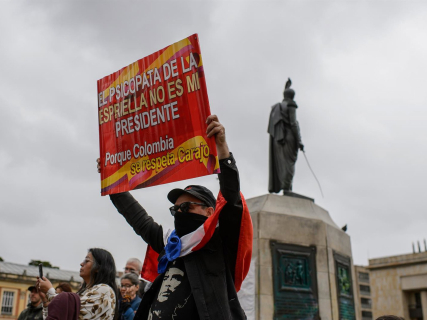

Thousands of people have taken to the streets this Wednesday in the main cities of Colombia to demand improvements in labor conditions and in the educational system, among other demands, in what is the first national strike called by unions and civil society organizations against the government of President Abelardo de la Espriella.
In Bogotá, the capital, a crowd has begun the mobilization that has ended up concentrating in Bolívar Square, generating detours and delays in public transportation despite the rain, and gathering prominent leaders from the opposition Pacto Histórico, such as former presidential candidate Iván Cepeda, who hours earlier had denounced on his social media a "intimidation strategy" of the Colombian Executive aimed at "repressing" the protest.
The march has also been joined by former president Gustavo Petro, who in images shared on his social media about the demonstration has defended that "this is how one responds to adversity with dignity with the desire to win again, without fear." "Life is the companion and not death. The people do not give up, damn it," he added, alluding to the slogan of Argentine President Javier Milei.
In addition to the main opposition coalition, the call has received support from the Central Unitaria de Trabajadores (CUT), the Colombian Federation of Educators (Fecode), university organizations, and civil society collectives, which have united labor, educational, economic, and territorial demands, as well as the rejection of the policies announced by the Executive.
The demonstrations take place, moreover, a day after the far-right leader signed a decree that modifies the protocols of action of the security forces during protests.
"The right to protest is not above the right to work, study, mobilize, and live in peace!" De la Espriella stated when presenting this measure, which, he claims, seeks to "strengthen the guarantees of those who manifest peacefully and ensure that the authorities act, within the framework of the law, against those who intend to sow chaos."
The first article of the decree establishes that "in the face of acts of violence, the obligation to prioritize dialogue and mediation constitutes a rule of preference (...) and not a prior requirement that conditions, suspends, or postpones the actions" of the security forces.