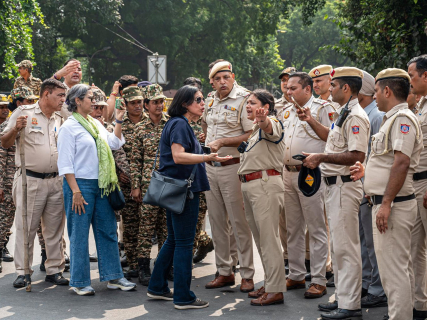

The International Federation of Journalists (IFJ, for its initials in English) made public this Wednesday that at least 30 information professionals were detained by the Delhi Police last Saturday and Sunday while covering the mobilizations led by the Indian movement Cockroach Party (CJP) against the Chief Election Commissioner (CEC), Gyanesh Kumar, for alleged irregularities in the electoral process. Thus, the IFJ has joined the National Union of Journalists of India (NUJI) in condemning what both organizations describe as an "offensive against the media."
"The International Federation of Journalists joins its affiliated organization, the National Union of Journalists of India, to condemn the offensive against the media, which undermines India's constitutional commitments regarding press freedom and democracy," states the statement released by the IFJ, which mentions the detention of around thirty reporters during the weekend protests against Kumar "despite having identified themselves as accredited members of the press."
According to the organization, among those detained are workers from local, national, and international agency media who "have reported physical assaults, harassment, and obstruction while carrying out their work." The Federation emphasizes that, among the police actions, "excessive force was used in detaining journalists," phones and other communication devices were confiscated, and "key metro stations" were closed.
The mobilization was driven by the CJP movement along with student collectives and organizations demanding the resignation of the Chief Election Commissioner following accusations of voter roll manipulation. In particular, the group claims that the names of 130 million citizens were removed from the electoral register to favor the current Prime Minister, Narendra Modi, an accusation that the Electoral Commission denies, arguing that the review of the register aimed to exclude ineligible or duplicate voters.
In light of the reports of possible police abuses, the Supreme Court held an urgent hearing on Sunday and ruled against the illegal detention of unarmed civilians, ordering the reopening of the main transport nodes and the end of the obstacles to journalistic work, according to information gathered by the Federation. However, it warns that, according to local media, security forces have continued to arrest protesters despite these directives.
In this context, the National Union of Journalists of India has strongly condemned "the detention of journalists covering the recent youth protests and other political demonstrations in New Delhi and across India." "Journalists must be able to exercise their profession freely, independently, and without fear or intimidation," defended the NUJI, which has called on law enforcement "to respect press freedom and to refrain from unnecessarily detaining, harassing, or imprisoning journalists while they carry out their legitimate professional responsibilities."
The FIP, for its part, has also denounced "the arbitrary and violent detention of journalists, as well as the draconian restrictions on information and internet services during the CJP protests," referring to the forced network cuts and the removal of hundreds of social media posts by the Delhi Police on the grounds of "limiting the spread of misinformation."
"All journalists who remain detained must be released immediately, and a thorough investigation into the allegations of violence and harassment must be carried out," the Federation has also demanded, insisting that "both state and national authorities must respect the Supreme Court's directives and fulfill their obligations to protect press freedom and democracy, ensuring that journalists can work without fear of reprisals."