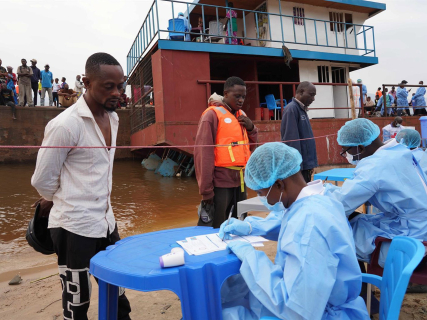

The Ebola epidemic hitting the Democratic Republic of the Congo (DRC) continues to grow at an exponential rate as one hundred days pass since the official declaration of the outbreak. The disease has already caused 2,516 deaths and affects a geographical area that exceeds the size of France, a scenario that has led the United Nations to urgently call for more international financial support to prevent the humanitarian response from being overwhelmed.
Since Congolese authorities reported the start of the outbreak on May 15, 5,290 infections and 2,516 deaths have been recorded, according to the latest health data released this Friday. A total of 1,152 people have managed to overcome the disease, while about 840 remain isolated or hospitalized in medical centers. The fatality rate stands at 47.6% and contact tracing reaches 82.9% of the detected cases.
The United Nations senior coordinator for the Ebola response, Julien Harneis, has warned from Bunia, in the Ituri province, that the outbreak is advancing faster than the efforts deployed to contain it.
"In the last three months, 2,500 people have died, and half of those deaths have occurred in the last 20 days," Harneis indicated, who emphasized that the virus is already spreading across a territory "larger than France."
In this regard, the UN official stressed that the emergency requires an immediate injection of additional funds. "We only have funds for the next few weeks, and they will run out very soon," he revealed. "Every delay in funding and implementation makes this epidemic more lethal, harder to stop, and more costly. Therefore, we need that international support immediately," he added.
Healthcare workers on the front lines, also victims of the outbreak
The response is taking place in an environment marked by violence and by severely deteriorated health and social services after decades of conflict, especially in the provinces of Ituri, North Kivu, South Kivu, Haut-Uele, Tshopo, and Bas-Uele, where the deficiencies in public infrastructure are particularly severe.
In this context, the teams fighting the virus are also suffering its consequences. To date, at least 160 health professionals have contracted Ebola and 43 have lost their lives. This is compounded by the continuous attacks against personnel and health facilities.
"When we respond, in addition to the threat of the virus, healthcare workers and frontline personnel have been attacked by youths, ambulances have been set on fire and stoned, and healthcare centers have been attacked," described Harneis.
Logistical difficulties further complicate the humanitarian operation. For example, the UN coordinator reported that they recently needed three hours to drive just 60 kilometers to an area with a high incidence of the disease.
"The conditions on the ground are extremely difficult, but we will continue to deploy all necessary humanitarian and medical assistance until the task is completed," he assured.
Lack of funding and problems paying teams
To the challenges of security and transportation is added the fragility of the local financial system. The scarce presence of banks in the affected areas complicates payment to the workers participating in the operations, while connectivity limitations prevent the widespread use of solutions like mobile banking.
"In this area, the banking system barely functions," Harneis pointed out, before lamenting that they cannot "raise the amount of money needed to pay the workers, which has generated great discontent among frontline employees."
From the United Nations, they have also warned that cuts in humanitarian aid have diminished the operational capacity of the organizations present in the country, reducing it by more than 30% in recent years.
The international action plan to contain the Ebola outbreak in the Democratic Republic of the Congo is structured around five axes led by Congolese authorities, with the support of UN agencies and NGOs. Among the priorities are strengthening epidemiological surveillance, increasing community involvement, expanding safe burials, and increasing the number of beds available for patients from about 900 to 3,000 in the next three months.
In these tasks participate the World Health Organization (WHO), the World Food Programme (WFP), the United Nations Children's Fund (UNICEF), and the International Organization for Migration (IOM), along with humanitarian organizations like Doctors Without Borders.
Given the risk of expansion, the UN has also begun to strengthen preparedness against possible infections in neighboring countries such as South Sudan, Central African Republic, Burundi, and Uganda.
Vaccination, clinical trials, and psychological impact
Vaccination is another key tool to curb the spread. WHO estimates about 50,000 doses intended for frontline workers and has launched a clinical trial to study the possible protection against the Bundibugyo virus. However, the organization insists that the active participation of communities remains essential to cut the chains of transmission.
Harneis has also wanted to emphasize the psychological impact of a disease that suddenly bursts into communities already battered by violence and poverty. "It is a disease, an invisible threat that comes to your community and, suddenly, people start getting sick around you and your loved ones die," he highlighted. "And that generates a lot of fear in any community."
In light of this situation, the United Nations reiterates that having more personnel and resources would allow for an expanded response to the most remote areas and reduce transmission in the coming months. On the other hand, the lack of funding could increase mortality and raise the risk of the outbreak spreading to other countries in the region.